
Short answer: a custom PTFE parts manufacturer earns the title if it can take your drawing and return three things within days: a manufacturability review naming the production route (molding, ram or paste extrusion plus CNC), a tolerance feasibility statement against PTFE’s real behavior (including cold flow and thermal expansion roughly 10x that of steel), and a cost breakdown that separates material, machining and tooling. Quotations that skip all three are resellers pricing a catalogue.
Custom PTFE components sit at an awkward intersection: the material machines like a soft plastic but behaves like no other plastic — it creeps under load, expands about ten times more than steel with temperature, and cannot be injection molded. That makes the manufacturer’s process knowledge, not their machine list, the real product you are buying. This guide walks through the drawing-to-part workflow and where specifications succeed or fail at each step.
Stage 1: Drawing review — what a capable manufacturer flags immediately
Give five suppliers the same drawing and the quality of their questions predicts the quality of their parts. Expect pushback on:
- Tolerances below ±0.05 mm on unrestrained PTFE: achievable at inspection temperature, but the part will move with temperature and creep under clamp load. A good supplier asks what the tolerance is protecting before promising it.
- Sharp internal corners: PTFE relaxes; corners radiused 0.5 mm or more hold better and cost less.
- Thin walls under ~1 mm on large parts: warpage risk in sintering; may need post-machining instead of near-net molding.
- Surface finish specs copied from metal drawings: skived or machined PTFE has its own achievable range; specifying metal-grade Ra values just adds cost.
Stage 2: Route selection and its cost consequences
| Route | Best for | Watch out for |
|---|---|---|
| Compression molding + finishing | Quantities above ~50 pcs, diameters to ~1 m | Mold tooling cost; size limits of sintering ovens |
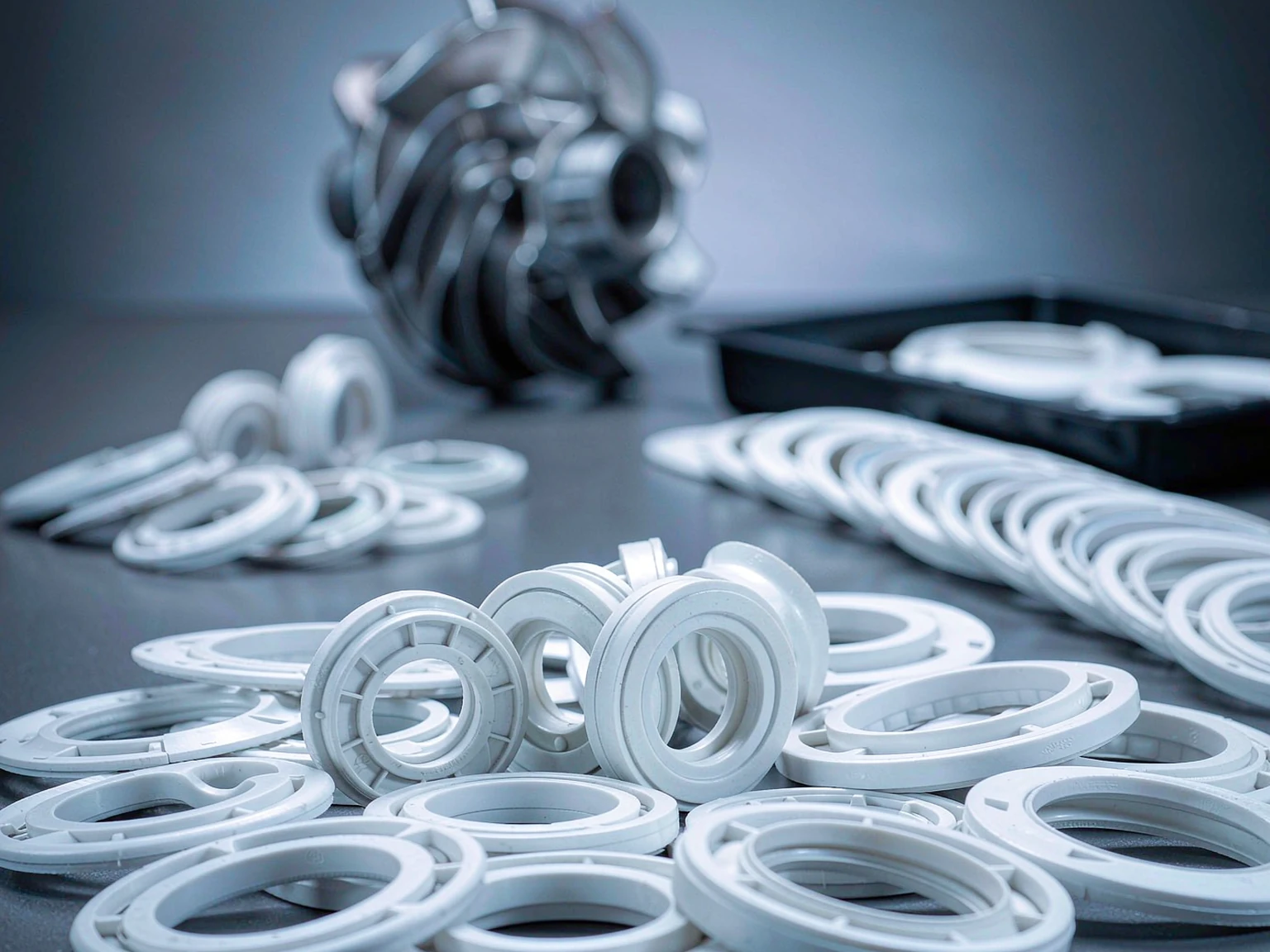
| Auto-molding | High-volume small parts (seats, washers) | Only economical at volume; tooling is the barrier |
| Machining from rod/tube/sheet stock | Prototypes, low volumes, complex geometry | Material cost per part; grain orientation from stock |
| Isostatic molding | Large, thin-wall or complex hollow forms | Fewer suppliers own the equipment; longer cycle |
The honest manufacturer tells you when machining from stock beats molding even at volume — often below a few hundred pieces per year, it does. The dishonest one quotes molding with hidden amortized tooling on every piece forever.
Stage 3: Tolerances that survive reality
PTFE moves. Plan for: thermal expansion coefficient around 110–130 × 10⁻⁶/K (about 10x steel); creep under sustained load (the “cold flow” that closes clearances); and post-sintering shrinkage of 1–4% depending on resin and cycle, which the mold must compensate for. Practical rules: put critical tolerances only on the surfaces that function; specify inspection temperature; and for running clearances (bushings, seals), design the gap for PTFE’s behavior rather than copying a steel dimension. Chunhuan machines to ±0.05 mm under SPC control, but the engineering conversation about which dimensions actually need it is what keeps parts functional and prices sane.
Stage 4: Approval and repeat supply
Insist on first-article inspection against the drawing revision, then lock the process: material grade, mold or program revision, and sintering cycle recorded. For repeat batches, the certificate package should be identical every time — that consistency is the entire value of qualifying a manufacturer instead of shopping each order. Chunhuan Group has produced custom-machined PTFE components since 1985 across chemical, semiconductor, food and industrial applications, with free samples for standard items and documented first-article approval for custom work. Send the drawing with quantity and duty; the quote you get back will name the route, the tolerances it holds and the evidence that comes with shipment.
Frequently Asked Questions
What tolerance can custom PTFE parts hold?
CNC-machined PTFE can hold about ±0.05 mm on critical features at inspection temperature, but thermal expansion and cold flow mean tolerances should be limited to functional surfaces only.
Is it cheaper to mold or machine custom PTFE parts?
Molding wins above roughly 50-100 pieces per geometry after tooling; machining wins for prototypes and low volumes. A capable manufacturer will tell you when stock machining beats molding.
Why did my PTFE part change size after machining?
PTFE’s thermal expansion is about 10x steel’s and it creeps under load. Parts measured at a different temperature, or restrained in assembly, will drift from nominal dimensions.
What should a custom PTFE RFQ include?
A dimensioned drawing with revision, material grade or filler, duty conditions, first-order quantity plus forecast, and required certificates. This avoids assumption-based quotes.

 English
 Russian
 French
 Spanish
