
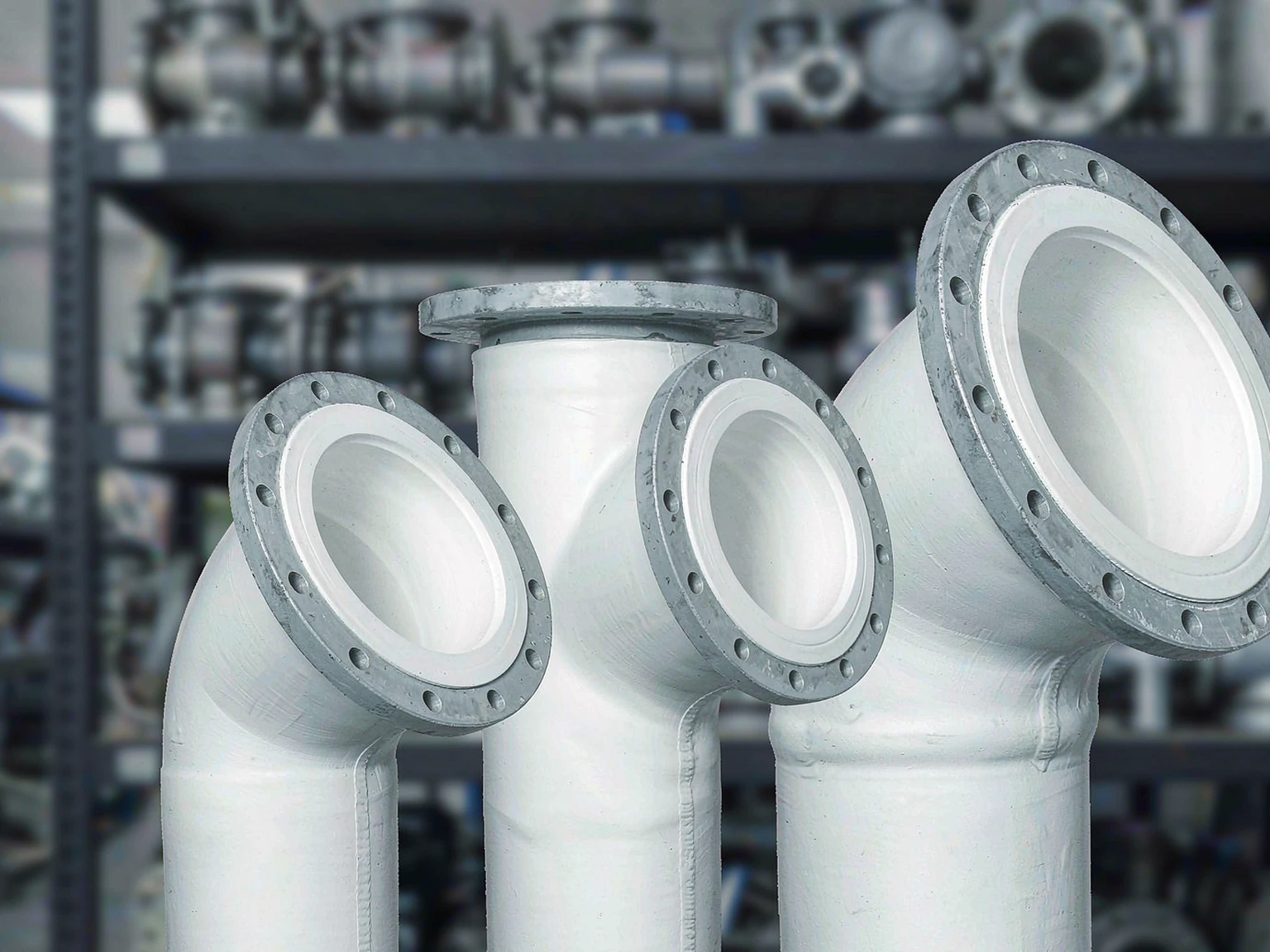
Short answer: PTFE lined pipe fittings — elbows, tees, reducers, crosses — are molded per geometry, and their quality lives at the thin spots: the extrados of elbows and the transitions of reducers. Specify fitting-by-fitting with the same liner spec as the pipe, and buy them from the same vendor as the spools.
Per-fitting notes
- Elbows: liner thins at the outer radius — require thickness measurement there, not just nominal.
- Tees: the branch junction is a hand-lined zone; ask how it’s formed and spark-tested.
- Reducers: the cone transition concentrates strain during thermal cycling — vacuum and cycling rating should be stated for reducers explicitly.
- Crosses/caps: rarely stock items — confirm tooling before promising delivery dates.
Interface discipline
Fitting flange faces are where systems leak; machined-after-lining faces with dimensional reports are the standard to demand. Mixing fitting vendors with pipe vendors is the classic assembly-day failure — one molding source keeps liner geometry consistent. Chunhuan molds and lines PTFE/PFA fittings since 1985 with per-piece spark records. Send the fitting list with sizes and duty; expect thickness data at the thin spots, not just nominal walls.
Frequently Asked Questions
Where do lined fittings fail first?
Elbow extrados and reducer transitions — where the liner thins and strain concentrates. Require thickness measurements at those spots.
Can lined fittings come from a different vendor than pipe?
Possible but risky: flange-face geometry and liner thickness at interfaces are where assembly mismatches appear.
Are all lined fittings standard items?
No — crosses, special angles and large reducers often need tooling. Confirm tooling status before accepting delivery dates.


 English
 Russian
 French
 Spanish
