
Short answer: For most industrial flanges, 1.5 mm to 3 mm virgin PTFE gaskets cover the majority of duties. Go thinner (0.8–1.5 mm) on smooth, rigid flanges with high bolt loads; go thicker (3–6 mm) only on damaged, warped, or glass-lined flanges where the gasket must fill a real gap — and accept higher creep and lower blowout resistance as the trade.
Thickness is one of the most underestimated gasket decisions. Buyers often treat it as a stock-code choice, but it directly changes sealing stress distribution, creep behavior, and how forgiving the joint is to flange imperfections.
Why Thickness Changes Sealing Behavior
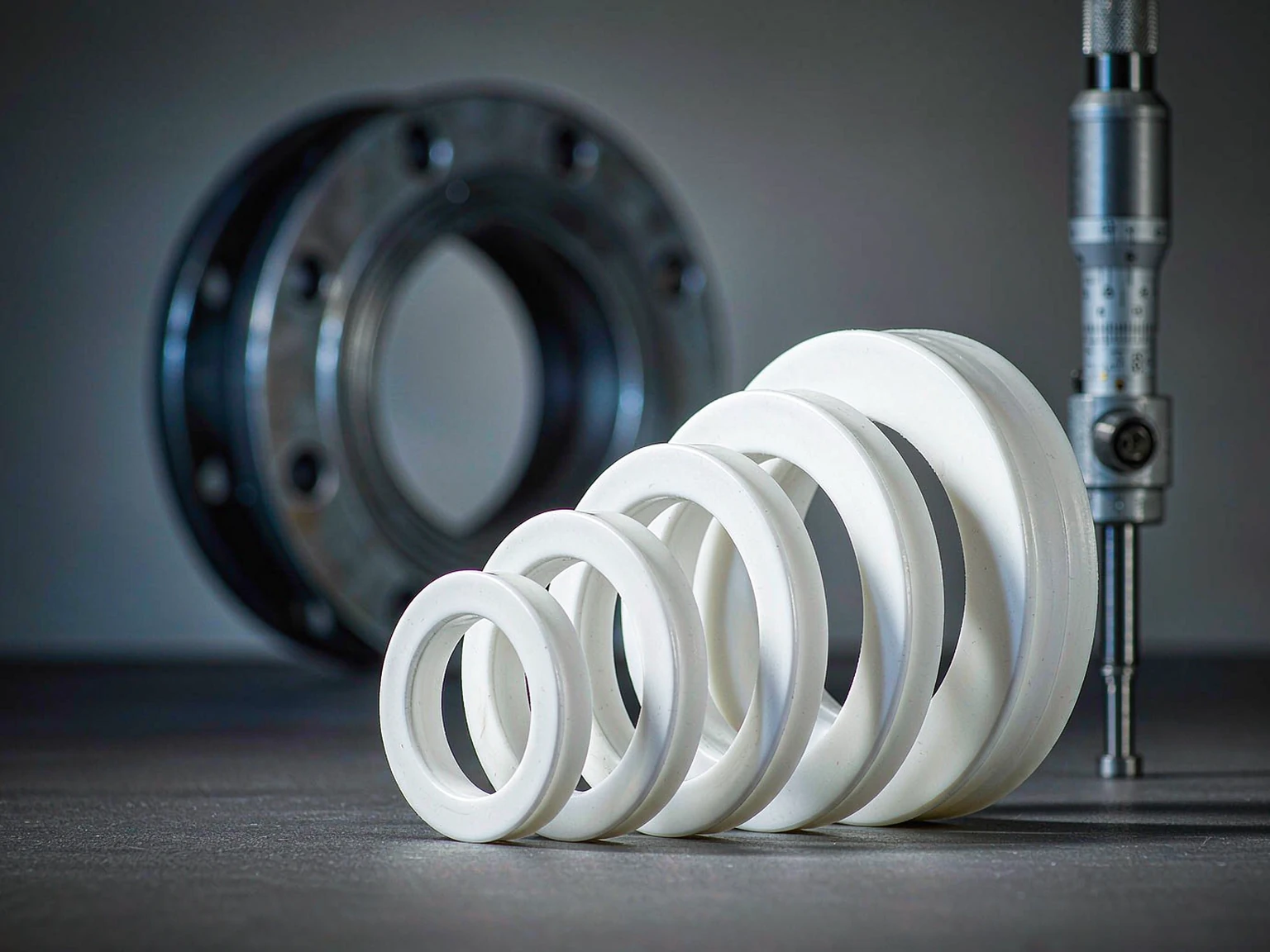
A gasket works by deforming under bolt load until it fills surface irregularities. Thinner gaskets need less deformation to seal, retain more of the bolt load over time, and resist blowout better. Thicker gaskets conform to wider gaps and compensate for flange misalignment, but they creep more under load — especially PTFE, which is inherently prone to cold flow.
| Thickness | Best suited for | Main limitation |
|---|---|---|
| 0.8–1.5 mm | Rigid steel flanges, good surface finish, high-pressure duties | Needs near-flat flanges; little gap-filling |
| 1.5–3 mm | General process piping, most ANSI/DIN flanges | Balance point — no extreme behavior either way |
| 3–6 mm | Glass-lined, worn, or warped flanges; large bolt spacing | Higher creep, more thickness relaxation, lower blowout margin |
Four Inputs That Decide Your Thickness
1. Flange condition. Measure the gap at four points around the flange with a feeler gauge with bolts at working torque. If the worst gap exceeds roughly 0.3–0.5 mm, a thin gasket will not fill it and you either machine the flange or step up thickness.
2. Pressure and media. Above roughly 10 bar, or with hazardous media, every extra millimeter of thickness reduces your safety margin. Specify the thinnest gasket that fills the measured gap.
3. Temperature. PTFE creep accelerates above 150 °C. On hot duties, moving from 3 mm to 1.5 mm often eliminates the “re-torque every shutdown” problem on its own.
4. Modified vs virgin PTFE. If your process allows a filled or modified grade (e.g., with silica or barium sulfate), you can run thicker sections with far less creep than virgin material. If the duty demands virgin PTFE for purity, the thickness discipline matters more.
Practical Selection Sequence
- Record flange size, rating, and surface condition (photograph the faces).
- Measure the worst-case gap with feeler gauges at working bolt load.
- Start at 1.5–3 mm and only deviate with a documented reason.
- For gaps over 3 mm, fix the flange rather than stacking gaskets — two thin gaskets in series is never an acceptable substitute.
- Confirm the chosen thickness against the media and temperature with your supplier’s chemical and creep data.
Chunhuan Group (est. 1985) supplies virgin and modified PTFE gaskets from 0.5 mm to 6 mm nominal thickness, cut to DIN 28091 or custom dimensions, with lot-level thickness certification to ±0.05 mm.
Frequently Asked Questions
Is a thicker PTFE gasket always safer?
No. Thickness beyond what the flange gap requires increases creep and reduces blowout resistance. Specify the thinnest gasket that fills the measured gap.
What thickness PTFE gasket for standard ANSI flanges?
For standard raised-face ANSI flanges in good condition, 1.5–3 mm virgin PTFE is the usual starting range; 3 mm and above is reserved for damaged or glass-lined flanges.
Can I stack two thinner PTFE gaskets instead of one thick one?
No. Stacked gaskets create an internal leak path and behave unpredictably under load. Use a single gasket of the required thickness.
Does temperature affect PTFE gasket thickness choice?
Yes. PTFE creep increases sharply above 150 °C, so hot duties favor thinner sections or creep-resistant filled grades.

 English
 Russian
 French
 Spanish
