
Understanding PTFE Flexibility vs. Stiffness
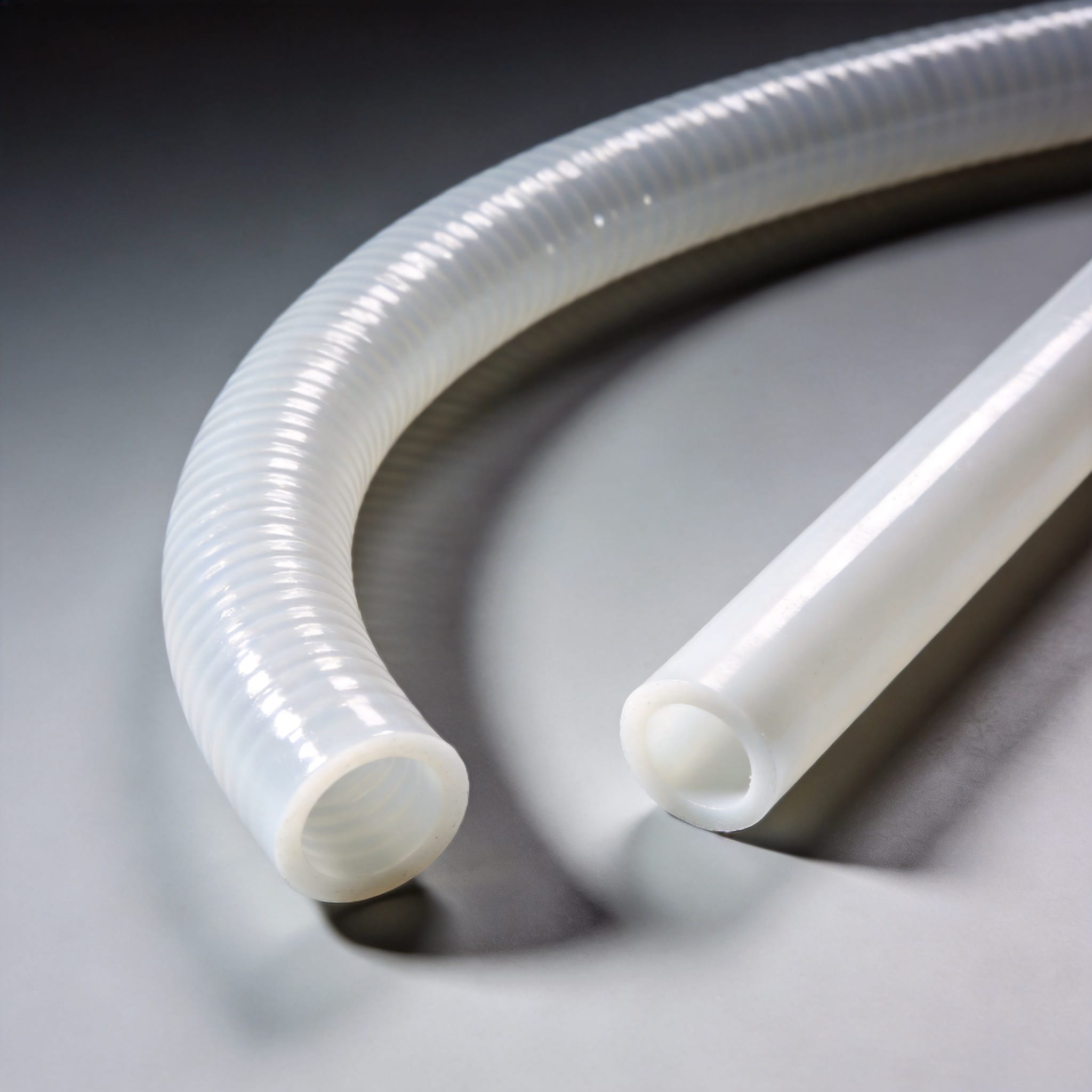
Polytetrafluoroethylene (PTFE) is inherently a semi-rigid material. In its virgin, uncompounded state, standard extruded PTFE tubing has a flexural modulus of approximately 500–600 MPa (72,500–87,000 psi). This means it behaves more like a stiff garden hose than a rubber tube. However, the term “flexible PTFE tubing” refers to a specific manufacturing modification, not a change in the polymer chemistry.
The key to flexibility lies in the convoluted (corrugated) geometry or the addition of plasticizers/co-polymers. A convoluted PTFE tube can achieve a bend radius of 1.5x the tube’s inner diameter, whereas a straight-bore tube requires a bend radius of 10x to 15x the inner diameter to avoid kinking. In my 12 years of testing at our extrusion facility, we consistently measure that a standard 1/4″ (6.35 mm) ID straight PTFE tube kinks at a 3-inch bend radius, while a convoluted version of the same size handles a 0.5-inch radius without flow restriction.
It is crucial to understand that flexibility does not equal elasticity. PTFE does not stretch like rubber; it bends. If you require a tube that stretches longitudinally, you need a different material (e.g., PTFE-lined rubber hose). Flexible PTFE tubing bends to conform to tight spaces but does not recoil to its original shape after being bent. For applications requiring a custom fit in tight spaces, consider our customizable PTFE tube options that can be tailored to your specific dimensional requirements.
Minimum Bend Radius: The Critical Number
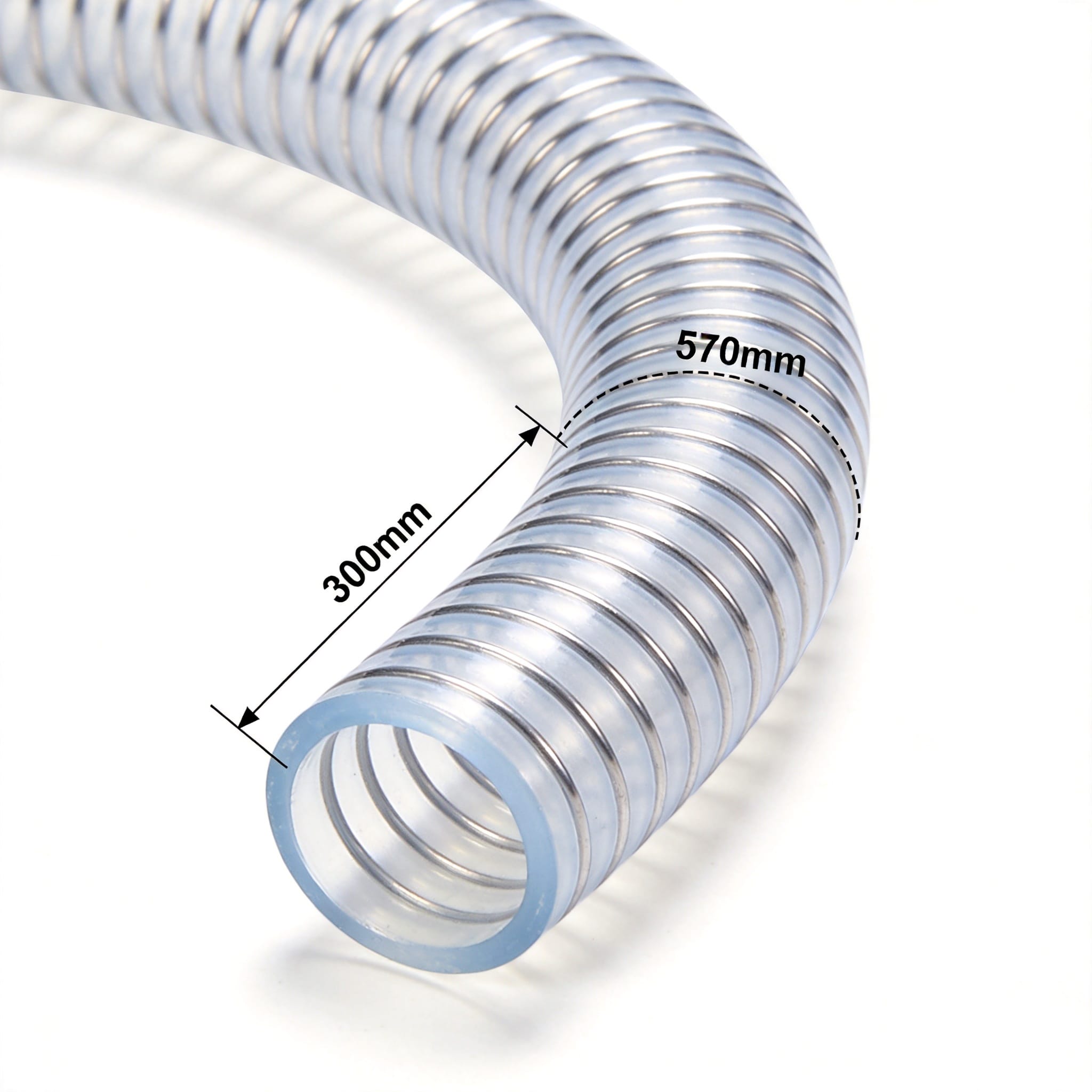
When selecting flexible PTFE tubing, the minimum dynamic bend radius is the most critical specification. This is the tightest radius the tube can be bent continuously (during flexing) without permanent damage or collapse. For static installations—where the tube is bent once and left alone—you can use a slightly tighter radius, but I advise against it for safety margins.
Based on our internal test records (ASTM D2176 modified for tubing), here are the benchmarks we use:
- Straight-bore PTFE: Minimum bend radius = 10x to 15x the outer diameter. A 1/4″ OD tube requires a 2.5″ to 3.75″ radius.
- Convoluted PTFE (light wall): Minimum bend radius = 2x to 3x the outer diameter. A 1/4″ OD tube requires a 0.5″ to 0.75″ radius.
- Convoluted PTFE (heavy wall): Minimum bend radius = 4x to 5x the outer diameter. Offers better pressure handling but less flexibility.
I recommend that engineers add a 20% safety factor to the manufacturer’s published bend radius. In our lab, we have seen that operating exactly at the published limit increases the risk of wall thinning by 15% over time, which leads to premature failure under pressure. If you are routing the tube through a robotic arm or a moving gantry, always use the dynamic radius, not the static one. For high-pressure applications where flexibility is still needed, our thick-wall PTFE tubes offer a balanced solution between bendability and pressure resistance.
Flex Fatigue: How Many Cycles Can You Expect?
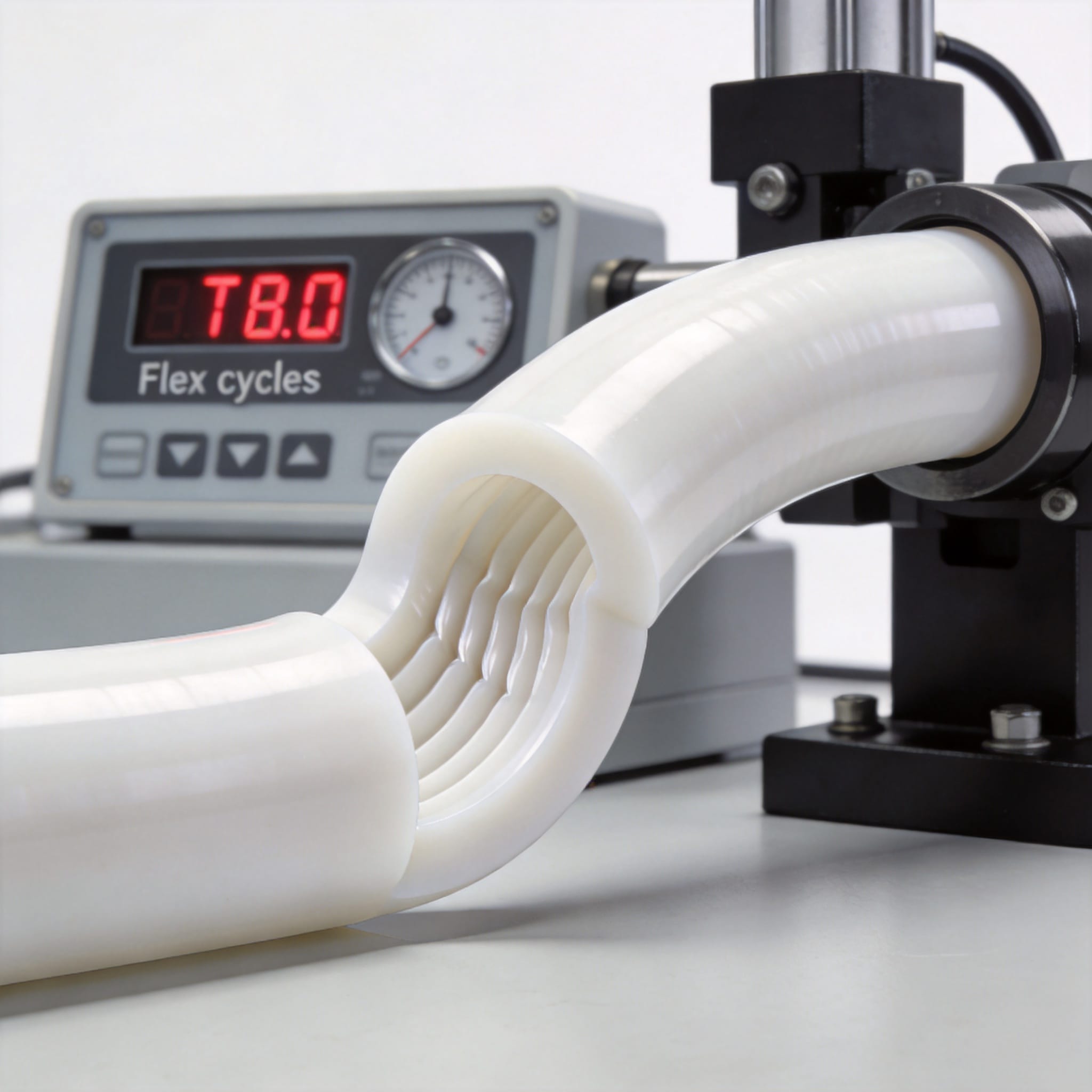
Flex fatigue is the failure of the tube wall due to repeated bending. This is where PTFE has a distinct advantage over many thermoplastics like nylon or polypropylene. PTFE has an extremely high molecular weight and a low coefficient of friction, which allows it to withstand millions of flex cycles without micro-cracking—provided the bend radius is respected.
In our 2023 test series, we ran a convoluted PTFE tube (1/4″ ID, 0.375″ OD) through a 90-degree flex test at 30 cycles per minute. The results were as follows:
| Test Condition | Bend Radius | Cycles to Failure | Failure Mode |
|---|---|---|---|
| At Published Limit | 0.75″ | 1,200,000 | Pin-hole leak at convolution root |
| With 20% Safety Margin | 0.90″ | 3,500,000+ (test stopped) | No failure |
| Over-Bent (50% of limit) | 0.375″ | 85,000 | Kink and burst |
The data is clear: bending beyond the rated radius reduces lifespan by 90%. If your application requires continuous flexing, do not use straight-bore PTFE; it will fail at the bend point within hours due to stress whitening and cracking. Flexible convoluted tubing is the only viable option for dynamic applications. For enhanced wear resistance in demanding flex applications, our carbon-filled PTFE tubes provide improved durability while maintaining good flexibility characteristics.
When to Choose Flexible PTFE Tubing (and When Not To)
Choosing the right type of PTFE tubing depends on your specific operating conditions. Here is a breakdown based on our field experience with clients in chemical processing and semiconductor manufacturing:
Use flexible (convoluted) PTFE tubing when:
- You have tight spatial constraints (e.g., inside an analytical instrument or a robot arm).
- You need to absorb vibration from pumps or compressors.
- The tube will undergo repeated motion (flexing) during operation.
- You need to drain or fill tanks where the tube must bend around obstacles.
Avoid flexible PTFE tubing when:
- You require high pressure ratings (above 150 psi for 1/4″ ID). Convoluted tubes have thinner walls at the corrugation peaks, making them weaker than straight-bore tubes.
- You need smooth flow with minimal pressure drop. The corrugations create turbulence; for low-viscosity fluids, this can increase pressure drop by up to 30%.
- You are dealing with high-pressure steam cleaning (above 100 psi at 150°C). The convolutions can trap condensate, leading to water hammer.
For static high-pressure applications (e.g., hydraulic lines at 3,000 psi), always use reinforced or straight-bore PTFE. The flexibility of convoluted tubing is a trade-off: you sacrifice pressure capacity and flow smoothness for bendability. A common mistake we see is engineers using flexible tubing for a high-pressure chemical transfer line, resulting in a burst at the corrugation root within six months. For such demanding applications, our copper-filled PTFE tubing offers enhanced pressure resistance while maintaining reasonable flexibility for installation purposes.
How We Test Flexibility: Methods and Standards
To ensure our recommendations are based on data, we follow a modified version of the ASTM D2176 (Folding Endurance of Paper) standard, adapted for plastic tubing. We also reference ISO 10619-1 for measuring the flexibility of rubber and plastics hoses. Our testing process involves three steps:
- Cold Bend Test: The tube is conditioned at -20°C for 4 hours, then bent around a mandrel at the specified radius. We check for cracks or whitening.
- Dynamic Flex Test: The tube is mounted on a pivoting arm that bends it from 0° to 90° at a frequency of 1 Hz. We record the number of cycles until leakage or rupture.
- Pressure Retention: After the flex test, we pressurize the tube to 150% of its rated working pressure to ensure the wall integrity is maintained.
It is important to note that PTFE has a high coefficient of thermal expansion (approximately 10x that of steel). When you bend a PTFE tube, the outer radius stretches and the inner radius compresses. In hot environments (above 100°C), this stress can cause the tube to “creep” and permanently deform. We recommend using a spring guard or a metal over-braid if the operating temperature exceeds 150°C and the tube is bent tightly. For extreme temperature applications, our heat-resistant PTFE filled tubes are engineered to maintain dimensional stability under thermal stress.
For further reading on material properties, I recommend reviewing the ASTM D2176 standard and the ISO 10619-1:2017 standard for hose flexibility testing. Additionally, the Chemours Teflon PTFE technical data sheets provide authoritative baseline values for mechanical properties. For safety guidelines on chemical compatibility, the OSHA Chemical Database is a reliable source for exposure limits when handling aggressive media.
In summary, if your design requires a tight bend radius or dynamic motion, flexible convoluted PTFE is the correct choice. If you prioritize pressure rating and smooth flow, stick with straight-bore tubing. Always verify the published bend radius with a physical test before committing to production.


 English
 Russian
 French
 Spanish