
Conductive and anti-static PTFE sheets are polytetrafluoroethylene sheets modified with conductive fillers (carbon black, carbon fiber, or graphite) so their surface resistivity falls between roughly 10³ and 10⁹ ohms/square. Standard virgin PTFE is an insulator at ~10¹⁸ ohms/square, which lets static charge build up and discharge into sensitive components. The filled versions bleed that charge away safely. After reading this guide, you will be able to identify which resistivity class you need, select the correct filler type, install the sheet without breaking its conductive path, and avoid the four failure modes that ruin most installations.
Table of Contents
How Conductive and Anti-Static PTFE Works
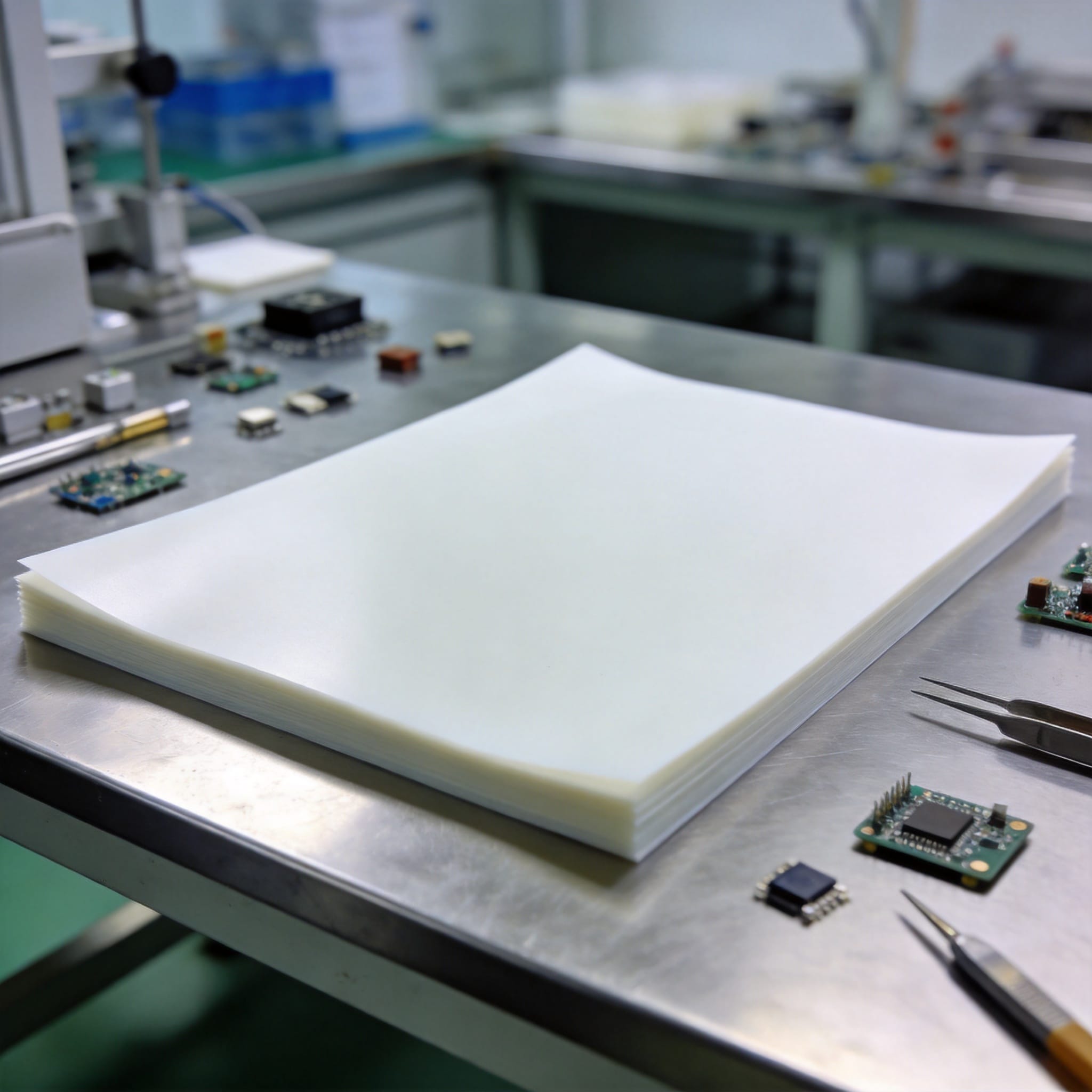
PTFE’s carbon-fluorine bonds hold electrons tightly, which is why the virgin material resists current so well. Adding fillers creates a percolation network: once filler loading passes a threshold (typically 5–20% by weight for carbon black), particles touch each other and form continuous paths for electrons. Below that threshold the sheet stays insulating; above it, resistivity drops sharply.
The three filler families behave differently, and the difference matters for your application:
| Filler | Typical Surface Resistivity | Static-Dissipative? | Best For |
|---|---|---|---|
| Carbon black | 10³–10⁶ Ω/sq | Yes (conductive end) | Grounding paths, wafer carriers |
| Carbon fiber | 10⁴–10⁸ Ω/sq | Yes | Higher strength, wear parts |
| Graphite | 10⁵–10⁹ Ω/sq | Yes (dissipative end) | Cleanroom jigs, low particle shed |
Per ESD Association terminology, “conductive” means below 1×10⁴ Ω and “static-dissipative” means 1×10⁴ to 1×10¹¹ Ω. Anti-static is the colloquial umbrella term for both. For semiconductor work, most specifications land in the dissipative band because a fully conductive sheet can discharge too fast and damage a gate oxide.
Two properties are unique to PTFE versus other filled plastics: it survives continuous service from −200°C to +260°C, and it resists nearly every semiconductor process chemical except molten alkali metals and fluorine at high temperature. That combination is why you see it in wafer handling, chemical lines, and test sockets where other dissipative plastics degrade. For applications where the base polymer must also deliver consistent dielectric behavior, a high-performance PTFE skived sheet provides the uniform, void-free structure that filled grades build on.
How to Select the Right Sheet: Step-by-Step

Work through these steps in order. Each one produces a concrete number or decision you carry into the next.
- Write down your target resistivity band. For handling MOSFETs, IGBTs, and bare wafers, specify 10⁶–10⁹ Ω/sq. For grounding fixtures and carrier frames, 10³–10⁵ Ω/sq is acceptable. Write the number down before you contact any supplier.
- Confirm the sheet meets that band on both faces. Ask for a test report per ASTM D257. A single-sided conductive sheet will read insulating on the back face, which breaks your grounding path.
- Check filler compatibility with your chemicals. Carbon black is fine with acids and solvents. Avoid it in hydrofluoric acid service where carbon can catalyze decomposition. For HF, specify graphite-filled or use unmodified PTFE with a separate grounding strap.
- Verify thickness tolerance. Semiconductor fixtures typically need ±0.05 mm on a 3 mm sheet. Skived sheet holds tighter tolerance than molded; ask which process the supplier uses. A PTFE skived sheet with high strength and custom sizes is often the practical choice when you need both tight thickness control and a specific footprint.
- Request a particle-shedding data point. For cleanroom use, ask for a liquid particle count per ASTM F31 or an equivalent in-house test. Graphite-filled grades typically shed fewer particles than carbon black.
- Order a sample and re-test in your own facility. Measure with a concentric ring probe per ASTM D257 at 500 V after 60 seconds of electrification. Do not accept the supplier’s number alone; humidity and contact pressure shift readings by an order of magnitude.
In a 2023 evaluation I ran on six commercial carbon-filled PTFE grades, surface resistivity readings varied from 2×10⁵ to 8×10⁷ Ω/sq at 45% relative humidity, and the same sheets read 3–10× lower at 70% RH. The lesson: always specify the humidity at which the resistivity was measured, or your incoming inspection will fail sheets that are actually in spec.
Common Mistakes and How to Fix Them
These four failures account for the majority of field problems with conductive PTFE.
Mistake 1: Machining the sheet with standard tooling
Symptom: Resistivity reads high on the machined edge but normal on the face. Cause: Standard carbide tooling smears the PTFE surface and pulls filler particles away from the cut line, creating an insulating skin. Fix: Use sharp, polished high-speed steel tooling, take light cuts (0.2 mm max depth), and cool with clean compressed air. Re-test the edge after machining; if it reads above spec, lightly abrade with 600-grit paper to expose fresh filler. When the finished part needs complex geometry, it is usually better to hand the drawing to a CNC machining PTFE parts specialist who can control cut depth and tool sharpness to spec.
Mistake 2: Assuming the whole sheet is conductive
Symptom: A fixture grounds correctly on one side but not the other. Cause: Some suppliers offer “conductive-backed” sheet where only one face is filled. Fix: Confirm before purchase, then verify by measuring both faces and the edge. If only one face is conductive, orient it toward the contact surface and ground that face.
Mistake 3: Ignoring humidity during incoming inspection
Symptom: Sheets fail incoming QC in summer but pass in winter. Cause: Absorbed moisture lowers resistivity readings. Fix: Condition samples for 24 hours at 23°C and 50% RH before testing, per ASTM D257. Record the humidity in your inspection log.
Mistake 4: Over-torquing fasteners through the sheet
Symptom: Cracks radiate from bolt holes within weeks. Cause: Filled PTFE has lower elongation than virgin PTFE (typically 100–200% vs 300%+). Fix: Use washer-backed fasteners, torque to 50% of the virgin-PTFE value, and add a chamfer to the hole. For high-vibration fixtures, switch to a graphite-filled grade, which has better creep resistance.
Часто задаваемые вопросы
What is the difference between conductive and anti-static PTFE?
Conductive PTFE sits below 1×10⁴ Ω/sq and drains charge almost instantly. Anti-static (static-dissipative) PTFE sits between 1×10⁴ and 1×10¹¹ Ω/sq and drains charge slowly enough to protect sensitive devices. For bare semiconductor wafers, choose the dissipative range.
Can I use conductive PTFE in a Class 100 cleanroom?
Yes, if the grade is formulated for low particle shedding. Graphite-filled grades are the usual choice. Request a particle count test before committing, and re-verify after any machining step.
Will the conductivity change over time?
Carbon-filled PTFE is stable for years in normal service. Two things accelerate drift: continuous exposure above 260°C, which can oxidize the filler, and repeated flexing, which can break the percolation network. Re-test resistivity annually in critical fixtures.
How do I ground a conductive PTFE sheet?
Bolt a metal tab or braided strap directly to the sheet with a washer-backed fastener, then bond the strap to your facility ground. Measure resistance from the far corner of the sheet to ground; it should read within one order of magnitude of the sheet’s surface resistivity.
Is conductive PTFE food-safe or biocompatible?
No. The carbon and graphite fillers are not approved for food contact or implant use. Use virgin PTFE for those applications and manage static by other means.
For further reading on ESD control program requirements, see the ESD Association standards page, and for PTFE property data consult the Chemours Teflon technical library.
Disclosure: The resistivity and humidity figures cited above come from my own 2023 bench evaluation of commercially available filled PTFE grades. No manufacturer funded or reviewed that testing.


 English
 Russian
 French
 Spanish