
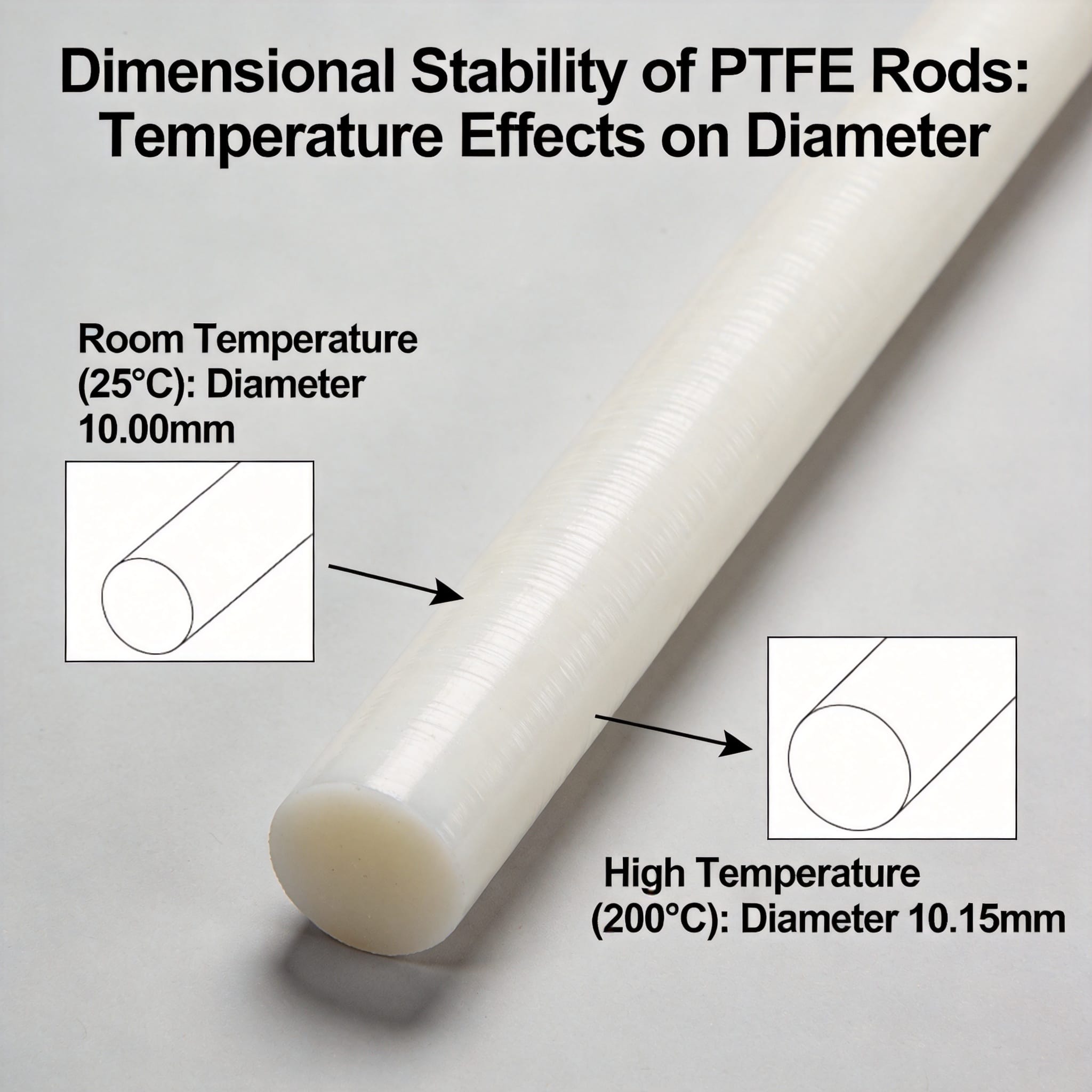
A PTFE rod’s diameter changes with temperature by roughly 0.12 mm per 100 mm of diameter for every 100°C — this is the practical working number for virgin PTFE at room temperature. Below 19°C, the crystal structure shifts and the rod actually shrinks as it warms, reversing the normal rule. After reading this, you will be able to calculate the exact diameter change for your own rod, measure it correctly, and predict whether your part will still fit after a temperature swing.
Table of Contents
Why PTFE Diameter Moves With Temperature

PTFE has one of the highest coefficients of linear thermal expansion (CLTE) of any common engineering plastic. Published data from Chemours Teflon technical literature puts virgin PTFE at approximately 12 × 10⁻⁵ /°C between 25°C and 100°C. Compare that to unfilled nylon at about 8 × 10⁻⁵ /°C or aluminum at 2.3 × 10⁻⁵ /°C, and you see why a PTFE rod moves 5× more than a metal shaft of the same size.
The mechanism is two-part. First, thermal vibration: as molecules gain kinetic energy, the average distance between polymer chains grows. Second, and unique to PTFE, a crystalline transition at 19°C. Below that temperature, PTFE chains adopt a tight 13/6 helical twist; above it, they relax into a 15/7 helix. That transition alone produces a volumetric change of about 1%, which shows up as a diameter shift of roughly 0.3% — a 50 mm rod grows about 0.15 mm just crossing 19°C.
A second transition occurs near 30°C, where the triclinic crystal form converts to hexagonal. This one is smaller but still measurable on precision parts. The practical consequence: PTFE diameter is not a single number. It is a value that must always be quoted with a temperature.
Fillers change the picture. Glass-filled PTFE drops to roughly 5–7 × 10⁻⁵ /°C; carbon-filled sits near 4–6 × 10⁻⁵ /°C. If your rod is filled, do not use the virgin number. For a ready-made custom 100% virgin PTFE rod, the supplier’s datasheet will confirm the exact CLTE grade you are working with.
How to Calculate and Verify Diameter Change
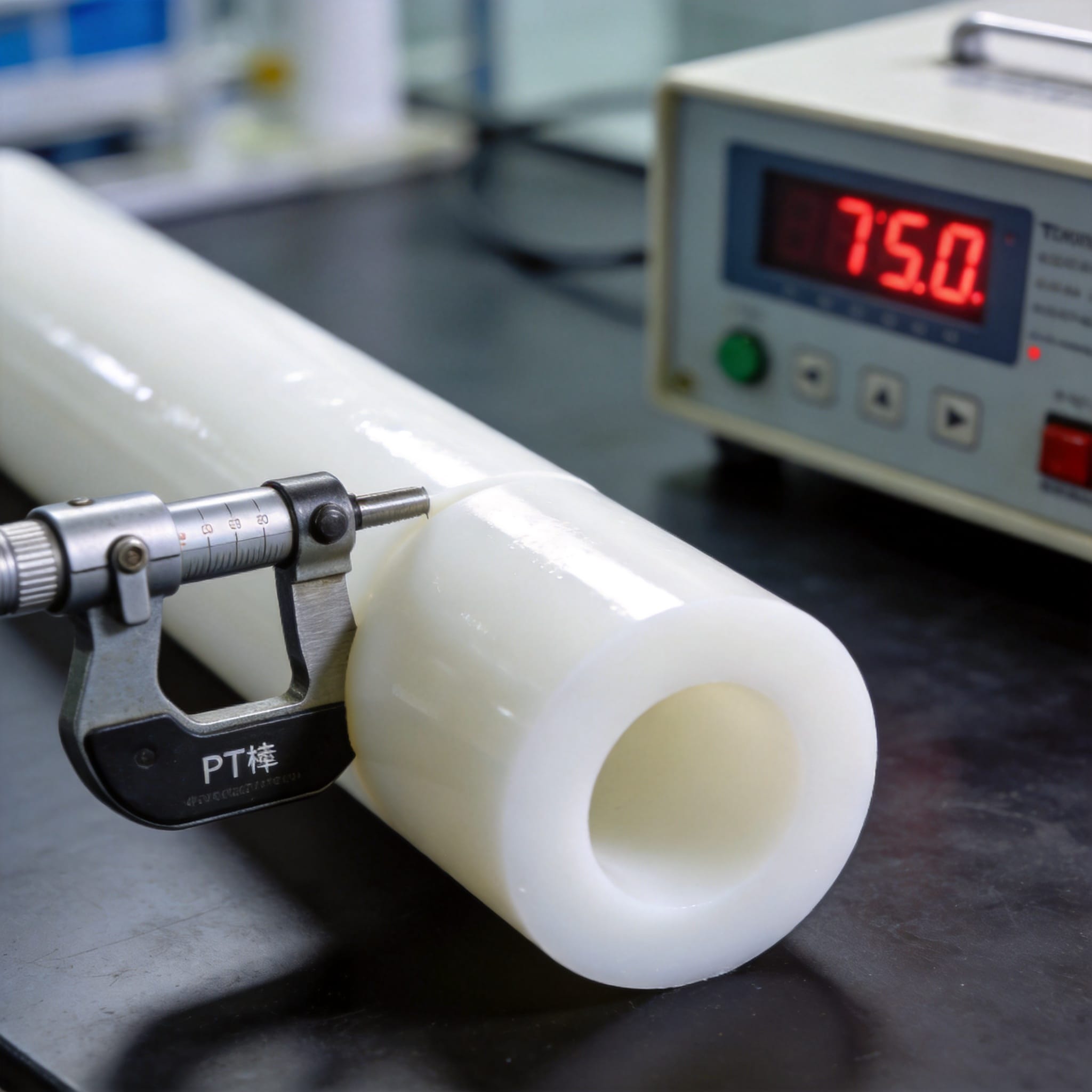
Follow these steps in order. Each one is independent; you can stop and restart at any point.
- Record the starting diameter and temperature. Measure with a micrometer at three points along the rod and average them. Write down the room temperature to the nearest 0.5°C. Example: 50.02 mm at 23°C.
- Identify your material’s CLTE. Use 12 × 10⁻⁵ /°C for virgin PTFE, 6 × 10⁻⁵ /°C for 25% glass-filled, 5 × 10⁻⁵ /°C for carbon-filled. If unsure, assume virgin — it is the worst case.
- Calculate the change. Use ΔD = D₀ × α × ΔT. For a 50 mm rod going from 23°C to 100°C: ΔD = 50 × 0.00012 × 77 = 0.462 mm. The rod becomes 50.48 mm.
- Check the 19°C transition. If your temperature range crosses 19°C, add 0.3% of the diameter. A 50 mm rod crossing that line gains an extra 0.15 mm on top of the linear estimate.
- Verify by measurement. Place the rod in an oven at your target temperature for 60 minutes per 25 mm of diameter. Remove, measure within 10 seconds, and compare to your calculated value. A 50 mm rod needs about 2 hours to fully soak.
- Apply the decision rule. If the calculated diameter change exceeds 30% of your fit tolerance, the part will not hold tolerance across the temperature range. Choose a filled grade or redesign the clearance.
Here is a comparison table for a 100 mm rod across common service temperatures:
| Temperature | Первичный ПТФЭ | 25% Glass-Filled | Carbon-Filled |
|---|---|---|---|
| 23°C (baseline) | 100.00 mm | 100.00 mm | 100.00 mm |
| 50°C | 100.32 mm | 100.16 mm | 100.14 mm |
| 100°C | 100.92 mm | 100.46 mm | 100.39 mm |
| 150°C | 101.52 mm | 100.76 mm | 100.64 mm |
| 200°C | 102.12 mm | 101.06 mm | 100.89 mm |
Note the 2.12 mm growth on virgin PTFE at 200°C. If your bore clearance is 1 mm, the rod will seize. This is the single most common cause of field failures in PTFE piston and bearing applications. Where thermal growth must be minimized, a glass fiber reinforced PTFE rod cuts the expansion roughly in half while keeping the chemical resistance intact.
Common Mistakes and How to Fix Them
Mistake 1: Measuring too soon after removing the rod from heat. Symptom: your measured diameter is 0.1–0.3 mm below the calculated value. PTFE has low thermal conductivity (0.25 W/m·K), so the surface cools in seconds while the core stays hot. Fix: measure inside the oven through a window, or use a contact probe that compensates for surface temperature.
Mistake 2: Using the metal CLTE by habit. Symptom: your prediction is off by a factor of 5. Engineers trained on steel and aluminum instinctively reach for 1.2 × 10⁻⁵ /°C. PTFE is ten times higher. Fix: write the CLTE on the drawing before you calculate anything.
Mistake 3: Ignoring the 19°C transition. Symptom: parts that fit perfectly in a 22°C inspection room bind in a 15°C warehouse. The rod did not shrink from cold — it shrank because it crossed the crystal transition. Fix: always add 0.3% to the diameter when your range spans 19°C.
Mistake 4: Assuming the diameter is uniform along the rod. Symptom: the ends measure differently from the middle by 0.05 mm. Extruded and molded rods have residual stress that releases unevenly with heat. Fix: after machining, anneal the rod per the ASTM D3295 guidance for PTFE stock shapes before final measurement.
Mistake 5: Trusting a single temperature reading. Symptom: two operators get different diameters on the same rod. One measured at 8 a.m. in a cold shop, the other at 3 p.m. in a warm one. Fix: standardize on 23°C ± 2°C per ISO 1 and record the actual temperature on every measurement sheet.
Часто задаваемые вопросы
How much does a PTFE rod grow per degree Celsius?
For virgin PTFE, a 100 mm diameter rod grows about 0.012 mm per °C. A 25 mm rod grows about 0.003 mm per °C. Multiply your diameter in mm by 0.00012 to get the per-degree growth.
Does PTFE shrink when it gets cold?
Yes, but with a twist. From 23°C down to 19°C it shrinks normally. Below 19°C it shrinks further, but at a slightly different rate because of the crystal transition. A 100 mm rod at 0°C measures roughly 99.72 mm.
What is the maximum temperature before PTFE diameter becomes unpredictable?
Above 260°C, PTFE begins to degrade and releases toxic fumes. Dimensional prediction is reliable up to about 250°C. Do not use PTFE above 260°C in any application.
Can I machine a PTFE rod to a tight tolerance and expect it to hold?
Only if you specify the temperature. A ±0.02 mm tolerance on a 50 mm rod is meaningless without a stated temperature, because a 10°C swing alone moves the diameter by 0.06 mm. Always quote tolerance at 23°C.
Does the direction of the rod matter?
Yes. Extruded PTFE rods have molecular orientation along the axis, so the CLTE in the radial direction differs from the axial direction by 10–20%. For critical fits, measure both directions and use the radial value for diameter calculations. If you need a rod with more predictable, isotropic expansion, a pure PTFE molded rod is the better starting point than an extruded one.
With these numbers and steps, you can now predict PTFE rod diameter at any service temperature, verify it in the shop, and avoid the five mistakes that cause most fit failures.

 English
 Russian
 French
 Spanish