
Short answer: evaluate a PTFE tube manufacturer on three things that traders cannot fake: whether they extrude in-house (paste extrusion for small IDs, ram extrusion for larger or filled grades), whether they publish real dimensional tolerances per size rather than “as required”, and whether they can certify dielectric strength and purity data for your specific lot. Everything else on a supplier’s website is marketing.
PTFE tube looks interchangeable in catalogues and fails differently in practice. A semiconductor flush line with a slight taper, a chemical transfer line with poor inner-surface finish, or an insulating sleeve with pinholes — all trace back to the extrusion process and the quality system behind it. Here is how to evaluate suppliers with the same rigor your engineering team applies to the tube itself.
Start from the size, not the supplier
PTFE tube is dimension-driven, so the fastest way to qualify a manufacturer is to check whether their standard program covers your sizes with stated tolerances:
| Parameter | Typical commercial range | What to confirm in writing |
|---|---|---|
| ID | 0.5–200 mm | Tolerance class per size (e.g. ±0.05 mm on small IDs is meaningful; ±10% is commodity) |
| Wall | 0.1–5 mm | Minimum wall, eccentricity limit, and whether tolerance is on wall or OD only |
| Length | Coils or cut lengths | Continuous coil lengths versus welded sections — welds in “seamless” tube are a classic problem |
| Grade | Virgin, conductive, anti-static, pigmented | Resin class and filler type named, not just “PTFE” |
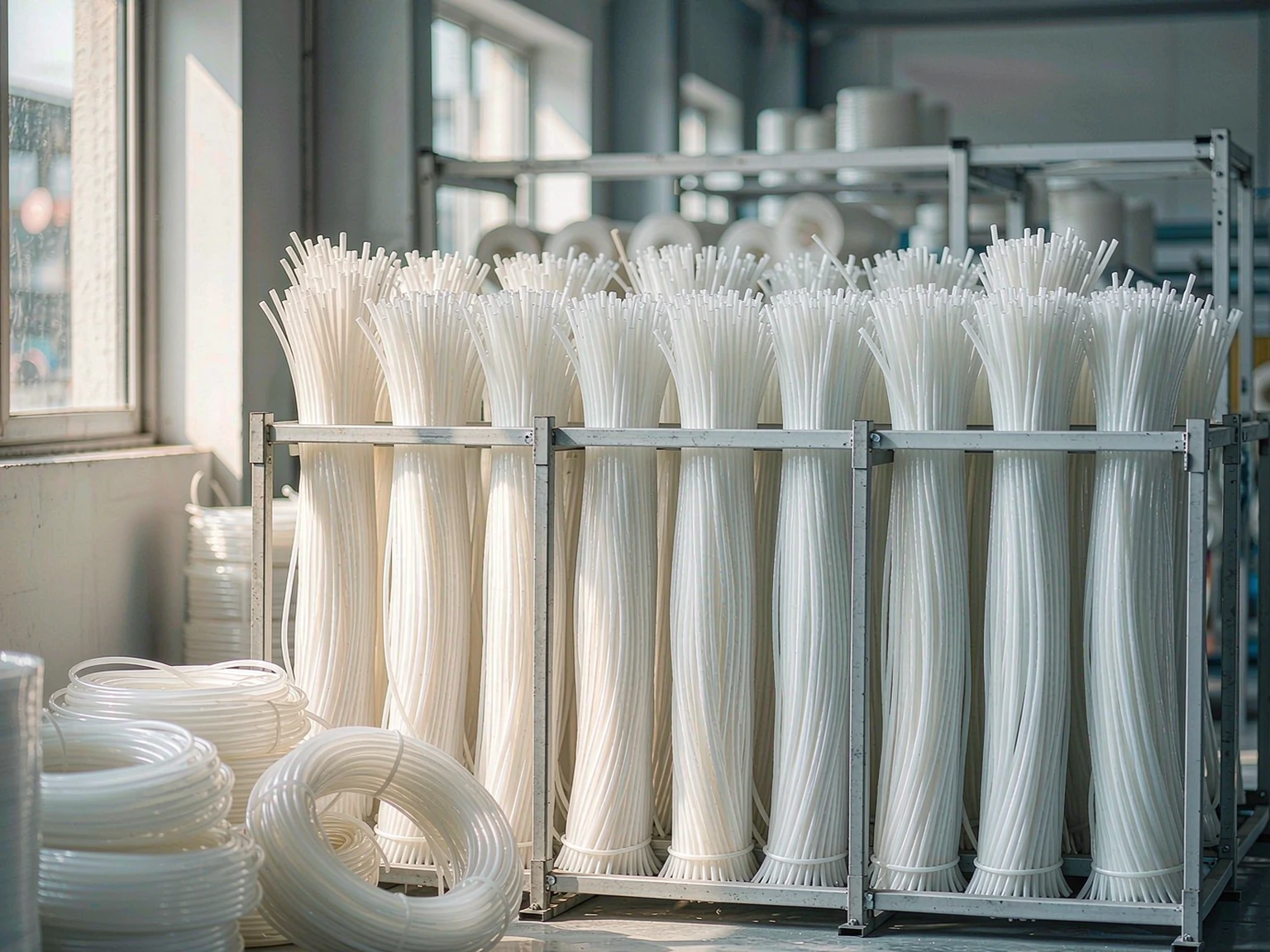
Ask the supplier to state which sizes they run as standard stock versus which are made to order, and what the tooling charge is for a non-standard ID. A manufacturer with its own paste-extrusion line answers immediately; answers like “all sizes available” without tooling discussion indicate trading.
Match the process to the application
- Semiconductor and high-purity fluid handling: require virgin resin, documented extractables, and inner-surface finish. Ask whether the tube is made in a controlled area and how it is packed (double-bagged, cut ends protected).
- Chemical transfer at elevated temperature: the weak point is permeation, not chemical attack — PTFE resists nearly everything but small molecules diffuse through walls. Thicker wall and fluorinated co-components reduce it; ask the manufacturer for their permeation guidance at your temperature rather than a generic chart.
- Electrical insulation: demand dielectric strength (PTFE typically 10 kV/mm and up on thin wall) and pinhole test evidence. Dielectric failures come from contamination and voids during extrusion, which is exactly what a quality system either catches or ignores.
- Mechanical sleeves and bearings: consider filled grades (glass, bronze, carbon) — but confirm the manufacturer can extrude filled compounds, since many only buy and resell them.
Supplier evaluation: the three questions that sort manufacturers from traders
- “Which extrusion method do you use for my ID/wall combination, and why?” Paste extrusion suits fine, flexible small-bore tube; ram extrusion handles larger bores and certain compounds. A real manufacturer explains the trade-off in one sentence.
- “Can I get lot-level data — dimensions, dielectric or pressure test — with the shipment?” Records should exist under ISO 9001; if they must be requested “specially”, the process is not actually controlled.
- “What is your sample policy for a non-standard size?” Willingness to run a short trial extrusion (even against tooling cost) signals real capability.
Documents to expect with a qualified PTFE tube supply
Dimensional inspection report, material certificate with resin class, dielectric and/or pressure test data where relevant, MSDS, and compliance documents (RoHS, REACH; FDA 21 CFR 177.1550 for food and pharma lines; USP Class VI where medical contact applies). Chunhuan Group extrudes PTFE tube in-house since 1985 with capacity of about 50 tons per month across standard and custom PTFE tube sizes, plus the matching PTFE rod and sheet for downstream fabrication. Send your ID/wall/tolerance and application; you will get a documented feasibility answer, not just a price.
Frequently Asked Questions
What sizes can a PTFE tube manufacturer produce?
Commercial PTFE tube spans roughly 0.5-200 mm ID with walls from 0.1-5 mm. Confirm per-size tolerances and whether non-standard IDs require tooling.
Which process is used for PTFE tube?
Paste extrusion for fine small-bore flexible tube; ram extrusion for larger bores and filled grades. The choice affects surface finish, tolerance and minimum wall.
How do I prevent permeation through PTFE tube?
Permeation is a wall-thickness and temperature issue, not a chemical-attack issue. Increase wall, reduce temperature where possible, and get permeation guidance from the manufacturer at your actual duty.
What certificates should come with PTFE tube?
Dimensional report, resin-class material certificate, dielectric or pressure test data where relevant, plus RoHS/REACH and FDA documentation for food, pharma and semiconductor use.

 English
 Russian
 French
 Spanish
