
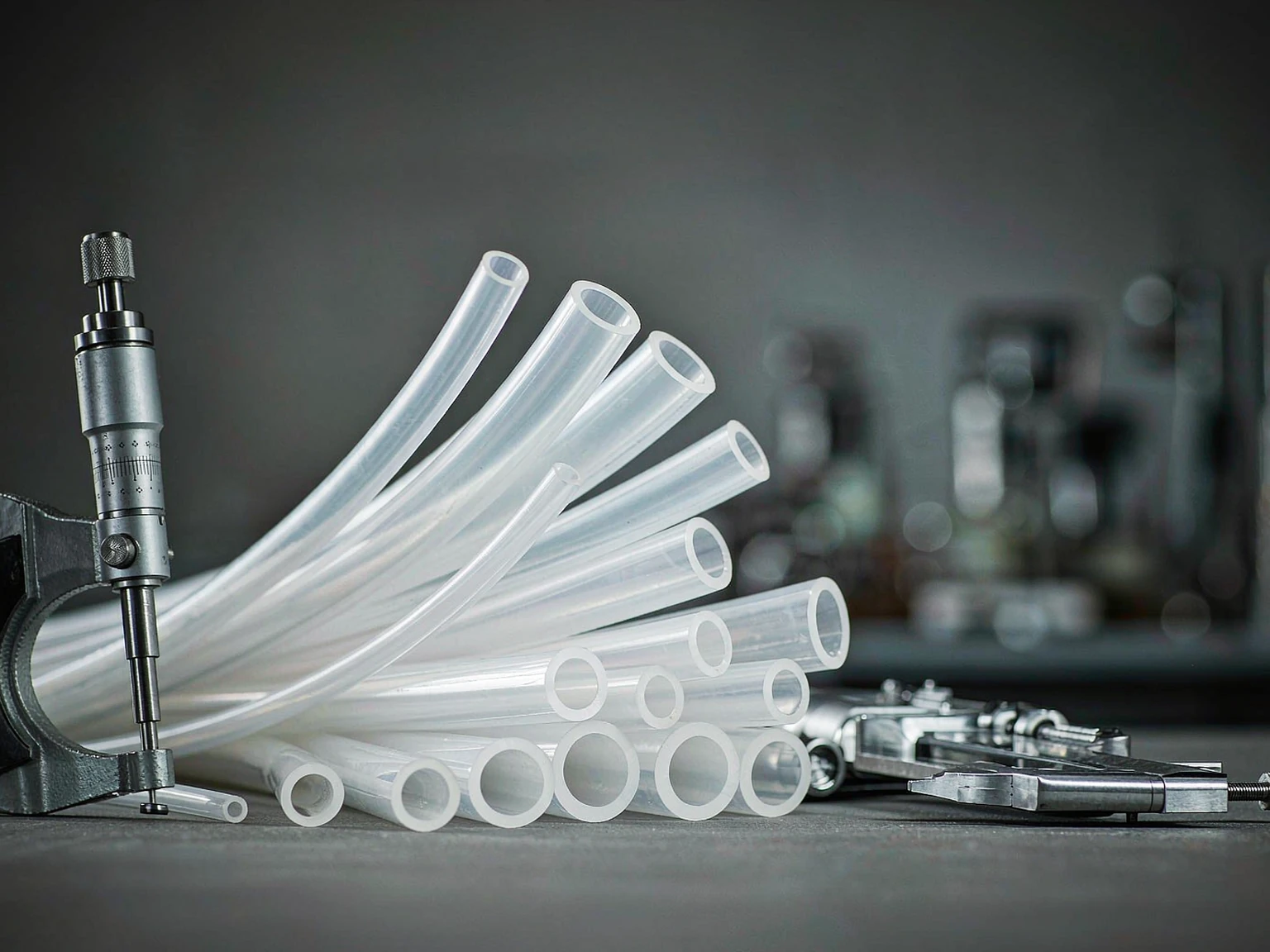
Short answer: PTFE tubing is specified by four dimensions — inner diameter (ID), outer diameter (OD), wall thickness and length — with ID from roughly 0.5 to 200 mm and walls from 0.1 to 5 mm in commercial practice. Only two of the four are independent: OD = ID + 2 × wall, so you must specify exactly which two the manufacturer holds to tolerance.
Sizing confusion is the number-one cause of tubing rework. A buyer specifies “6 mm tube” and receives ID 6, while the fitting expected OD 6. This reference gives the standard dimension conventions, realistic tolerances per size class, and how to write a tubing callout that cannot be misread.
The four dimensions and who controls what
| Dimension | Typical range | Common tolerance | Usually controlled by |
|---|---|---|---|
| ID | 0.5–200 mm | ±0.05–0.2 mm (small IDs tighter) | Extrusion die — the primary process dimension |
| Wall | 0.1–5 mm | ±10–20% commercial; tighter by agreement | Mandrel/tooling and draw-down ratio |
| OD | derived | ±0.1–0.3 mm | Follows from ID + wall; specify only if fittings require it |
| Length | coils to ~50 m; cut lengths | as agreed | Packaging and post-cut accuracy |
Tolerance classes: what is realistic at each size
Paste-extruded small-bore tube (under ~10 mm ID) holds the tightest ID tolerances — ±0.05 mm is routine and ±0.02 mm achievable with die selection and screening. Large-bore ram-extruded tube (50–200 mm) typically carries percentage tolerances because the material’s post-extrusion relaxation dominates. Beware quotations promising metal-class tolerances on large bore — they are either unmeasured or unshipped. Eccentricity matters as much as nominal wall: a tube specified “0.5 mm wall” with 30% eccentricity has a 0.35 mm minimum wall, and that minimum is what bursts or collapses. Ask how eccentricity is measured and reported.
Writing an unambiguous tubing callout
Specify two dimensions with tolerance and state which is functional: for fittings, OD and wall (fittings grip outside); for flow calculations, ID and wall. A correct callout reads: PTFE tube, ID 6.0 ±0.1 mm, wall 1.0 ±0.15 mm (min 0.85), length per coil 20 m, virgin PTFE. Adding “min wall” protects you from average-based compliance. For high-purity or electrical uses, append the property that matters: dielectric strength (typically ≥10 kV/mm on thin wall) or extractables documentation for semiconductor lines.
Size programs and tooling
Standard programs cover common ID steps; anything off-standard requires a die. Tooling charges are usually modest and sometimes waived against volume — but the question to ask is whether the die is the supplier’s standard or newly cut, because newly cut tooling means first-article verification matters even more. Chunhuan extrudes PTFE tube from 0.5 to 200 mm ID in-house with lot-level dimensional reports; supply your callout in the format above and the quote will state exactly which tolerances are held and how they are measured.
Frequently Asked Questions
What sizes does PTFE tubing come in?
Commercial PTFE tubing covers roughly 0.5-200 mm ID with 0.1-5 mm walls. Only two dimensions are independent since OD = ID + 2×wall.
What tolerance can PTFE tube hold?
Small-bore paste-extruded tube holds ±0.05 mm ID routinely; large-bore ram-extruded tube carries percentage tolerances. Specify minimum wall, not just nominal.
Should I specify ID or OD for PTFE tube?
Specify the dimension your application grips or flows through, plus wall, and state which is functional. For fittings use OD + wall; for flow use ID + wall.
What is eccentricity in tubing?
Wall thickness variation around the circumference. A 0.5 mm wall tube with 30% eccentricity has only 0.35 mm minimum wall — the value that determines burst pressure.


 English
 Russian
 French
 Spanish
