
Short answer: PEEK beats PTFE on strength, stiffness, wear and creep by wide margins and costs 5–15x more; PTFE wins on chemical universality, friction, dielectrics and price. In precision parts the question is almost always “is PEEK’s stiffness needed, or is PTFE’s chemistry the point?” — parts rarely need both, and hybrids (PTFE-filled PEEK, PEEK-guided PTFE) exist for the rare cases that do.
These materials sit at opposite ends of the fluorinated-plastics world: PTFE maximizes inertness and slipperiness at the cost of softness; PEEK maximizes mechanical performance at high temperature while remaining chemically excellent — just not universal. The comparison below is by the property that drives your part.
Property comparison for precision parts
| Propiedad | PTFE | PEEK |
|---|---|---|
| Tensile strength | ~15–35 MPa | ~100 MPa |
| Stiffness | Very low | ~70x higher |
| Continuous temperature | ~260°C (soft — strength near zero when hot) | ~250°C with load capacity |
| Cold flow | Alto | Low |
| Wear | Poor–fair | Excellent |
| Chemical range | Universal | Excellent but attacked by strong acids, some halogens/solvents at temperature |
| Friction | ~0.05–0.10 | ~0.2–0.3 (worse; fillers help) |
| Dielectrics | Excellent | https://ptfesuppliers.com/product-category/ood |
| Relative cost | 1× | ~5–15× |
Decision patterns
- Seal or low-friction liner: PTFE, or PEEK with PTFE fillers when the seal must also carry load.
- Precision guided component at 200°C under load: PEEK — PTFE creeps away from tolerance the moment it heats.
- Chemical contact with unknown mixtures: PTFE — PEEK’s chemical map has holes (concentrated acids, some solvents hot) that mixtures expose.
- Backup rings, seats, high-pressure wear parts: PEEK or PEEK/PTFE blends.
- Insulating part where cost matters: PTFE unless temperature-under-load forces PEEK.
Chunhuan manufactures PTFE (10,000+ grades, semi-finished program) and will say plainly when a duty has outgrown the material — the cost of an honest “this needs PEEK” is lower than a failed PTFE part. Send duty, load and temperature; expect a recommendation with reasoning.
Frequently Asked Questions
Is PEEK stronger than PTFE?
Dramatically: roughly 3x tensile strength, ~70x stiffness, far better wear and creep. PTFE’s advantages are chemistry, friction, dielectrics and price.
When does PTFE beat PEEK despite lower strength?
Universal chemical exposure, lowest-friction surfaces, electrical insulation, and any budget-constrained part without mechanical load.
What is PEEK with PTFE filler used for?
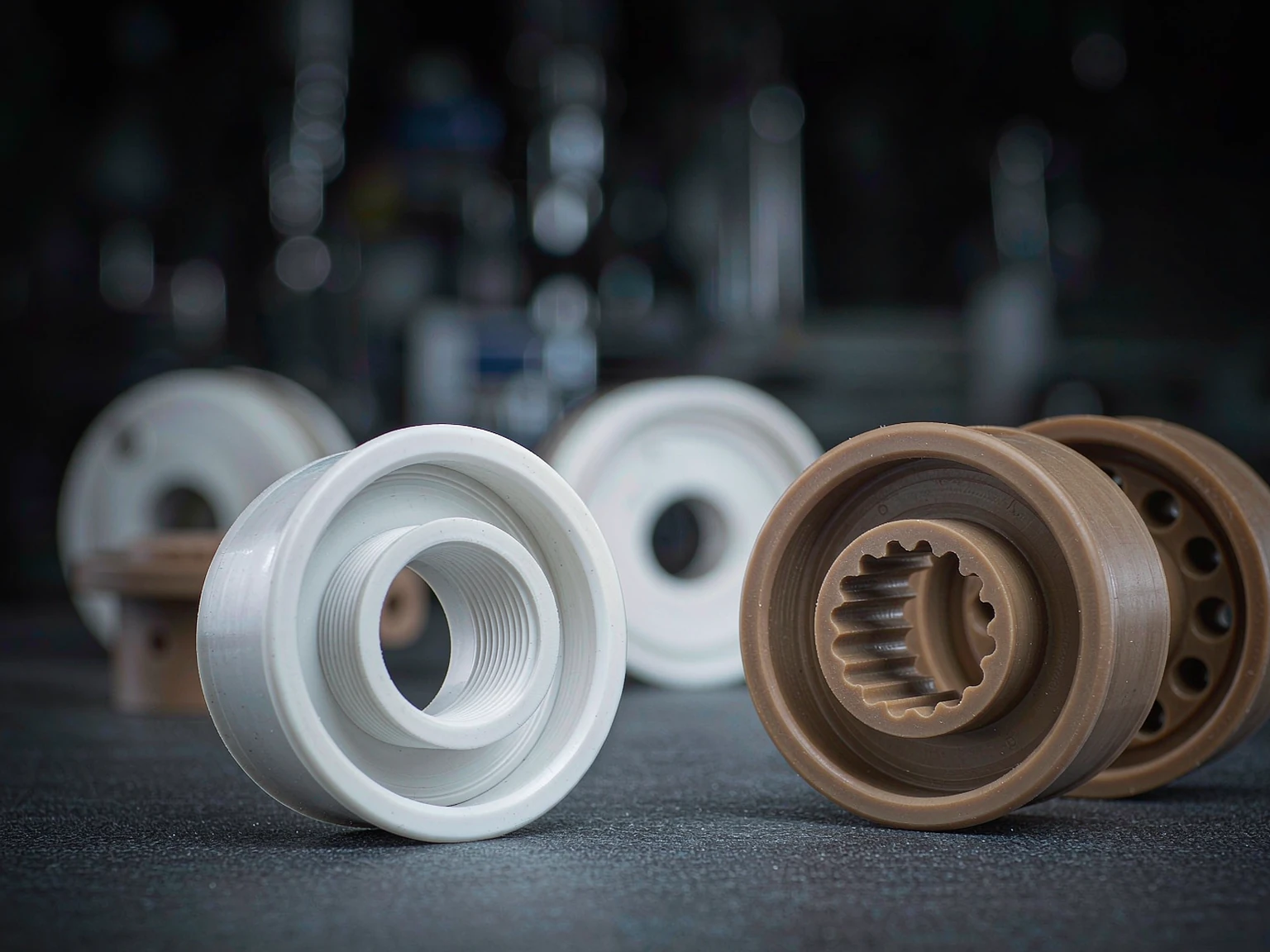
Hybrid grades (typically 5-25% PTFE) add low friction and stick-slip resistance to PEEK’s strength — common in seals, bearings and wear rings.

 English
 Russian
 French
 Spanish
