
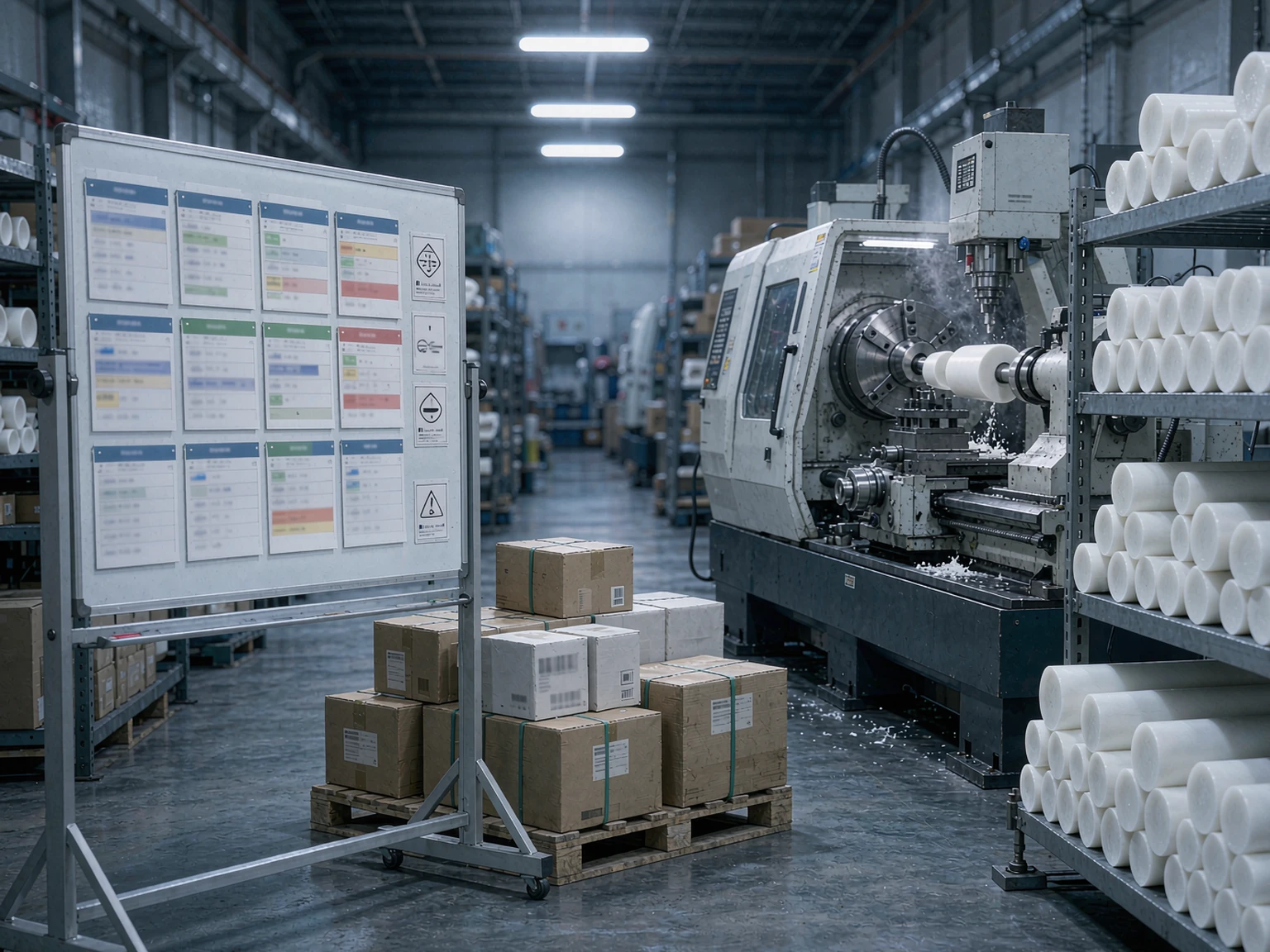
Short answer: PTFE machining lead time is driven by five factors in order of weight: material availability (stock shapes or blanks on hand vs molded to order), machine scheduling and batching, order complexity (setups and fixturing), documentation requirements (FAI, SPC, certificates), and quantity. Typical ranges: 1–2 weeks for stocked-material simple parts, 3–5 weeks for custom-material or heavily documented programs.
PTFE lead time surprises people in both directions — faster than expected when material is on the shelf, slower when a special billet must be molded and sintered. Understanding the drivers lets you compress the timeline deliberately.
Factor 1: Material Availability (The Big One)
| Material situation | Added lead time |
|---|---|
| Standard grade, common stock size on hand | 0 — machining can start immediately |
| Common grade, unusual size | 1–2 weeks (molding + sintering cycle) |
| Filled/custom grade, any size | 2–4 weeks (resin compounding, billet molding, sintering) |
Sintering is a slow thermal process that can’t be rushed — a billet may take days in the oven. Suppliers who mold their own stock control this; converters wait on distributors.
Factor 2–5: The Machining Side
- Scheduling/batching: your order joins a queue; shared setups with similar jobs run sooner. Ask how your order batches.
- Complexity: each additional setup and fixture adds days, not hours.
- Documentation: full FAI with temperature-controlled measurement adds days; plan it in rather than expediting it out.
- Quantity: 10 pieces and 1,000 pieces machine in similar time per piece — the difference is usually material, not cutting.
How to Shorten Your Own Lead Time
- Choose grades and sizes the supplier already stocks (ask for their standard list).
- Consolidate parts into one batched order.
- Release drawings complete — revisions restart the clock.
- Agree documentation scope at RFQ, not at shipping.
Chunhuan’s in-house molding and sintering means even special grades follow one internal calendar instead of a distributor chain — the structural reason our program customers get predictable 2–4 week deliveries.
Frequently Asked Questions
What drives PTFE machining lead time most?
Material availability — a stocked grade machines in 1–2 weeks, while a custom billet adds 2–4 weeks of molding and sintering that cannot be compressed.
Why can’t PTFE billets be produced faster?
Sintering is a slow thermal process with a fixed temperature-time profile; rushing it creates internal defects that surface as machining or service failures.
How can I shorten my PTFE parts lead time?
Use the supplier’s stocked grades and sizes, batch parts into consolidated orders, release complete drawings, and fix documentation scope at RFQ stage.
Does order quantity greatly affect PTFE lead time?
Less than expected — 10 or 1,000 pieces machine similarly per piece. Quantity affects lead time mainly through material preparation.


 English
 Russian
 French
 Spanish
