
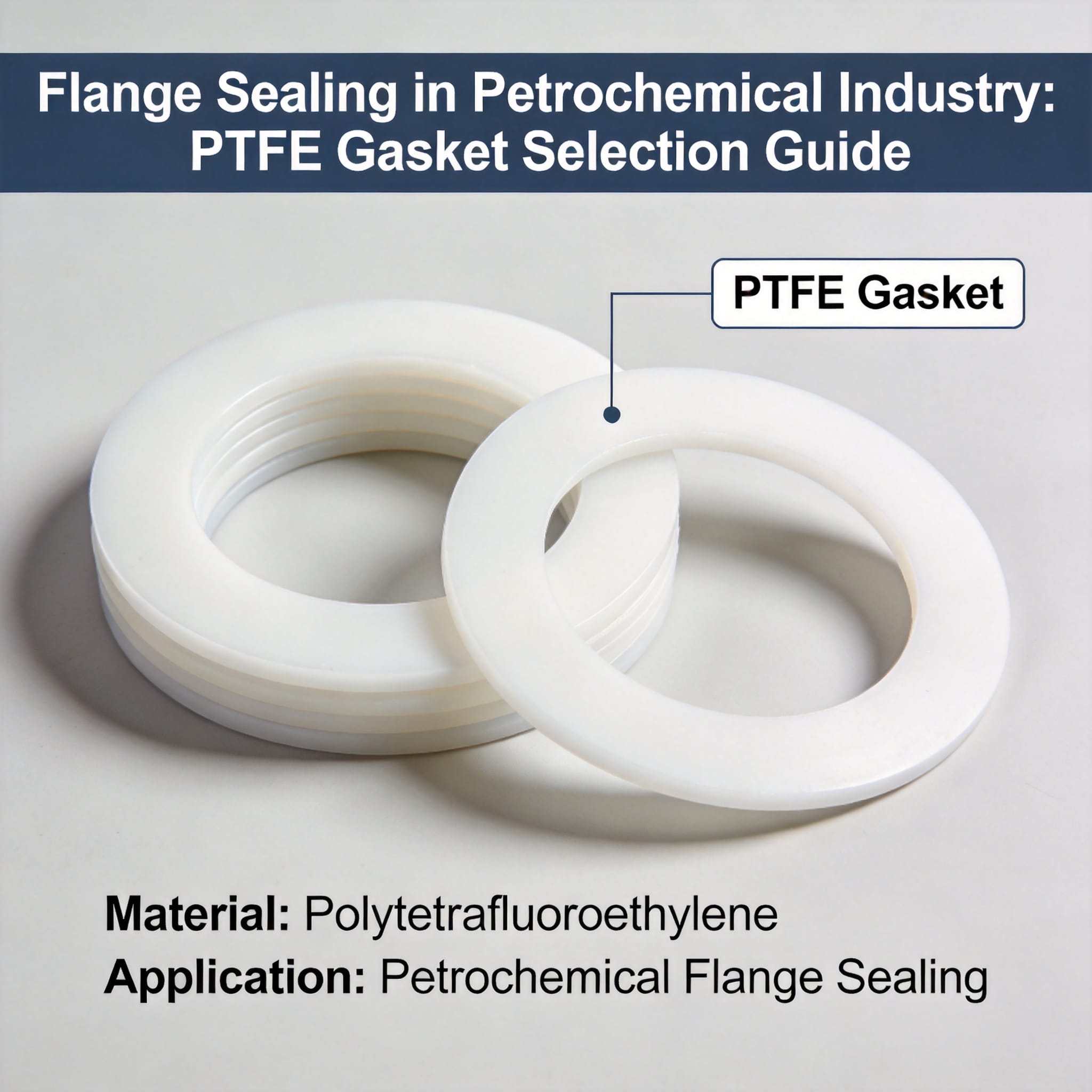
A PTFE gasket is a flange sealing component made from polytetrafluoroethylene, selected for petrochemical service based on three variables: chemical compatibility with the process fluid, operating temperature and pressure, and the flange facing type. PTFE works because its carbon-fluorine bonds resist attack by nearly all industrial chemicals, and its low friction coefficient allows it to cold-flow into surface imperfections under bolt load.
By the end of this guide, you will be able to read a piping line specification, match it to the correct PTFE gasket grade and filler, calculate a starting bolt torque, and install the gasket without the four errors that cause most flange leaks.
Table of Contents
- Why PTFE Gaskets Seal Petrochemical Flanges
- How to Select a PTFE Gasket: 6 Steps
- PTFE Gasket Grade Comparison Table
- Common Mistakes and How to Fix Them
- FAQ
Why PTFE Gaskets Seal Petrochemical Flanges
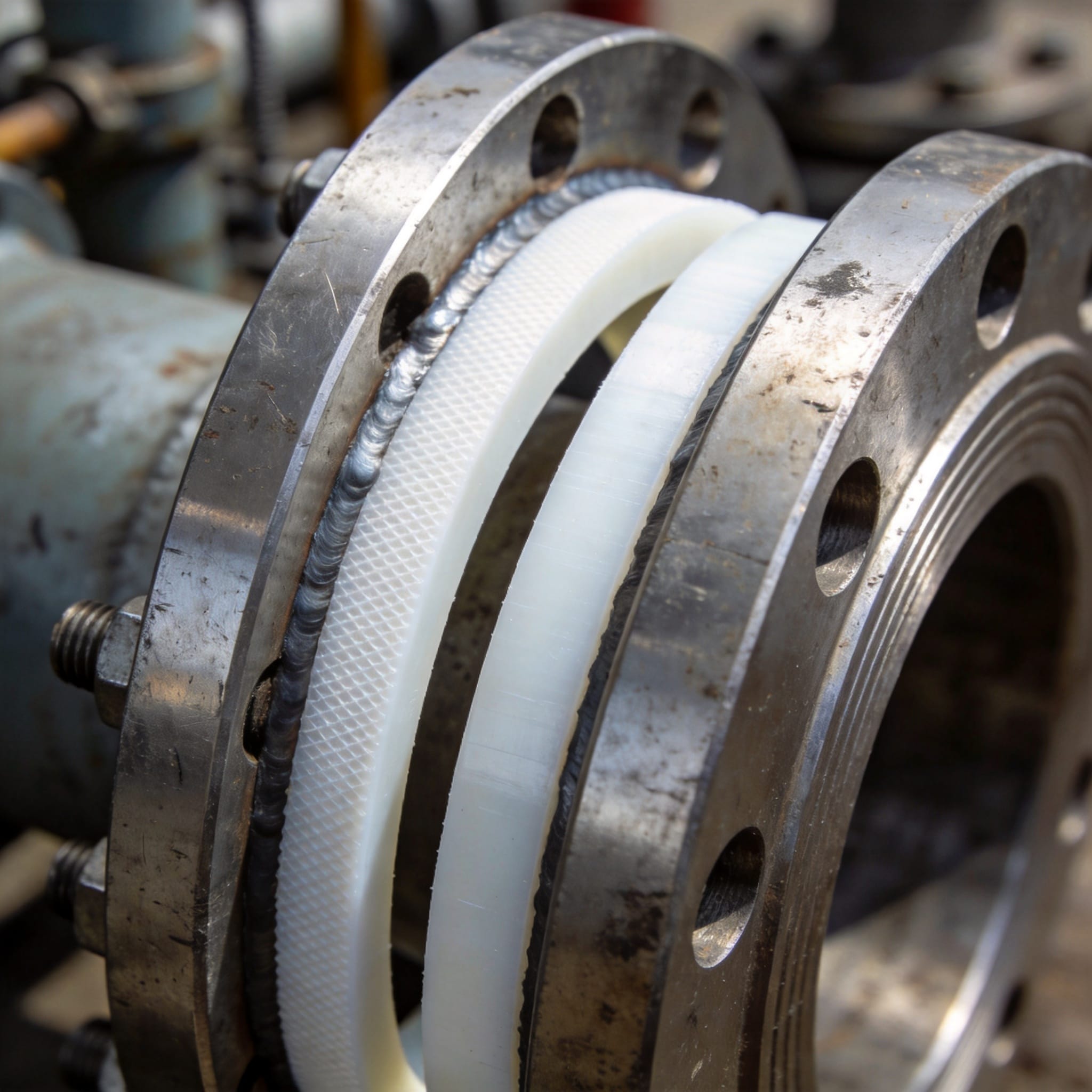
Sealing happens in two stages. First, the bolts compress the gasket until it fills every microscopic groove in the flange face. Second, internal pressure tries to push the gasket outward, and the gasket must resist that force while staying compressed.
PTFE behaves differently from spiral-wound or graphite gaskets in this second stage. Virgin PTFE has a compression set of roughly 40-60% at elevated temperature, meaning it keeps deforming after the bolts stop turning. This is called cold flow or creep, and it is the single biggest reason PTFE flange joints leak after thermal cycling.
This is why filled PTFE grades exist. Adding 15-25% glass, carbon, or graphite by weight reduces creep and increases thermal conductivity, which lets heat escape from the gasket instead of building up inside it. A 25% glass-filled PTFE gasket holds roughly 3-4 times more residual bolt load after 100 hours at 150°C than virgin PTFE of the same thickness.
For reference on material behavior under load, the ASTM F38 Standard Test Methods for Creep Relaxation of a Gasket Material defines the test procedure used to generate these numbers. You can view the standard scope at ASTM F38.
How to Select a PTFE Gasket: 6 Steps
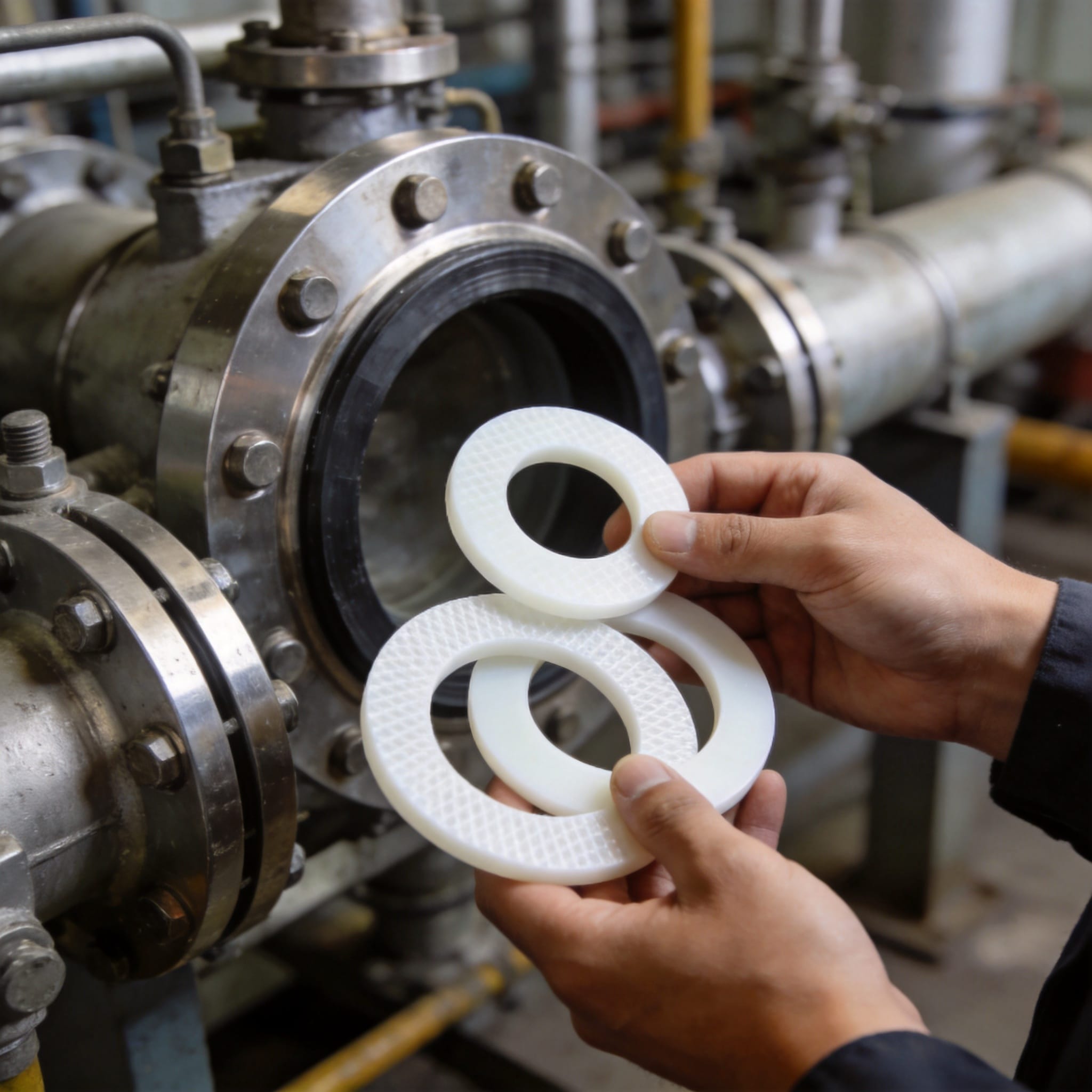
Work through these steps in order. Each one eliminates options, so by step 6 you have one gasket specification.
- Read the line number and fluid service from the P&ID. Write down the fluid name, concentration, and phase (liquid, gas, or slurry). Example: “98% sulfuric acid, liquid, ambient.”
- Record the design temperature and pressure from the line list. Use design values, not operating values. Example: “Design 120°C, 16 bar.”
- Check chemical compatibility. Compare your fluid against a PTFE compatibility chart. PTFE is rated compatible with the fluid if the expected swell is under 5% and weight change is under 2% after 30 days immersion at design temperature.
- Choose the PTFE grade using the temperature rule. Below 100°C: virgin PTFE is acceptable. 100-200°C: use a filled grade (glass, carbon, or graphite). Above 200°C: PTFE is out of range — switch to expanded PTFE or a different material family.
- Match the gasket to the flange facing. Raised-face (RF) flanges take a flat ring gasket. Male-and-female or tongue-and-groove facings take the matching profile. Never use a flat ring on a ring-joint (RTJ) flange.
- Calculate a starting bolt torque. Use the gasket manufacturer’s published torque table for your gasket thickness and bolt size. If none is available, start at 50% of the bolt yield stress and verify with a leak test at 1.5× design pressure.
Step 6 is where most field errors happen. Torque is not a fixed number you memorize — it changes with bolt material, lubrication, and gasket thickness. A 3 mm thick PTFE gasket in a 4-bolt, 1-inch flange typically needs 40-60 N·m with lubricated bolts. The same flange with dry bolts may need 70-90 N·m to reach the same gasket stress.
PTFE Gasket Grade Comparison Table
Use this table to move from step 4 to a specific grade. Values are typical for 3 mm thick sheet gaskets.
| Grade | Max Continuous Temp | Creep Resistance | Best For |
|---|---|---|---|
| Virgin PTFE | 100°C | Low | Low-pressure water, dilute acids, ambient service |
| Glass-filled (25%) | 150°C | Medium | Strong acids, hydrocarbons, general chemical service |
| Carbon-filled (25%) | 180°C | High | Steam, solvents, high-pressure gas |
| Graphite-filled (25%) | 200°C | High | Hot hydrocarbons, heat transfer fluids |
| Expanded PTFE (ePTFE) | 260°C | Medium-High | Fragile flanges, glass-lined equipment, high-temp chemical |
One caution on the table: glass-filled PTFE is attacked by hydrofluoric acid and hot caustic solutions. If your fluid is HF or concentrated NaOH above 80°C, move to a graphite-filled PTFE gasket or ePTFE. The U.S. Occupational Safety and Health Administration publishes process safety guidance for highly hazardous chemicals that reinforces why material selection errors in these services carry outsized consequences — see OSHA Process Safety Management.
Common Mistakes and How to Fix Them
These four errors account for the majority of PTFE flange leaks I have seen in 12 years of field and lab work on petrochemical sealing systems.
Mistake 1: Reusing a PTFE gasket after disassembly
Symptom: A joint that held pressure for two years leaks within a week of reassembly.
Cause: PTFE takes a permanent compression set. Once compressed, it will not spring back to its original thickness, so it cannot re-seal at the same bolt load.
Fix: Always install a new gasket. Budget gasket cost per flange per maintenance cycle rather than treating it as reusable hardware.
Mistake 2: Over-torquing to stop a leak
Symptom: The leak slows, then returns worse within hours. The gasket may extrude out of the flange gap.
Cause: PTFE has a low yield point. Past a certain stress, it flows sideways instead of sealing. More torque makes the leak worse, not better.
Fix: Stop. Depressurize, replace the gasket, and torque to the manufacturer’s table using a calibrated wrench in a star pattern.
Mistake 3: Ignoring flange face damage
Symptom: New gasket leaks at the same spot as the old one, every time.
Cause: A radial scratch, corrosion pit, or warp deeper than 0.05 mm gives the gasket a path to leak that no amount of bolt load will close.
Fix: Inspect the face with a straight edge and a light source before installation. Resurface or replace any flange with damage deeper than 0.05 mm.
Mistake 4: Mixing gasket thickness on one flange pair
Symptom: Uneven bolt loading; some bolts bottom out while others stay loose.
Cause: A 2 mm gasket on one side of a joint and a 3 mm gasket on the other changes the compression geometry.
Fix: Use identical gaskets on both sides of a joint. If the flange pair requires different thicknesses, that is a design error — flag it before installation.
FAQ
Can I use virgin PTFE for a 150°C steam line?
No. Virgin PTFE creeps too much above 100°C and will lose bolt load. Use carbon-filled or graphite-filled PTFE for steam service up to 180-200°C.
How do I know if my PTFE gasket is chemically compatible?
Check a published compatibility chart for your specific fluid, concentration, and temperature. Accept the material only if expected swell stays under 5% and weight change stays under 2% after 30 days at design temperature.
What torque should I use on a 1-inch, 4-bolt flange?
With a 3 mm filled PTFE gasket and lubricated bolts, start at 40-60 N·m. Verify by pressurizing to 1.5× design pressure and checking for leaks. Never guess — use the gasket supplier’s torque table when one exists.
Why did my PTFE gasket extrude out of the flange?
Over-torquing combined with a gasket that is too soft for the pressure. Switch to a filled grade with higher creep resistance and reduce torque to the published value.
Is expanded PTFE better than filled PTFE?
They solve different problems. An expanded PTFE gasket handles higher temperatures (up to 260°C) and fragile flanges. Filled PTFE handles higher pressure and offers better creep resistance at moderate temperatures. Choose based on which constraint is tighter in your line.
For low-temperature, low-pressure lines where virgin PTFE is acceptable, a pure PTFE gasket offers the highest chemical purity with no filler leaching. And when a standard ring will not fit an irregular or non-circular flange, a customizable PTFE gasket can be machined to the exact profile.
Disclosure: This guide is based on field observations and published material test data. No manufacturer or supplier influenced the content, and no commercial relationships exist with the standards bodies or agencies linked above.



 English
 Russian
 French
 Spanish