
Short answer: specifying custom PTFE tubing well means stating five things beyond the dimensions: resin grade, minimum wall (not just nominal), tolerance class and inspection method, end condition (coiled vs cut, with end finish), and the property the application actually depends on — dielectric strength, purity, pressure rating or bending radius. Dimension-only specs force the manufacturer to guess the purpose, and guessing shows up in your validation.
Custom tubing differs from catalogue tubing in one way: there is no history of what works. The specification has to carry that history instead. Below are the five fields, what each controls, and the failure each prevents.
1. Resin grade and additive declaration
Virgin PTFE for purity and dielectrics; conductive or anti-static grades (carbon-loaded) where static discharge or EMI matters; pigmented grades for line identification. Name the grade class and require it on the shipment certificate — visual inspection cannot distinguish a conductive tube from a black-pigmented one, and the mistake is expensive.
2. Minimum wall, not nominal wall
Extrusion produces wall variation; burst pressure, dielectric strength and permeation all key off the minimum. Write “wall 1.0 mm, min 0.85 mm” and ask how eccentricity is measured (typically at 4 or 8 points around the circumference). This single line prevents the most common custom-tubing dispute.
3. Tolerance class and how it’s proven
Small-bore paste-extruded tube holds ±0.05 mm ID routinely; large bore does not. State the class and require dimensional reports per lot — not “inspectable on request”, which means unmeasured.
4. End condition and packaging
Coils need a minimum bend radius statement; cut lengths need cut-end quality (burr-free, square or angled as fitted), length tolerance, and packaging that protects ends. Semiconductor buyers should specify double-bagging and cleanroom packing explicitly.
5. The functional property, stated as a test
- Fluid transfer: pressure rating at temperature (burst-tested, not calculated).
- Electrical: dielectric strength per lot (typ. ≥10 kV/mm thin-wall) with spark-test evidence.
- High purity: extractables or TOC documentation for the semiconductor duty.
- Permeation-limited service: wall thickness justified against the media and temperature, not assumed.
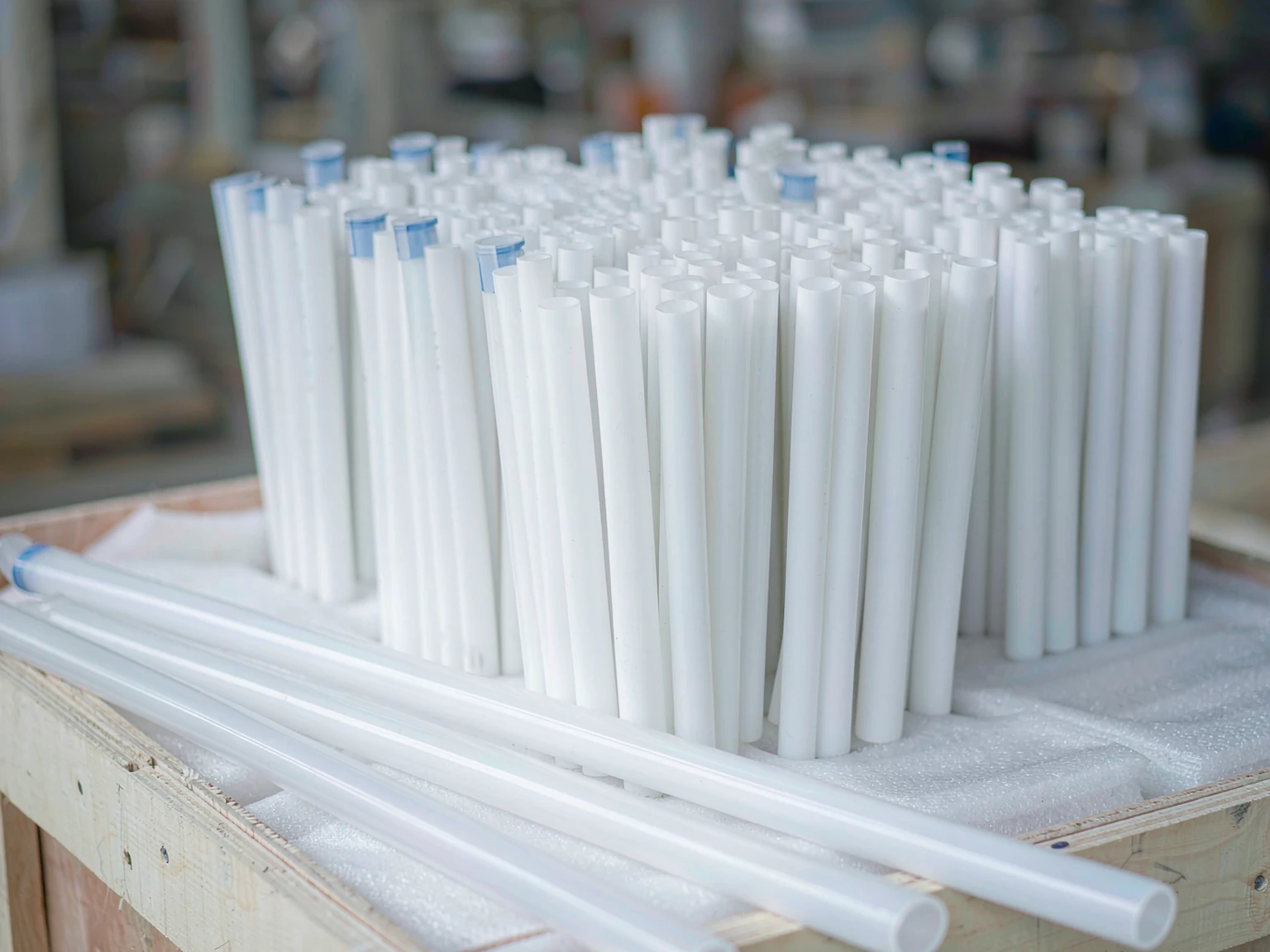
Chunhuan extrudes custom PTFE tubing in-house (0.5–200 mm ID, virgin and filled grades) with lot-level dimensional and functional test documentation — see the PTFE tube program. A specification written in these five fields gets you a firm quote with named tolerances, and a tube that passes validation the first time.
Frequently Asked Questions
What should a custom PTFE tubing specification include?
Resin grade, dimensions with minimum wall, tolerance class with inspection method, end condition and packaging, and the functional property (pressure, dielectric, purity) stated as a test.
Why specify minimum wall instead of nominal?
Burst pressure, dielectric strength and permeation all depend on minimum wall. Nominal-only specs allow eccentricity to eat the functional margin.
Can PTFE tube be made conductive?
Yes — carbon-loaded grades provide anti-static or conductive behavior. Require the grade on the certificate; black pigment alone proves nothing.
How is PTFE tubing pressure rated?
By burst testing at temperature, not by calculation alone. Ask for the test basis behind any quoted pressure rating.

 English
 Russian
 French
 Spanish
