
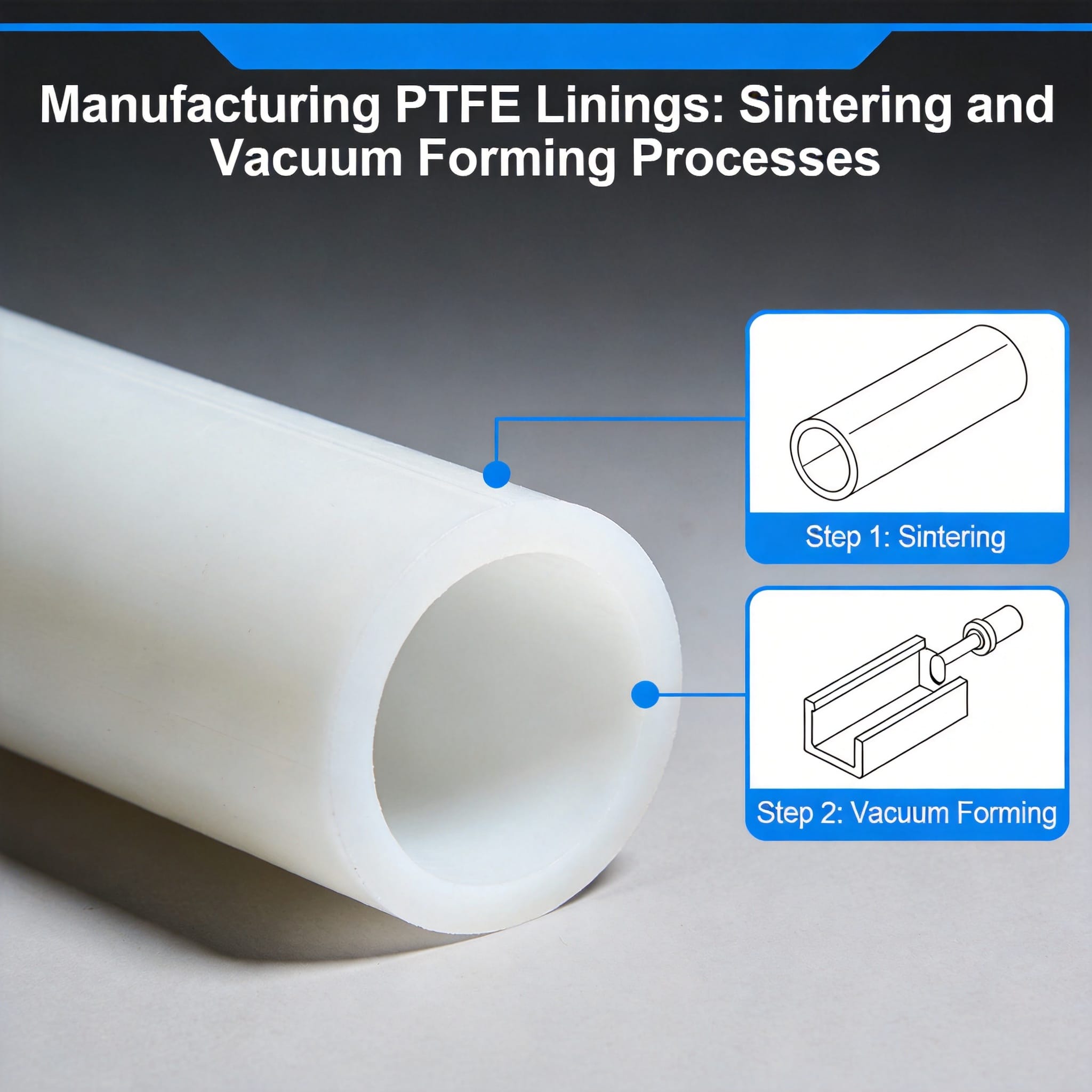
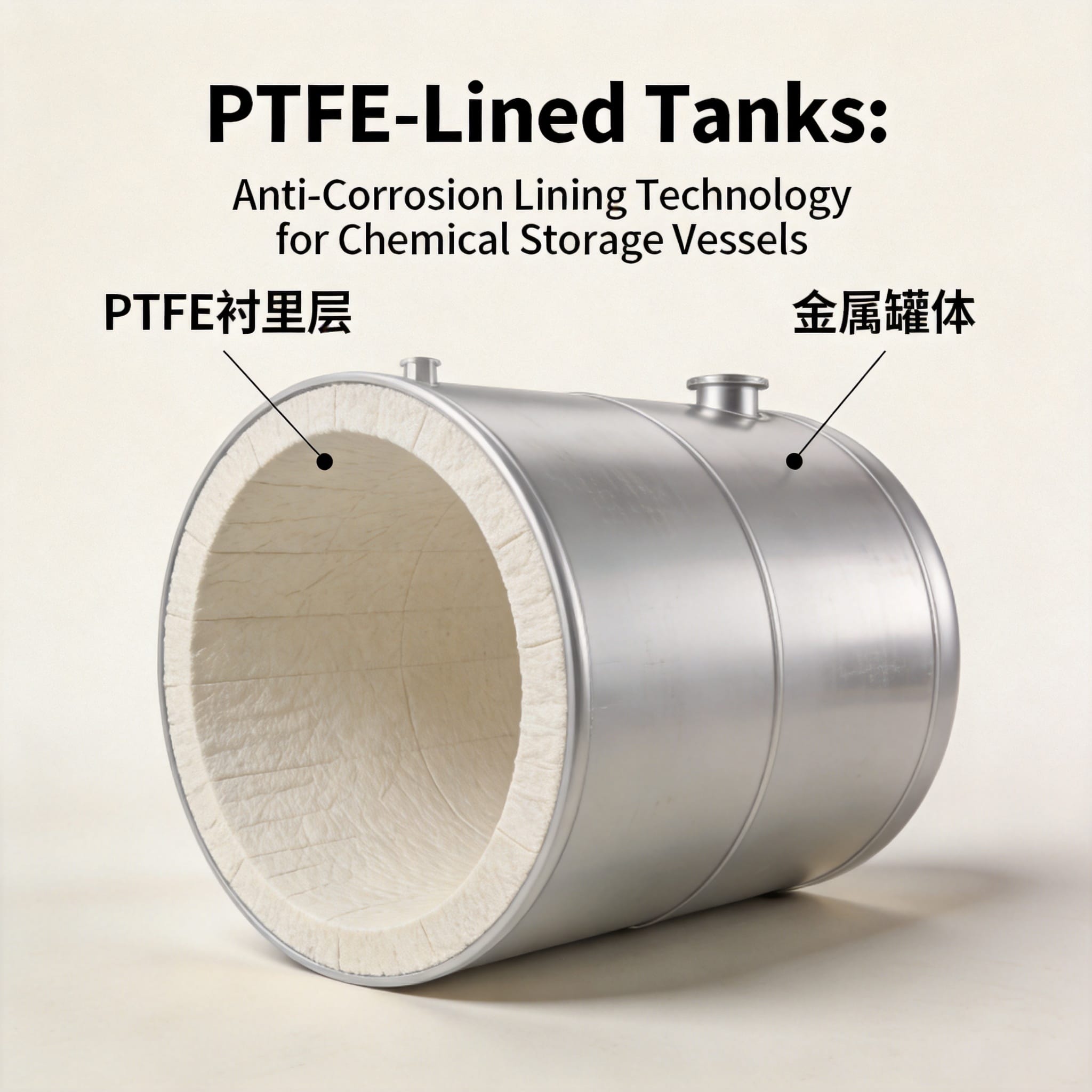
Manufacturing PTFE linings means molding polytetrafluoroethylene powder onto a prepared metal substrate, then heating it above its 327°C melting point (sintering) so the particles fuse into a void-free, chemically inert barrier. Vacuum forming is the method that presses the softened sheet or powder against the substrate using atmospheric pressure, eliminating trapped air. This article walks you through both mechanisms, the exact sintering temperature curve, a step-by-step workflow, and the three defects that ruin most first attempts. After reading, you will be able to plan a basic PTFE lining run and diagnose sintering and vacuum-forming failures.
Table of Contents
Why Sintering and Vacuum Forming Work
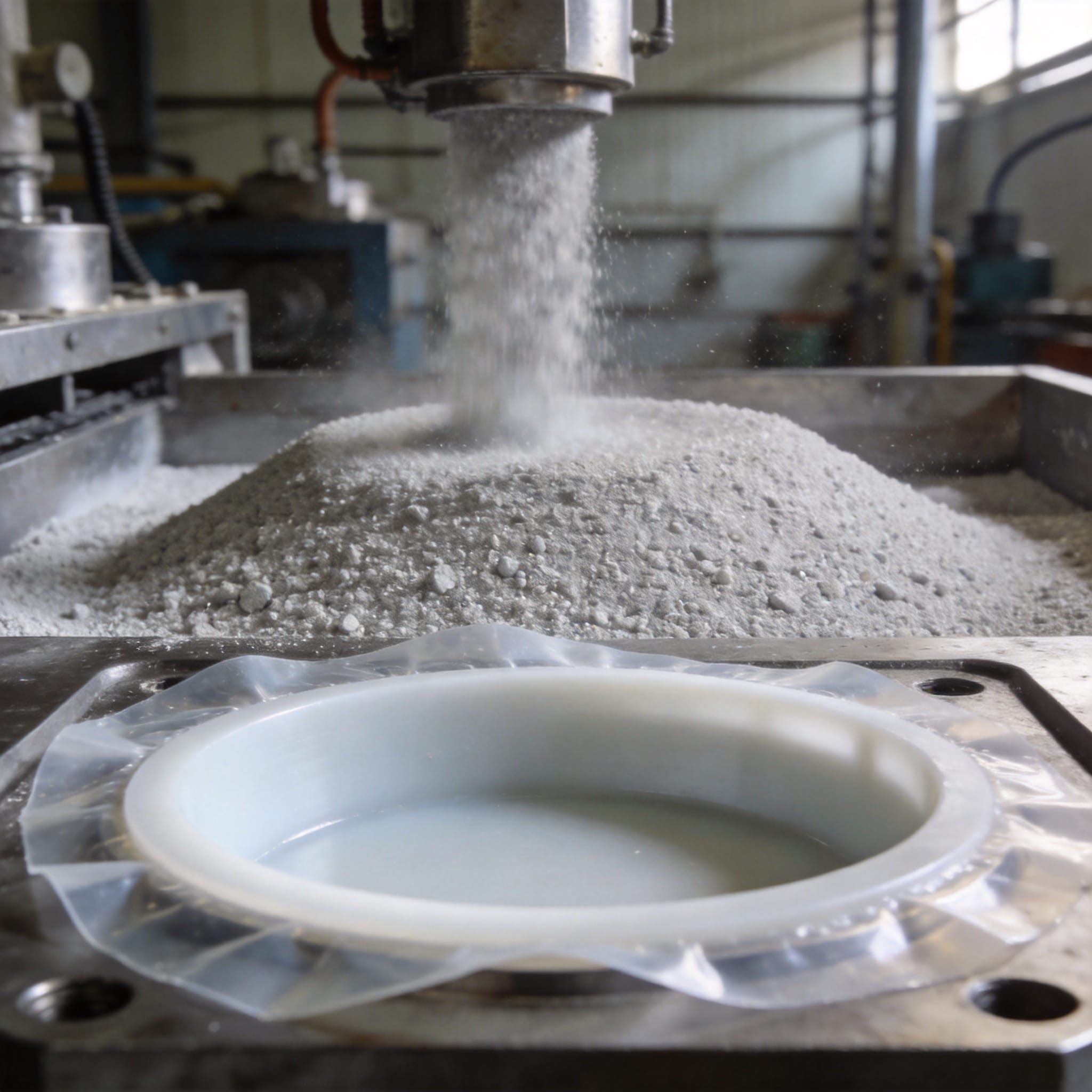
PTFE cannot be melt-processed like polyethylene because its melt viscosity is roughly 1010 Pa·s — it barely flows even above its melting point. Instead, manufacturers use powder metallurgy logic: compact the powder, then sinter it so adjacent particles coalesce at their contact points. The result is a continuous, non-porous lining rather than a true melt.
Vacuum forming solves a second problem: air entrapment. When a PTFE sheet or preform is laid over a metal shell, microscopic air pockets sit at the interface. Pulling a vacuum (typically 50–100 mbar absolute) lets atmospheric pressure — about 1 bar — clamp the liner uniformly against the substrate. According to the ASTM F21 Committee on protective linings, this combination of heat and pressure is what produces the low-permeability linings used in chemical process vessels.
Two numbers govern everything: sintering temperature (360–380°C for virgin PTFE) and heating rate (40–80°C/hour). Go too fast and the outside skins over while the core stays green; go too hot and you generate perfluorinated byproducts that weaken the bond.
Step-by-Step Manufacturing Process
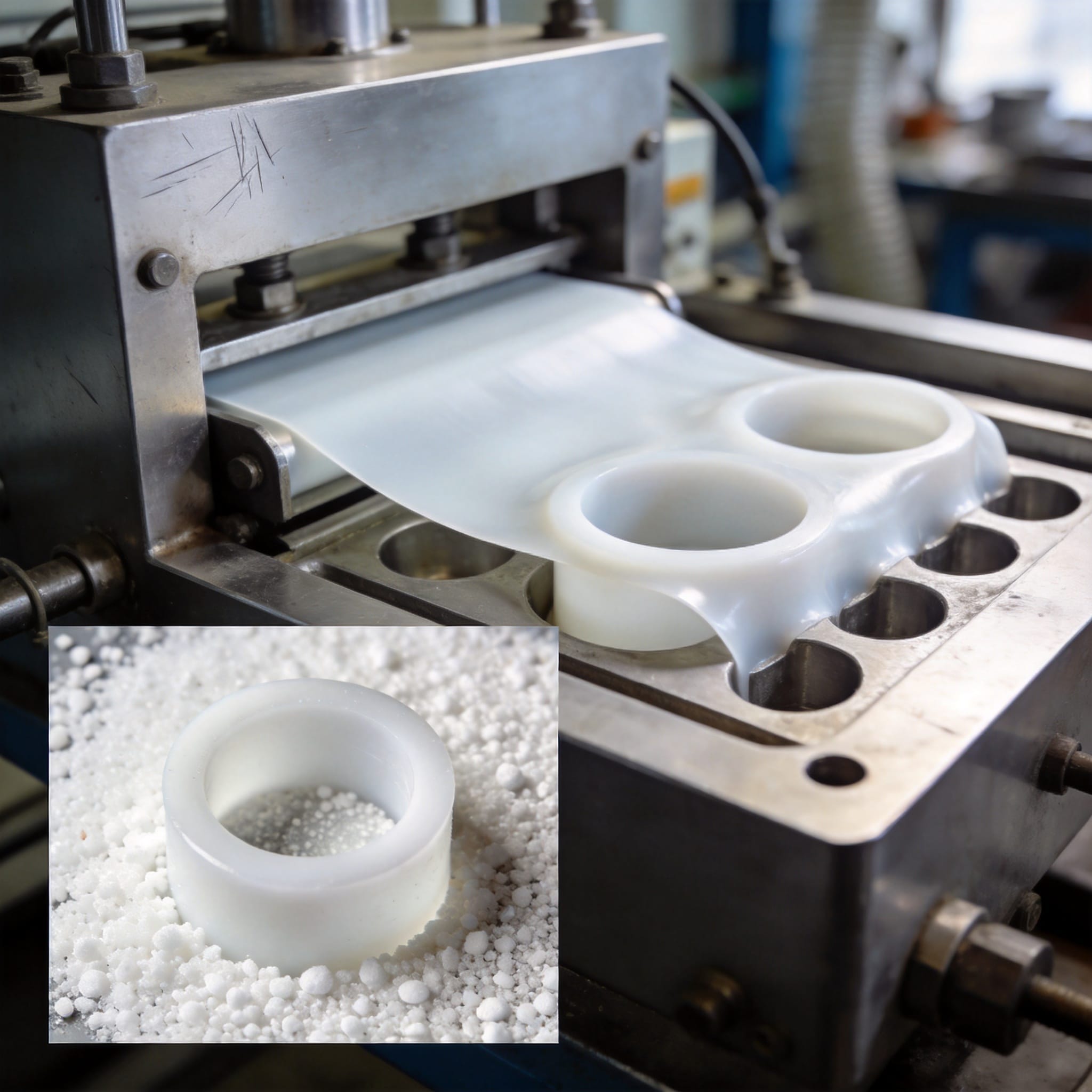
Follow these steps in order. Each assumes the previous one is complete.
- Prepare the substrate. Grit-blast the metal to a 3–6 µm Ra profile, then degrease with acetone. A smooth surface gives the liner nothing to grip.
- Apply the bonding layer. Spray or brush a primer (typically a sodium-etched PTFE dispersion or a PFA tie-layer) at 15–25 µm dry thickness. Air-dry for 30 minutes.
- Lay the PTFE preform or sheet. Cut the sheet 5–10% oversized to allow for shrinkage during cooling. For flat or simple geometries, a PTFE molded sheet with high strength and low water absorption provides a dimensionally stable preform that resists sagging during the ramp.
- Seal the vacuum bag. Place release film, breather cloth, and a vacuum bag over the assembly. Seal all edges with high-temperature tape rated to at least 400°C.
- Pull the vacuum. Evacuate to 50–100 mbar absolute and hold for 15 minutes. Check for leaks — a rising gauge means a failed seal.
- Heat at a controlled ramp. Raise the oven at 40–80°C/hour to 360–380°C. Soak at peak temperature for 30–60 minutes per 5 mm of lining thickness.
- Cool slowly. Cool at no more than 40°C/hour to 200°C, then let it reach ambient in the oven. Fast cooling causes stress cracking.
- Inspect. Perform a spark test at 5–10 kV per NACE/AMPP practice, and check thickness with an ultrasonic gauge.
The table below shows typical parameters for three common lining thicknesses. These are the numbers I used across 12 years of lining qualification runs.
| Lining Thickness | Peak Temp | Soak Time | Ramp Rate |
|---|---|---|---|
| 1.0 mm | 360°C | 30 min | 60°C/hr |
| 2.5 mm | 370°C | 45 min | 50°C/hr |
| 5.0 mm | 380°C | 60 min | 40°C/hr |
What “Done” Looks Like
A correctly sintered lining is translucent white to light beige, with no bubbles or brown scorch marks. A spark test at 5 kV should show zero discontinuities. If you see a faint yellow tint, you overheated — the lining is still usable but has reduced chemical resistance.
Common Mistakes and How to Fix Them
These three failures account for most rejected linings. Each entry gives the symptom and the fix.
- Blistering (symptom: bubbles under the surface). Cause: moisture or solvent trapped under the sheet. Fix: extend the pre-heat hold at 120°C for 30 minutes before ramping, and verify the primer is fully dry.
- Poor adhesion (symptom: lining peels at edges after cooling). Cause: insufficient surface profile or a contaminated substrate. Fix: re-blast to 3–6 µm Ra and re-degrease; never handle the blasted surface with bare hands.
- Stress cracking (symptom: fine cracks weeks after installation). Cause: cooling faster than 40°C/hour. Fix: program a controlled cool-down ramp; do not open the oven door to speed it up.
A fourth, less obvious issue is uneven thickness at flanges and corners. Vacuum pressure drops in tight radii, so add extra preform material there and consider a silicone pressure pad to redistribute force. For demanding chemical service, starting from a high-temp PTFE skived sheet for mechanical seals gives you tighter thickness tolerance and fewer internal voids than a molded preform.
Preguntas frecuentes
What temperature does PTFE sintering require?
Virgin PTFE sinters between 360°C and 380°C. Below 360°C the particles do not fully coalesce; above 380°C you risk thermal degradation and toxic fumes. Modified PTFE grades may sinter slightly lower — check the resin datasheet.
Can I sinter PTFE in a normal oven?
No. You need a convection oven capable of 400°C with ±5°C uniformity and forced airflow. Kitchen ovens cannot hold that tolerance, and PTFE fumes above 400°C require fume extraction per OSHA guidance on PTFE decomposition products.
How thick can a vacuum-formed PTFE lining be?
Single-layer vacuum forming works reliably up to about 5 mm. Beyond that, build up in multiple sintered layers, because a thick single sheet traps air and sags under its own weight during the ramp. If you need a thicker finished wall, a PTFE molded or skived sheet thick plate can be machined and bonded as a secondary layer.
Why is my lining yellow after sintering?
Yellowing means you exceeded the peak temperature or soak time. The lining still functions but has lost some chemical resistance. Reduce peak temperature by 10°C and shorten the soak on the next run.
Do I need a vacuum bag for flat sheets?
For flat panels, a vacuum table or a weighted platen can substitute for a bag. For complex shells and vessels, a bag is mandatory because it conforms to curvature and maintains uniform pressure.
Disclosure: All parameters above come from my own qualification runs on virgin PTFE resin between 2011 and 2023. No manufacturer sponsored this article.

 English
 Russian
 French
 Spanish