
Short answer: PTFE is an excellent electrical insulator — which is exactly the problem in flammable service: static charges generated by flowing liquids accumulate on insulating surfaces with nowhere to go, and a spark discharge can ignite solvent vapors. Flammable-duty lined systems need anti-static liners (carbon-loaded PTFE) with grounding continuity, verified end to end.
Of all PTFE’s properties, its insulation value is the one that turns into a safety topic. This is the content every plant handling flammables through lined equipment should have read before commissioning.
How Static Builds Up on Insulating Liners
- Charge generation: liquid flowing through pipe, splashing into vessels, or filtering separates charge — normal physics in every line.
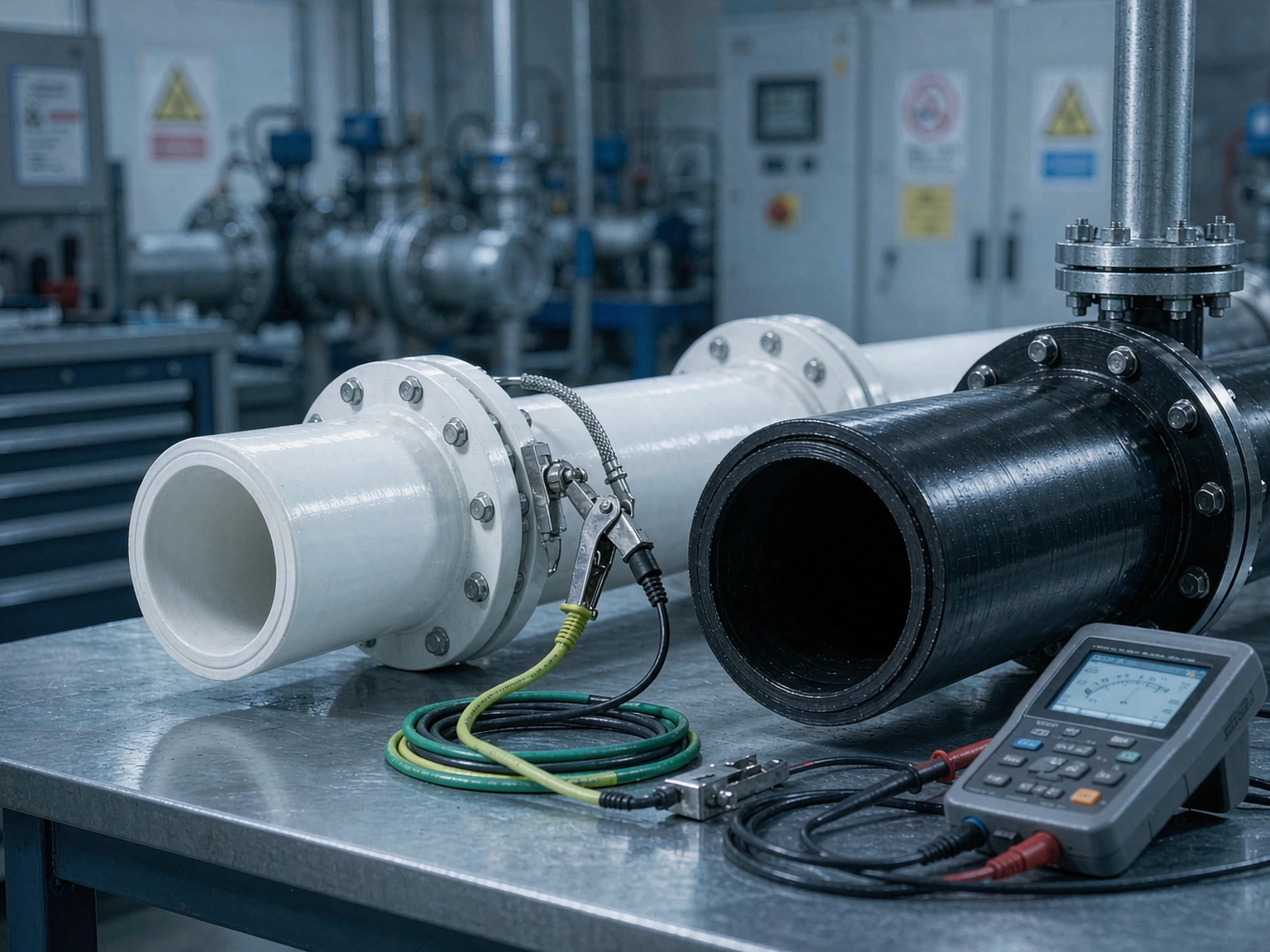
- Charge accumulation: in metal pipe, the charges drain to ground continuously. On an insulating PTFE liner, the wetted surface is isolated from the grounded steel behind it.
- Charge storage: the charged surface holds energy like a capacitor.
- Discharge: a brush or spark discharge from the surface — enough energy to ignite many solvent/air mixtures.
The hazard grows with flow velocity, low-conductivity liquids (toluene, hexane, fuels), splash filling, and filtering — all common in solvent and fuel handling.
The Fix: Anti-Static Liners
| Element | Requirement |
|---|---|
| Liner material | Carbon-loaded PTFE — conductive enough to bleed charge |
| Continuity path | Liner-to-flange-to-pipe grounding designed and verified at installation |
| Verification | Continuity test after installation and after maintenance |
| Documentation | Anti-static designation traceable on the liner certificates |
Carbon loading trades some properties — electrical insulation obviously, and chemical blind spots around strong oxidizers — so anti-static liners belong specifically in flammable service, not everywhere.
Where This Applies
Solvent transfer lines, fuel handling, coating and printing plants, pharma solvent recoveries, and any lined system where a low-conductivity liquid moves fast enough to generate charge. If your HAZOP hasn’t explicitly addressed static on lined equipment, this is the gap. Chunhuan manufactures anti-static lined pipe and components with verified grounding continuity and traceable liner certification.
Frequently Asked Questions
Why is PTFE a static hazard in flammable service?
It insulates the wetted surface from the grounded housing, so static charges from flowing low-conductivity liquids accumulate and can discharge as igniting sparks.
What is anti-static PTFE liner?
Carbon-loaded PTFE that conducts static charge away from the wetted surface to the grounded steel — required in flammable liquid service.
How is anti-static lining verified?
End-to-end continuity testing after installation and after any maintenance, with the anti-static designation traceable on liner certificates.
Does anti-static PTFE trade off other properties?
Yes — it loses insulating capability and carbon reacts with strong oxidizers, so it belongs specifically in flammable service.


 English
 Russian
 French
 Spanish
