
PTFE (polytetrafluoroethylene) rods are machined into high-purity components for semiconductor equipment because the material sheds almost no particles, resists nearly all process chemicals, and tolerates temperatures from -200°C to 260°C. In this guide you will learn which PTFE grade to select, how to machine a rod into a finished part step by step, and how to inspect and clean it so it passes a fab contamination check.
Table of Contents
Why PTFE Works in Semiconductor Equipment

PTFE is a linear fluoropolymer with a carbon-fluorine backbone. That bond is one of the strongest in organic chemistry, which is why the material is chemically inert against acids, bases, solvents, and plasma byproducts used in wafer processing. It also has a very low coefficient of friction (0.04-0.10 against steel), so moving parts wear slowly without lubrication.
The property that matters most in a fab is outgassing and particle generation. Semiconductor-grade PTFE rod is formulated to release minimal volatile organic compounds under vacuum and to hold its shape so machined edges do not crumble into particles. For reference, SEMI standards define cleanliness and material handling expectations for equipment components, and the SEMI organization publishes the F57 specification covering polymer materials used in facilities and equipment.
Three grades are commonly machined into rods for fab use:
| Grade | Typical Filler | Best Use |
|---|---|---|
| Virgin / unfilled | None | High-purity fluid handling, liners, insulators |
| 25% Carbon-filled | Carbon | Wear parts, bearings, seals under load |
| 25% Glass-filled | Glass fiber | Structural parts needing higher stiffness |
For any component that touches a wafer, a chemical line, or a vacuum chamber interior, use virgin unfilled rod. Fillers add hardness but introduce metal or mineral particles that can contaminate a process. A 2021 study in the journal Polymers on polymer outgassing confirms that unfilled fluoropolymers release fewer condensable species under vacuum than filled grades. When sourcing stock, a virgin PTFE rod with a batch certificate is the safest starting point for these high-purity applications.
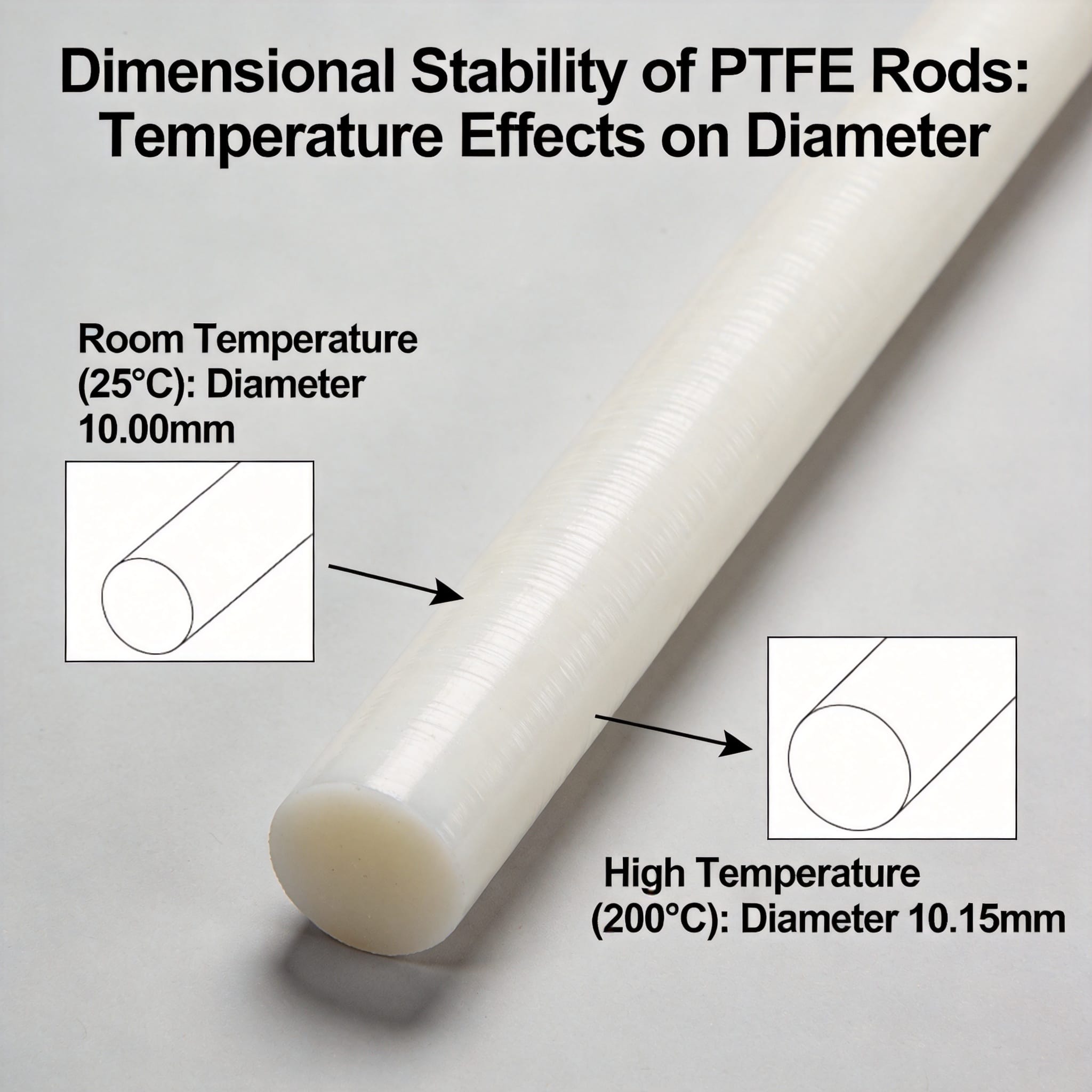
One practical constraint to plan for: PTFE has a high thermal expansion coefficient (about 12 × 10⁻⁵ /°C, roughly ten times that of steel). A 100 mm rod grows about 0.12 mm over a 10°C rise. Design clearances around this number rather than treating PTFE like a metal.
How to Machine a High-Purity PTFE Rod Component
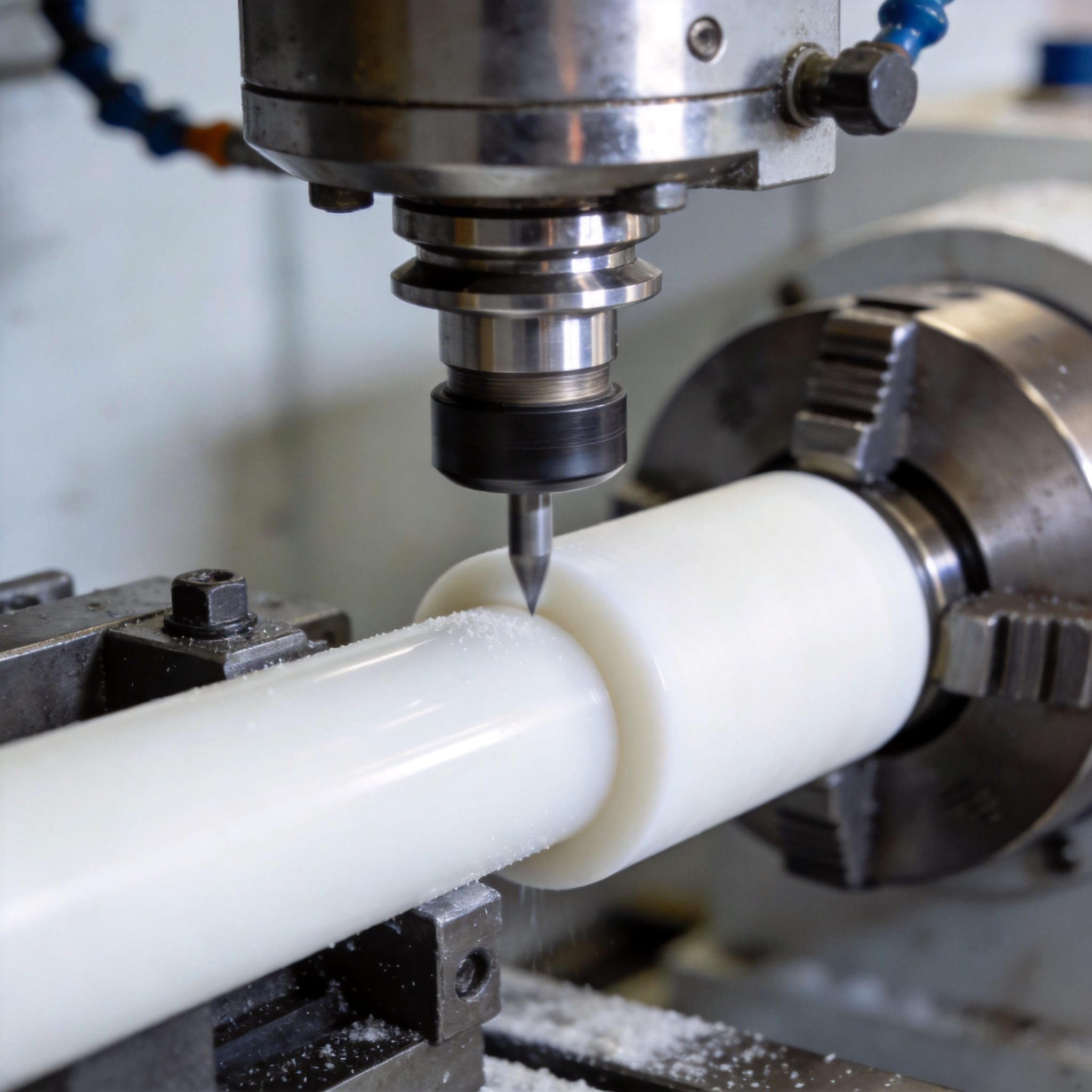
Follow these steps in order. Each one assumes the previous step is complete.
- Select the grade and verify the certificate. Confirm the rod is virgin, unfilled PTFE and that the supplier provides a batch certificate stating no regrind content. Regrind introduces contamination and inconsistent density.
- Condition the rod. Let the rod sit in the machining room at 20-23°C for at least 24 hours before cutting. This equalizes internal stress and prevents ovality after machining.
- Cut blanks on a band saw with a fine-tooth blade. Use a blade with at least 14 teeth per inch and a slow feed. A coarse blade grabs the material and creates a rough, chipped edge.
- Face and center the blank. Take a light facing cut of 0.25 mm to establish a true reference face. Do not skip this; an untrue face causes taper in every later operation.
- Set up sharp, polished tooling. Use high-speed steel or carbide inserts with a positive rake angle of 15-25° and a sharp edge. Dull tools rub instead of cutting, generating heat and a fuzzy surface.
- Turn at high speed and low feed. Run the spindle at 300-600 surface feet per minute with a feed of 0.05-0.15 mm per revolution and a depth of cut of 0.5-1.5 mm. These ranges produce a clean chip and a smooth finish.
- Support thin sections. If the wall thickness is under 3 mm, use a follower rest or fill the bore with a low-melting wax. Unsupported thin walls deflect and cut oversize.
- Drill with a slow, pecking motion. Use a drill with a 118° point and withdraw it every 2-3 mm to clear chips. PTFE chips are stringy and pack into flutes quickly.
- Deburr with a sharp blade, not abrasives. Scrape edges with a carbide scraper or a fresh utility blade. Sandpaper embeds grit in the soft surface.
- Measure after a 2-hour relaxation. PTFE springs back after cutting. Wait at least two hours, then measure again and record the final dimensions.
- Clean in an ultrasonic bath. Use a sequence of DI water, then isopropyl alcohol, then DI water again, 5 minutes per stage. This removes machining residue without attacking the polymer.
- Inspect and package. Check critical dimensions, verify surface finish, and seal the part in a cleanroom bag with a batch label before it leaves the bench.
For tolerance planning, PTFE holds ±0.05 mm reliably on a lathe with sharp tooling. Tighter than ±0.02 mm requires temperature-controlled machining and is rarely worth the cost unless the part is a sealing face. For complex geometries or production volumes, working with a specialist in PTFE precision machined parts helps ensure consistent results across every batch.
Common Mistakes and How to Fix Them
Mistake 1: Using dull or negative-rake tooling. Symptom: the surface looks fuzzy and tears instead of cutting cleanly, and the part feels warm after machining. Fix: switch to a sharp, polished insert with a positive rake of 15-25° and replace it as soon as the edge dulls. A single dull pass can ruin a finished diameter.
Mistake 2: Measuring immediately after the cut. Symptom: the part measures in tolerance on the machine but is undersized or oversized when the customer checks it a day later. Fix: let the part relax for at least two hours at room temperature before final measurement, and keep the shop within ±2°C during that window.
Mistake 3: Choosing filled PTFE for a wafer-contact part. Symptom: particle counts spike after the component is installed, or a process defect appears downstream. Fix: switch to virgin unfilled rod for anything in the process path. Reserve carbon- and glass-filled grades for wear parts that never touch a wafer.
Mistake 4: Deburring with sandpaper. Symptom: a gritty residue appears on the part after cleaning, and the surface shows embedded dark specks. Fix: deburr only with a sharp blade or scraper, then verify with a 10× loupe before cleaning.
Mistake 5: Skipping the ultrasonic clean. Symptom: the part looks clean but fails a wipe test. Fix: run the three-stage DI water / IPA / DI water bath for 5 minutes per stage, then dry with filtered nitrogen.
FAQ
Can I machine PTFE rod on a standard metal lathe?
Yes. A standard lathe works fine. The only changes are higher spindle speed, lower feed, and sharper tooling than you would use on aluminum or steel.
What tolerance can I realistically hold on a PTFE rod part?
Plan on ±0.05 mm for most turned features. You can reach ±0.02 mm with temperature control, but expect the part to move if the shop temperature swings more than 2°C.
Why did my PTFE part change size overnight?
PTFE has a high thermal expansion coefficient and it relaxes after machining. Both effects shrink or grow the part after it leaves the machine. Condition the rod before cutting and measure after a two-hour relaxation.
Is virgin PTFE always the right choice?
For any part that touches a wafer, a chemical line, or a vacuum chamber, yes. Use filled grades only for wear parts that stay outside the process path. If you need extra wear resistance, a carbon-filled PTFE rod is a good option for non-wafer-contact components.
How do I know my part is clean enough for a fab?
Run the three-stage ultrasonic clean, then perform a wipe test with a cleanroom wipe and DI water. If the wipe shows visible residue or the particle count exceeds your internal limit, repeat the clean cycle.
Can PTFE parts be used in plasma environments?
Yes, with a caveat. PTFE resists most plasma chemistries but etches slowly in oxygen and fluorine plasmas. For long-exposure plasma parts, verify etch rate against your specific recipe before committing to PTFE.

 English
 Russian
 French
 Spanish