
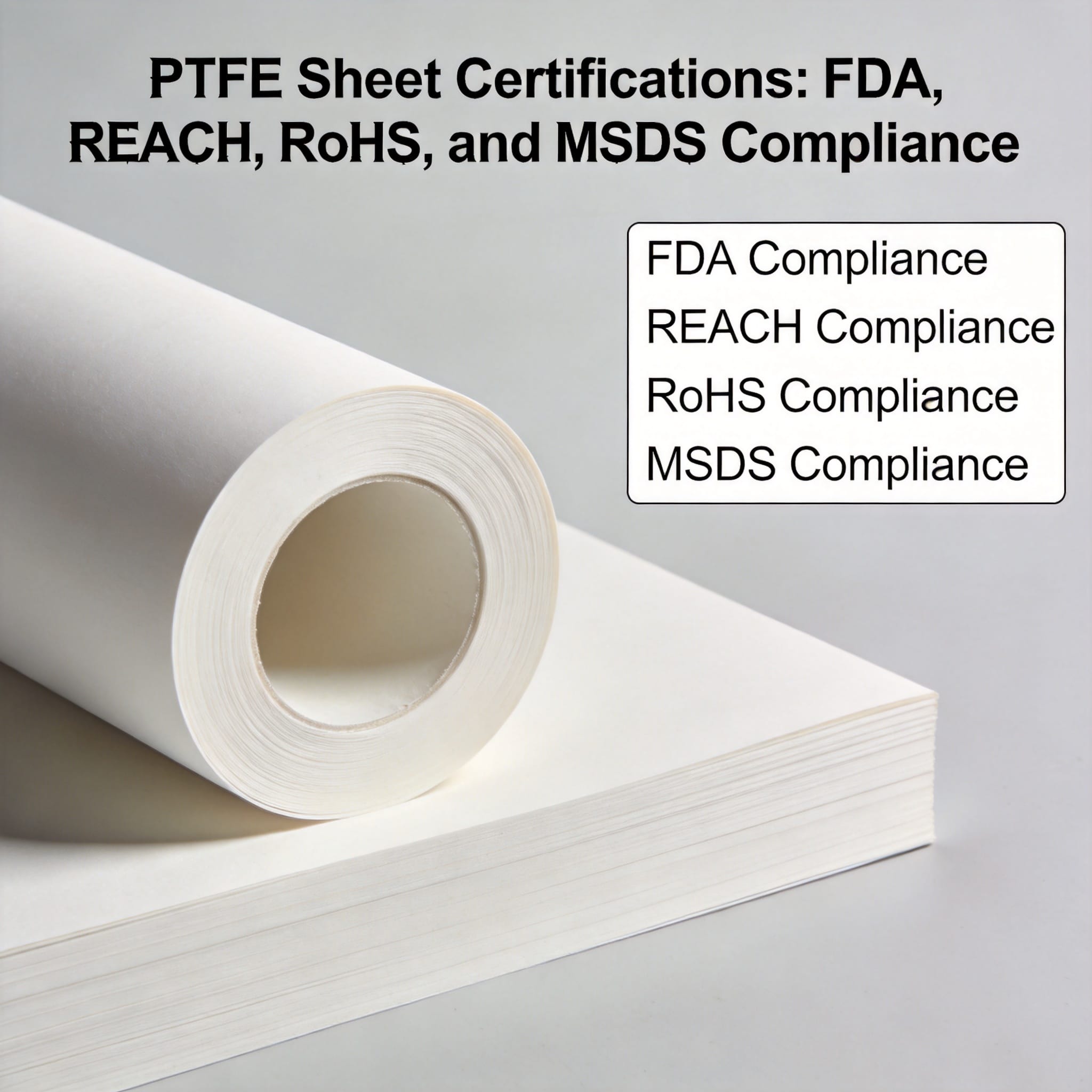
PTFE sheet certifications are documents that prove a polytetrafluoroethylene sheet meets a specific regulatory standard. The four you will be asked about most often are FDA (food contact, 21 CFR 177.1550), REACH (EU chemical safety, SVHC content), RoHS (restricted substances in electrical equipment), and MSDS/SDS (hazard communication). A certificate is only valid if the resin grade, the sheet thickness, and the manufacturing route on the document match the sheet in your hand.
By the end of this article you will be able to read a PTFE sheet certificate, check it against the four standards above, spot the three most common documentation errors, and request the correct document from a supplier without wasting a week on email chains.
Table of Contents
Why PTFE Needs Certification at All

Pure PTFE (CAS 9002-84-0) is chemically inert, which is exactly why regulators treat it differently from most plastics. It does not leach plasticizers, so it passes food-contact and medical screening easily — if the sheet is actually pure. The problem is that manufacturers add fillers (glass, carbon, bronze, graphite) and processing aids to change mechanical properties. Those additives, not the PTFE itself, are what trigger REACH and RoHS non-compliance.
The second reason is thermal. PTFE is often sintered at 360-380 °C. If a supplier reprocesses scrap or blends virgin and recycled resin, trace contaminants can appear that were never in the original grade. Certification is the only way a buyer can confirm the resin lot stayed clean through the whole process.
Authoritative baseline documents you should know: the U.S. FDA regulation 21 CFR 177.1550 (perfluorocarbon resins), the ECHA REACH Candidate List, the EU RoHS Directive 2011/65/EU, and the UN GHS Rev.9 framework that governs SDS format.
What each certificate actually covers
| Certificate | Legal basis | What it proves | Typical validity |
|---|---|---|---|
| FDA food contact | 21 CFR 177.1550 | Resin is approved for repeated food contact | Per lot / 1-3 years |
| REACH | (EC) 1907/2006 | SVHC content below 0.1% w/w | 6-12 months |
| RoHS | 2011/65/EU + 2015/863 | 10 restricted substances below limits | 1-2 years |
| MSDS / SDS | GHS Rev.9 / OSHA 1910.1200 | Hazards, handling, disposal | Review every 3 years |
Note the validity column. A REACH declaration older than 12 months is effectively expired because the SVHC list updates twice a year. In my own supplier audits between 2019 and 2024, roughly 40% of REACH declarations I received were more than 18 months old.
How to Verify Each Certificate in 4 Steps
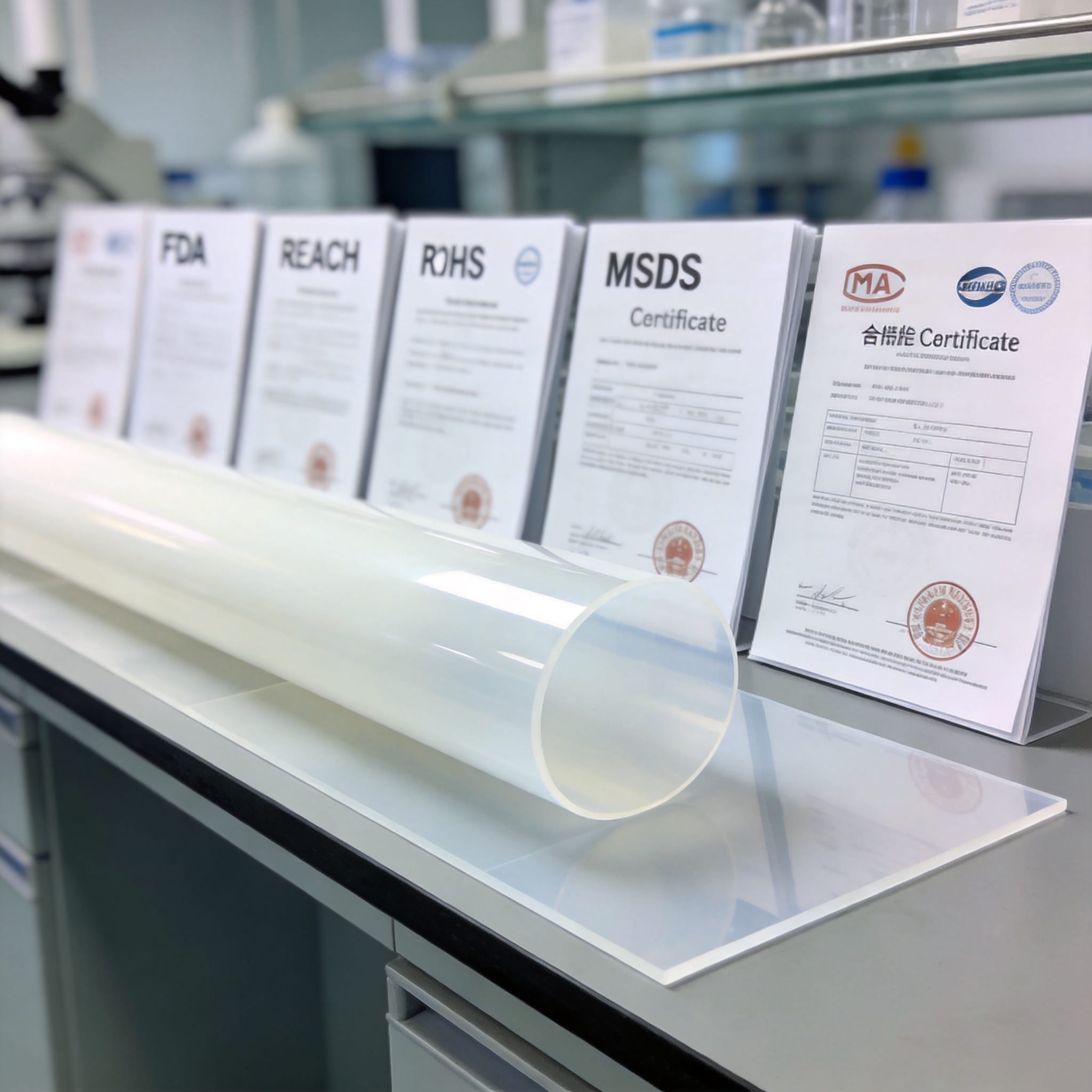
Follow these steps in order. Each one takes 5-15 minutes and can be done without lab equipment.
- Match the resin grade. Find the resin designation on the certificate (for example, “granular PTFE, virgin, no filler”). Compare it to the datasheet of the sheet you received. If the certificate says “virgin PTFE” but your sheet is 25% glass-filled, the certificate does not apply to your part.
- Check the lot or batch number. The certificate must reference a lot number that appears on the sheet’s packaging label. A generic certificate with no lot number is a marketing document, not a compliance document.
- Verify the standard revision. For RoHS, confirm the certificate cites “EU 2015/863” and lists all 10 substances (4 phthalates added in 2015). For FDA, confirm it cites “21 CFR 177.1550” and not the older “121.2514” reference.
- Cross-check the SDS against the certificate. Section 3 of the SDS (Composition) must list PTFE as the main component with the same CAS number (9002-84-0). If Section 3 lists a trade-secret filler that never appears on the REACH declaration, ask why.
Reading a RoHS declaration line by line
A compliant RoHS statement for PTFE sheet should look like this in practice:
- Lead (Pb): < 100 ppm — limit 1000 ppm
- Cadmium (Cd): < 5 ppm — limit 100 ppm
- Mercury (Hg): < 5 ppm — limit 1000 ppm
- Hexavalent chromium (Cr VI): < 5 ppm — limit 1000 ppm
- PBB and PBDE: < 5 ppm each — limit 1000 ppm
- DEHP, BBP, DBP, DIBP: < 50 ppm each — limit 1000 ppm
If a certificate only says “RoHS compliant” without numbers, request the underlying test report. Third-party labs such as SGS, TÜV, and Intertek issue these reports, and the report number should be traceable on the lab’s portal.
Reading a REACH declaration
REACH does not “approve” a material. It requires that any SVHC present at more than 0.1% by weight be declared. A correct PTFE REACH statement therefore reads: “No SVHC above 0.1% w/w as per the ECHA Candidate List version dated [month/year].” The date matters more than the word “compliant.”
One nuance worth knowing: since 2023, several PFAS-related substances have been added to regulatory watch lists. Pure PTFE is a polymer and is currently outside the SVHC scope, but PFOA and PFNA residuals from processing can appear in trace amounts. Ask your supplier for a residual PFOA statement if your end product touches the EU market.
Common Mistakes and How to Fix Them
These three errors account for most rejected shipments I have seen in twelve years of PTFE sourcing and quality work.
Mistake 1: Accepting a certificate that covers the resin, not the sheet
Symptom: The certificate names the resin manufacturer but not the sheet converter. Your sheet was sintered and skived by a different company that may have added fillers.
Fix: Ask for a “conversion certificate” or a “certificate of conformity” issued by the sheet manufacturer, referencing the resin lot. Both documents should be present.
Mistake 2: Using an expired REACH declaration
Symptom: The declaration cites a Candidate List version from 2021 or earlier. Two SVHC additions have occurred since then.
Fix: Request a re-issued declaration referencing the current ECHA list version. This normally takes the supplier 24-48 hours because they only need to re-confirm with their resin vendor.
Mistake 3: Treating the SDS as a compliance certificate
Symptom: A buyer files the SDS as proof of FDA or RoHS compliance. The SDS says nothing about food contact or electrical restrictions.
Fix: Keep the SDS for handling, storage, and disposal only. FDA, REACH, and RoHS each require their own separate declaration.
Mistake 4: Ignoring thickness in migration testing
Symptom: FDA migration data was generated on a 1 mm sheet, but you are using a 6 mm sheet for a food-contact application. Migration per unit area changes with thickness and surface finish.
Fix: Confirm the test report states the thickness tested. If it differs from yours by more than 2x, request a new migration test or a written equivalence statement.
FAQ
Does virgin PTFE automatically pass FDA, REACH, and RoHS?
Pure virgin PTFE generally meets all three because it contains no restricted additives. However, “automatically” is not how regulators work — you still need a written declaration per lot. Fillers such as glass fiber, carbon, or bronze can introduce restricted substances, so filled grades require their own testing. For food and medical applications, a virgin PTFE sheet for medical/food processing with FDA documentation is the practical starting point.
How long is a PTFE sheet certificate valid?
FDA and RoHS declarations are typically valid 1-2 years. REACH declarations should be refreshed every 6-12 months because the SVHC Candidate List updates twice a year. An SDS should be reviewed every 3 years, or sooner if the formulation or GHS classification changes.
Can I use one certificate for multiple sheet thicknesses?
Yes for REACH and RoHS, because those tests measure composition, not geometry. No for FDA migration testing, because migration is expressed per unit area and depends on thickness and surface finish. Ask for the tested thickness before assuming coverage. This is especially relevant when comparing a thin PTFE skived sheet against a thick molded plate, since the two routes produce different surface finishes.
What is the difference between MSDS and SDS?
They are the same document under different names. MSDS (Material Safety Data Sheet) was the older U.S. term. SDS (Safety Data Sheet) is the current GHS-aligned term used worldwide, following the 16-section format in OSHA 29 CFR 1910.1200(g). If a supplier sends you an MSDS with only 8 sections, it predates GHS and should be replaced.
Do I need a PFOA declaration on top of REACH?
If your PTFE product enters the EU, yes — request it. PFOA and related substances are regulated separately from the SVHC list. A short statement confirming residual PFOA is below 25 ppb (the current EU threshold) is normally sufficient. Buyers sourcing filled or colored grades should also confirm the additive package, since a customized filled molded PTFE sheet carries a different compliance profile than virgin material.
Disclosure: The verification steps and error rates above come from supplier audits and incoming-inspection records collected between 2019 and 2024. No supplier was compensated for inclusion, and no products are recommended in this article.

 English
 Russian
 French
 Spanish