
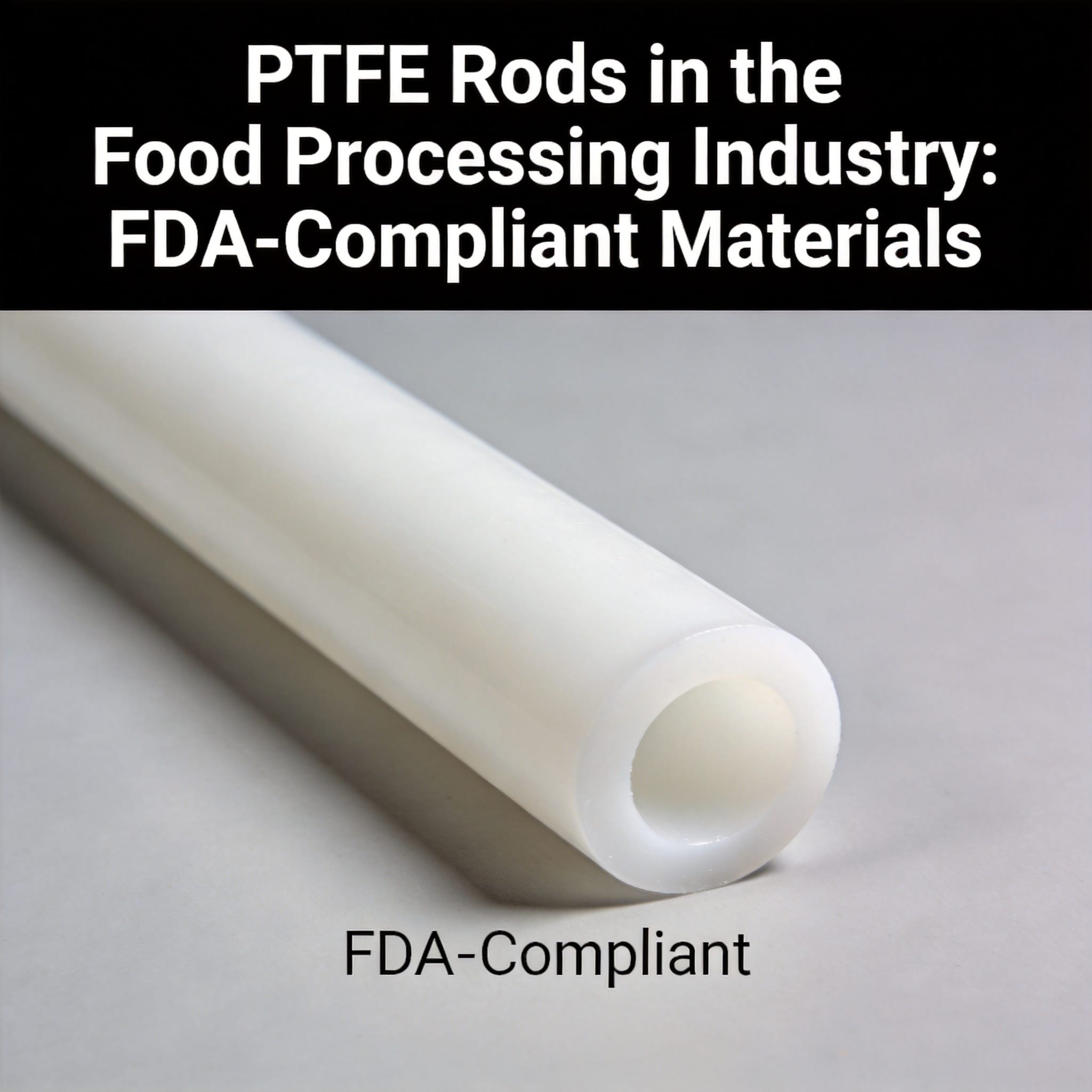
FDA-compliant PTFE rods are solid polytetrafluoroethylene shapes that meet U.S. Food and Drug Administration requirements for repeated food contact. Under 21 CFR 177.1550, PTFE is cleared as an indirect food additive for articles contacting food, provided the finished material passes extraction testing. In practice, you verify compliance by requesting a certificate of analysis (CoA) from your supplier that cites 21 CFR 177.1550 and reports extractable fluoride and residue limits.
By the end of this article, you will be able to read a PTFE compliance certificate, check whether a rod grade is suitable for your temperature and chemical conditions, machine and install it correctly, and recognize the three failure patterns that cause most food-plant problems.
Table of Contents
- Why FDA-Compliant PTFE Works in Food Contact
- How to Verify and Use PTFE Rods: Step by Step
- Common Mistakes and How to Fix Them
- PTFE vs. Other Food-Contact Plastics
- Preguntas frecuentes
Why FDA-Compliant PTFE Works in Food Contact
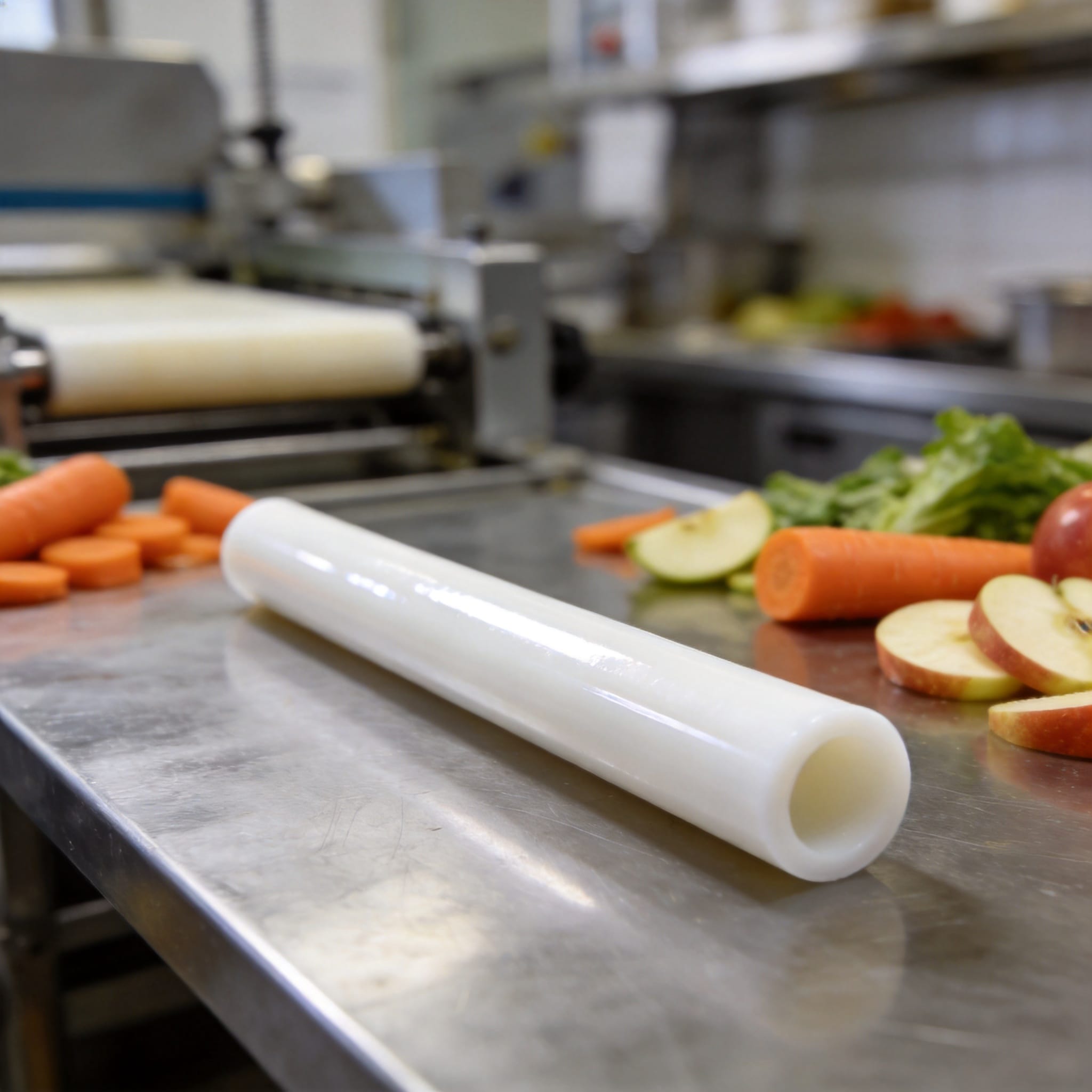
PTFE’s value in food processing comes from three properties that hold simultaneously: chemical inertness, a very wide service temperature range, and a non-stick, low-friction surface. Virgin PTFE resists attack by almost all food acids, bases, and solvents, and it operates continuously from roughly -200°C to +260°C (-328°F to +500°F). Those numbers are published in the material’s standard datasheets and are consistent across major resin producers.
The regulatory basis is the FDA’s indirect food additive regulation 21 CFR 177.1550, “Perfluorocarbon resins.” This section defines which perfluorocarbon resins may be used in articles contacting food and sets extraction limits. A rod is not automatically compliant just because it is “PTFE” — the resin and any fillers must fall within the regulation, and the finished part must pass the specified extraction test.
Key distinction: “Food-grade” and “FDA-compliant” are not the same claim. Food-grade is a marketing term without a legal definition. FDA-compliant means the material is covered by a specific regulation and the supplier can document it. Ask for the regulation number, not the phrase.
Fillers change the picture. Virgin PTFE is covered directly. Filled grades — glass, carbon, bronze, graphite — may or may not be acceptable depending on the filler and its own regulatory status. For direct and repeated food contact, specify virgin, unfilled PTFE unless your supplier provides a compliance letter covering the specific filled grade. For high-purity food and medical applications, a virgin PTFE sheet with FDA compliance for medical and food processing offers the same regulatory coverage in flat form.
How to Verify and Use PTFE Rods: Step by Step

Follow these steps in order. Each one produces a document or a measurement you can check independently.
- Request the compliance documentation before ordering. Ask for a certificate of analysis or a compliance letter that states: resin manufacturer, resin grade, regulation cited (21 CFR 177.1550), filler content (should read “none” for virgin), and the date of the extraction test. If the supplier cannot name the regulation, stop here.
- Confirm the extraction test result. The regulation specifies extraction in distilled water and in n-hexane, then measurement of extractables. Ask for the reported values and the test method reference. A compliant CoA will show measured extractables below the regulatory limit, not just a checkbox.
- Check the temperature rating against your process. Compare your maximum continuous process temperature (including clean-in-place cycles) to the rod’s rated continuous service temperature. Add a 20°C margin. If your CIP reaches 90°C, a rod rated to 260°C continuous is comfortable; a filled grade with a lower rating may not be.
- Verify chemical compatibility for your specific product. PTFE resists most food media, but check concentrated alkalis at elevated temperature and molten alkali metals, which attack it. Use the resin supplier’s chemical resistance chart, not a generic plastics table.
- Machine with sharp, dedicated tooling. Use carbide or high-speed steel tooling with positive rake, cutting speeds around 200–500 surface feet per minute, and generous coolant. PTFE is soft and deforms under a dull edge. Keep tooling used only for food-contact PTFE to avoid cross-contamination from other plastics.
- Clean and inspect before installation. Wipe machined surfaces with a lint-free cloth and food-safe solvent, then inspect for embedded chips. PTFE’s softness means debris presses into the surface rather than sitting on it.
- Install without over-compressing. PTFE cold-flows under sustained load. Torque fasteners to the manufacturer’s specification and use a backing washer or metal retainer where the rod is clamped. Over-torquing deforms the part and creates a crevice where product collects.
- Record the batch and file the CoA. Log the rod’s batch number, the CoA, and the installation date. During an audit, this record is what demonstrates your due diligence.
Common Mistakes and How to Fix Them
These three problems account for most food-plant PTFE failures I have seen over 12 years of specifying and testing these materials.
Mistake 1: Accepting “food grade” without a regulation number
Symptom: Your supplier’s documentation says “food grade” or “FDA approved” but never cites 21 CFR 177.1550 or provides extraction data. During an audit, the auditor asks for the regulatory basis and you cannot produce it.
Fix: Reject the documentation and request a CoA citing the regulation. If the supplier cannot provide one, change suppliers. This is a documentation problem, not a material problem — the same rod may be perfectly compliant, but you cannot prove it.
Mistake 2: Using a filled grade for direct food contact
Symptom: A glass- or carbon-filled PTFE rod performs well mechanically but the filler is not covered by the food-contact regulation. Extractables from the filler may exceed limits, and the compliance letter does not cover the filled version.
Fix: Switch to virgin PTFE for any surface that touches product. Reserve filled grades for non-contact structural parts. If you need the mechanical strength of a filled grade, get a written compliance letter for that exact grade before use.
Mistake 3: Over-torquing clamped PTFE parts
Symptom: After a few weeks, a PTFE seal or bushing shows a flattened, bulging profile. Product collects in the deformation and cleaning becomes ineffective. This is cold flow, and it is time- and load-dependent.
Fix: Reduce fastener torque to the specified value and add a metal backing ring to distribute load. Where possible, design the joint so the PTFE is in compression only within a confined cavity, which limits creep.
PTFE vs. Other Food-Contact Plastics
The table below compares PTFE with the plastics most often considered as alternatives. Values are typical continuous service temperatures and are drawn from standard material datasheets.
| Material | Typical Continuous Service Temp. | Resistencia química | FDA Food-Contact Regulation |
|---|---|---|---|
| PTFE virgen | -200°C a +260°C | Excellent, near-universal | 21 CFR 177.1550 |
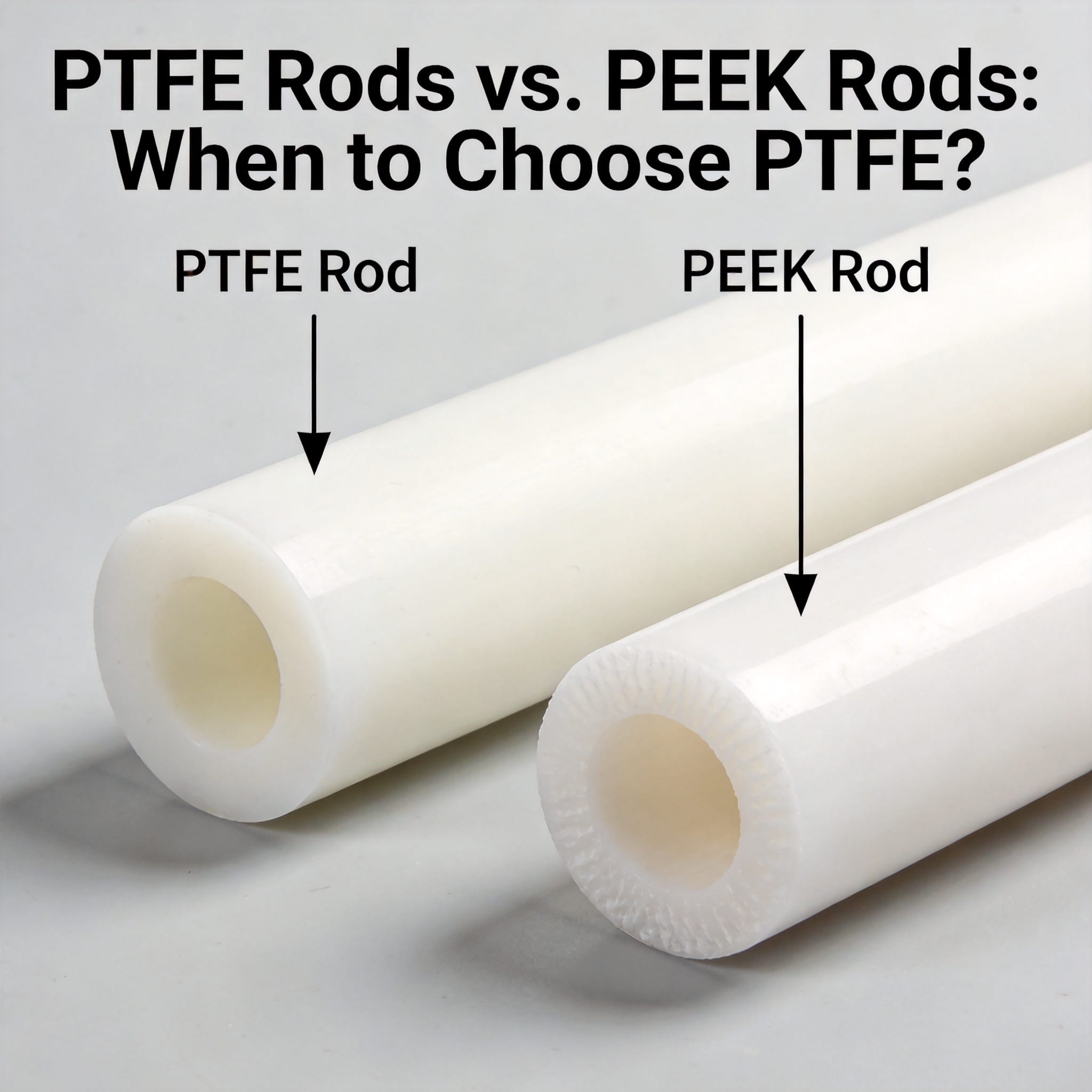
| PEEK | up to ~250°C | Very good, not universal | 21 CFR 177.2415 |
| HDPE | -50°C to +80°C | Good for acids/bases, poor for solvents | 21 CFR 177.1520 |
| Acetal (POM) | -40°C to +90°C | Moderate, attacked by strong acids | 21 CFR 177.2470 |
| Nylon (PA) | -40°C a +120°C | Good for oils, poor for acids | 21 CFR 177.1500 |
Decision rule: If your process exceeds 120°C, involves aggressive acids or solvents, or requires a non-stick surface, PTFE is the default choice. If your process stays below 90°C and uses mild media, HDPE or acetal will cost less and machine more easily. PEEK is the option when you need PTFE-level temperature performance plus higher mechanical strength and stiffness.
Note that each material above has its own regulation. A compliance certificate for one does not transfer to another, even from the same supplier.
Preguntas frecuentes
Is all PTFE FDA-compliant?
No. PTFE resin is covered by 21 CFR 177.1550, but compliance applies to the finished article, not the resin alone. Fillers, processing aids, and contamination during machining can all affect the result. Always verify with a CoA for the specific rod you receive.
Can I use PTFE rods at 300°C?
Not continuously. Virgin PTFE’s typical continuous rating is 260°C. Short excursions above that are sometimes tolerated, but sustained operation accelerates degradation and can release harmful fumes. If your process runs above 260°C continuously, PTFE is the wrong material — consider PEEK or a metal component.
How do I know if a PTFE rod is virgin or filled?
Two ways. First, read the documentation: a virgin grade will state “100% virgin PTFE” or “unfilled.” Second, look at the material: filled PTFE is usually off-white, gray, or dark, while virgin PTFE is a uniform opaque white. Color alone is not proof, so rely on the CoA.
Does PTFE need special cleaning between production runs?
PTFE is chemically resistant, so standard food-safe cleaning agents are fine. The real issue is mechanical: because the surface is soft, abrasive pads scratch it and create sites for bacterial retention. Use soft brushes or low-pressure rinses, and inspect for gouges after cleaning.
How long do PTFE rods last in food processing?
Under correct installation and within rated temperature and load, expect several years of service. The limiting factor is usually mechanical creep at clamped joints, not chemical degradation. Inspect clamped parts quarterly for deformation during the first year, then annually once performance is stable.
Disclosure: This article is based on published material datasheets, the eCFR regulatory text, and field observations from specifying food-contact components. No products or suppliers are endorsed. Verify all compliance claims against your own supplier’s documentation and your facility’s regulatory requirements.

 English
 Russian
 French
 Spanish