
Custom thickness and width for PTFE sheets means specifying a sheet’s gauge (typically 0.5 mm to 50 mm) and its roll or plate dimensions (commonly up to 1,500 mm wide) so the material matches the vessel, column, or duct it will line. You choose a thickness from the corrosion and permeation load, then choose a width from the equipment’s largest continuous surface and your welding or bonding method. After reading this guide, you will be able to write a complete PTFE sheet specification — thickness, width, tolerance, and grade — and check it against a real vessel lining job.
Table of Contents
Why Custom Sizing Works
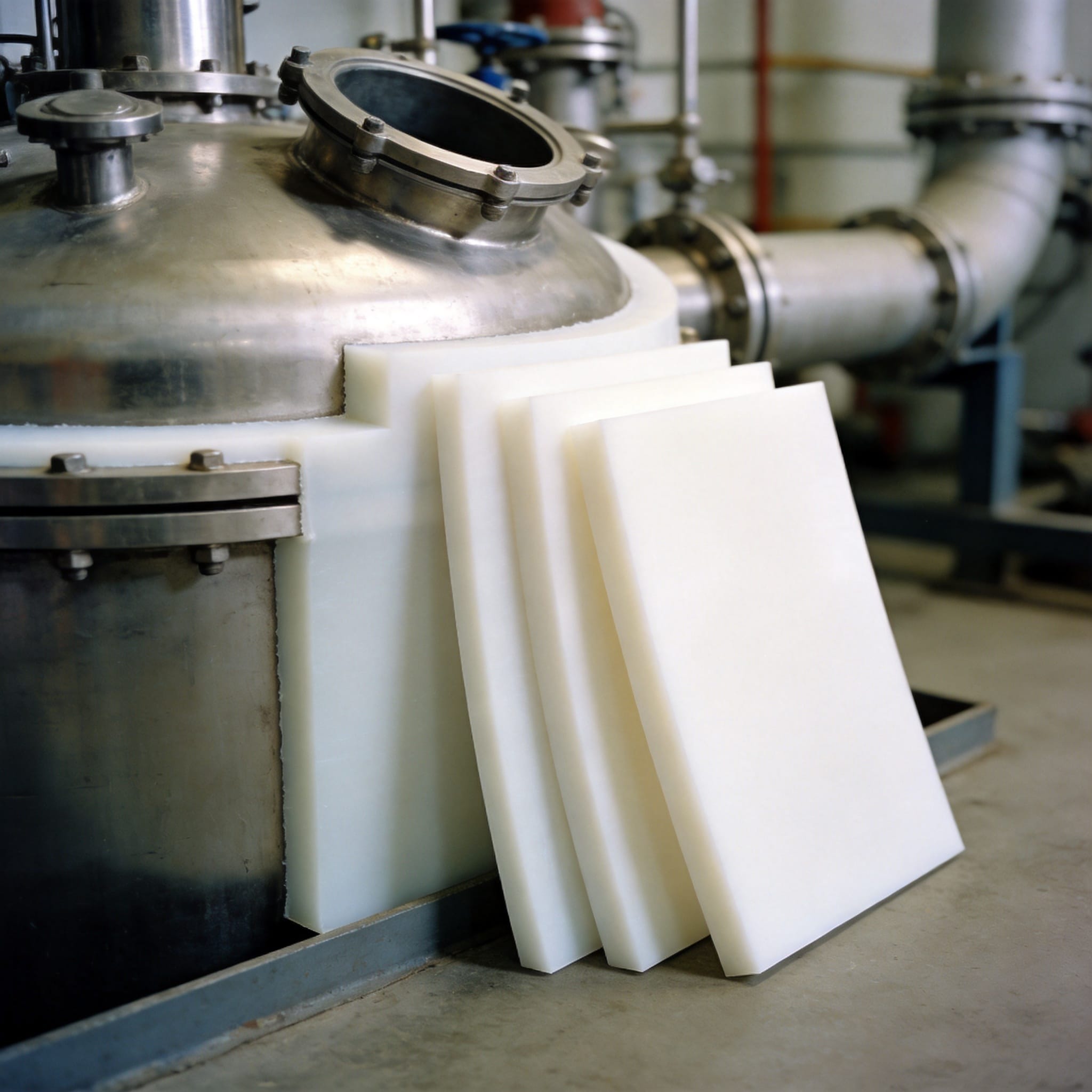
PTFE’s chemical resistance comes from its carbon–fluorine bonds, which are among the strongest in organic chemistry. That resistance is a property of the material, not the sheet size — so why does sizing matter so much? Because thickness controls two things the resin cannot control on its own: permeation path length and mechanical stiffness under vacuum or thermal cycling.
Permeation through a polymer follows roughly a linear relationship with thickness: double the wall, and you roughly halve the permeation rate for a given chemical at a given temperature. Hydrochloric acid at 80 °C, for example, will migrate through a 1 mm PTFE liner noticeably faster than through a 3 mm liner. For large equipment where the liner is the only barrier between the chemical and a steel shell, that difference decides service life.
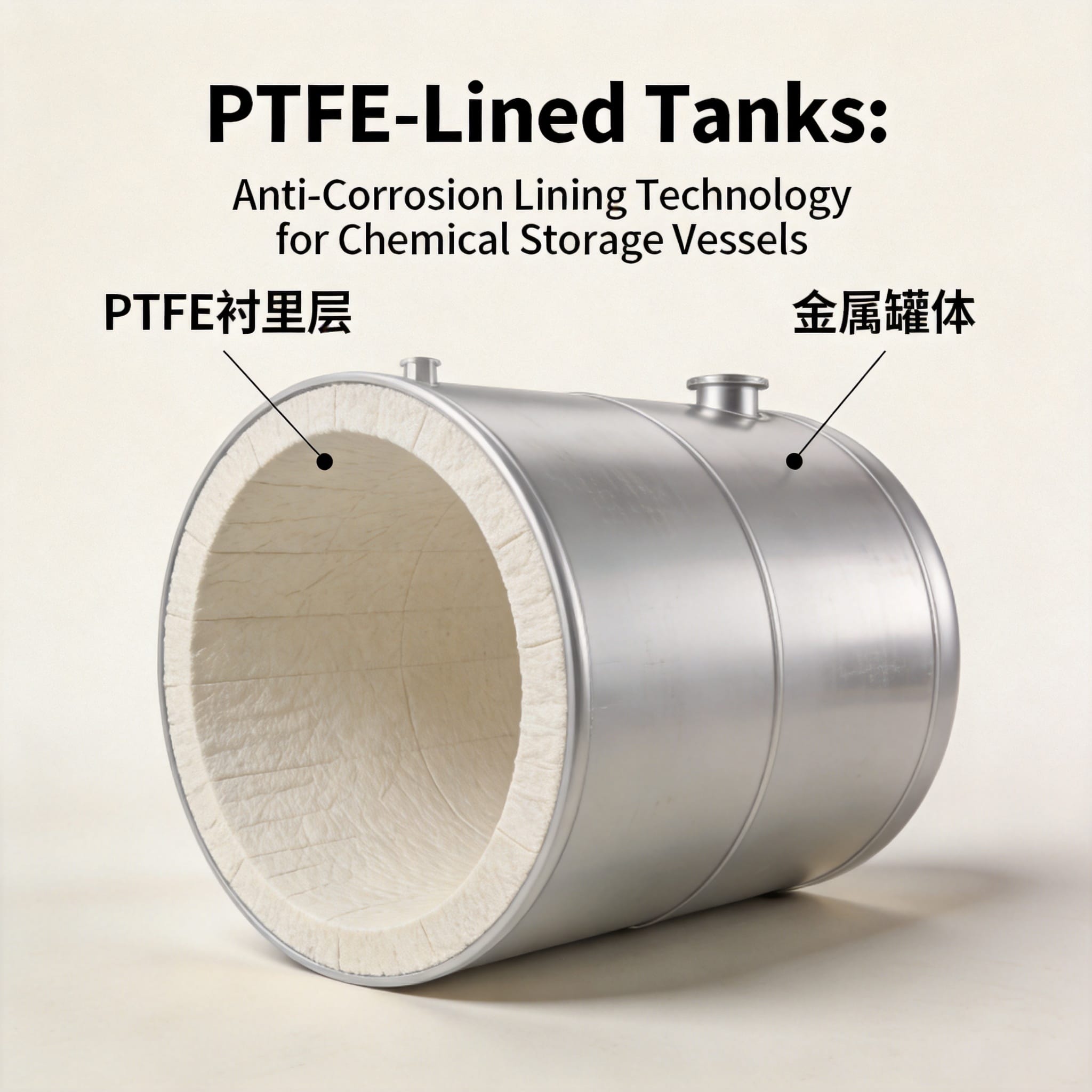
Width matters for a different reason: every joint is a potential leak path. A wider sheet means fewer welded seams. If a 4 m tall column can be lined with two 1,500 mm wide sheets instead of five 600 mm sheets, you eliminate three weld lines and the inspection labor that comes with them.
The trade-off is real. Wider and thicker sheets cost more per kilogram, are harder to handle, and require more heat to bend or drape. The goal is not “as thick and wide as possible” — it is the minimum size that satisfies the chemical duty and the fabrication method. ASTM D3294 and ASTM D3308 define the standard tolerances for PTFE sheet and skived tape, and those tolerances are what you should quote against.
How to Specify Custom Thickness and Width
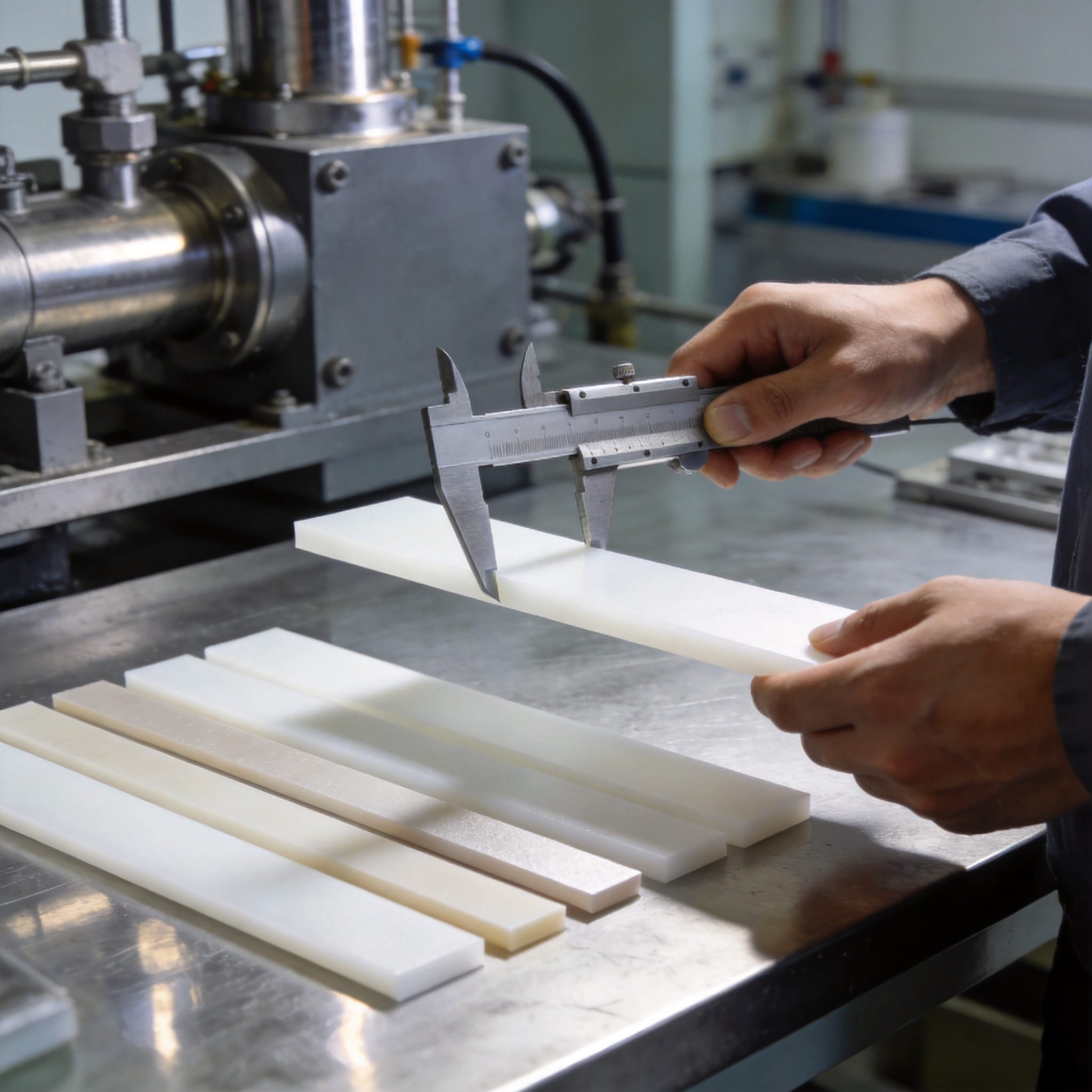
Work through these steps in order. Each one produces a number you will carry into the next.
- List the chemical, concentration, and maximum temperature. Write them as a single line, e.g. “37% HCl, 80 °C continuous, 95 °C peak.” This is the input to every later decision.
- Choose the thickness from a permeation and stiffness rule. For aggressive acids and solvents at 60–100 °C, use 3 mm minimum. For mild chemicals below 50 °C in non-vacuum service, 1.5–2 mm is workable. For vacuum service or equipment over 3 m tall, go to 4–6 mm so the liner resists collapse.
- Measure the largest continuous surface of the equipment. For a cylindrical shell, that is the circumference (π × diameter) by the height. For a rectangular tank, take the longest single panel.
- Pick a sheet width that divides that surface into the fewest panels. If the circumference is 3,140 mm, a 1,570 mm wide sheet gives exactly two panels. A 1,050 mm sheet gives three, with more waste.
- Confirm the sheet can be handled and installed. A 1,500 mm × 3,000 mm × 3 mm PTFE sheet weighs roughly 30 kg. Check that your lifting equipment and the vessel opening can accept it.
- Specify thickness tolerance and width tolerance. Skived PTFE sheet typically holds ±10% on thickness; molded sheet holds tighter. State the tolerance explicitly so the supplier cannot ship the loose end of the range.
- State the grade and any filler. Virgin PTFE for food and pharma; 25% glass-filled or carbon-filled for higher creep resistance in structural liners. Fillers change the thickness you need, so decide before quoting.
- Write the specification line. Example: “PTFE sheet, virgin, 3.0 mm ±10%, 1,500 mm ±10 mm wide × 3,000 mm long, skived, ASTM D3294 Type I.”
Here is how the numbers play out for three common equipment types:
| Equipment | Duty | Épaisseur | Practical width | Panels needed |
|---|---|---|---|---|
| Storage tank, 2 m dia | 20% NaOH, 40 °C | 2 mm | 1,050 mm | 6 per ring |
| Absorption column, 1 m dia × 6 m | 37% HCl, 80 °C | 3 mm | 1,570 mm | 2 per ring |
| Reactor, 3 m dia, vacuum | Solvent mix, 120 °C | 6 mm | 1,500 mm | 7 per ring |
Notice that the vacuum reactor uses the widest practical sheet but still needs seven panels per ring, because its circumference is 9,425 mm. Width reduces seams; it does not eliminate them. Plan the seam layout before you order.
For reference on chemical compatibility at temperature, the Chemours Teflon technical library publishes permeation and compatibility data that you can cite in your specification. For regulatory context on fluoropolymer handling, the EPA TSCA program pages describe how these materials are regulated in the United States.
Common Mistakes and How to Fix Them
Mistake 1: Specifying thickness by habit instead of by duty.
Symptom: the liner blisters or the steel shell shows corrosion within 18 months, even though the PTFE itself looks intact. This is permeation, not chemical attack.
Fix: recalculate using the chemical’s permeation rate at your actual maximum temperature, and increase thickness by one step (e.g. 2 mm to 3 mm). If the equipment runs under vacuum, add another step.
Mistake 2: Ordering the widest sheet available without checking the vessel opening.
Symptom: the sheet arrives, but it cannot pass through the manway, so it is cut on site — destroying the width advantage you paid for.
Fix: measure the smallest opening the sheet must pass through before ordering. If the manway is 500 mm, a 1,500 mm sheet must be rolled, which may crease it. Specify a width that rolls to fit, or plan a factory-welded panel that ships in sections.
Mistake 3: Ignoring thickness tolerance.
Symptom: two sheets from the same order weld poorly because one is 2.7 mm and the other is 3.3 mm at the seam.
Fix: state the tolerance in the purchase specification and require a thickness map or spot-check certificate. For welded liners, hold thickness variation to ±5% across the weld zone.
Mistake 4: Mixing filled and virgin PTFE in one liner.
Symptom: the seam between a glass-filled panel and a virgin panel fails first, because the two grades have different thermal expansion and welding behavior.
Fix: use one grade for the entire wetted surface. If you need filler for creep resistance, use it everywhere, including the weld rod.
FAQ
What is the maximum width PTFE sheet is made in?
Skived PTFE sheet is commonly produced up to about 1,500 mm wide, and some suppliers reach 1,800 mm, such as this 100% virgin white PTFE skived sheet with width 100–2700mm. Molded sheet is usually narrower, often 1,200 mm or less. If you need a wider continuous surface, you weld panels — there is no standard roll wider than roughly 1,800 mm.
How thick should a PTFE liner be for a chemical tank?
Use 2 mm for mild chemicals below 50 °C, 3 mm for aggressive acids and solvents at 60–100 °C, and 4–6 mm for vacuum service or tall vessels. The controlling factor is permeation at your maximum temperature, not the tank size alone. For heavy-duty thick plate options, see this PTFE plastic molded/skived sheet thick plate.
Does a thicker sheet always last longer?
For permeation-limited failures, yes — roughly proportionally. For mechanical failures such as creep or thermal stress, thicker can be worse if the liner is not anchored correctly, because a stiff liner pulls harder on its fasteners. Match thickness to the failure mode you expect.
Can I cut a wide PTFE sheet down to a custom width myself?
Yes, but the edge quality matters for welding. A utility knife leaves a ragged edge that traps air. Use a shear or a guided rotary cutter, and deburr the edge before welding. Cutting also voids any width tolerance the supplier certified. If you need a sheet already cut to your exact dimensions, a customizable size 100% pure PTFE skived sheet is a better starting point.
What tolerance should I write on the drawing?
For thickness, ±10% is standard for skived sheet; ask for ±5% if the sheet will be welded. For width, ±10 mm on a 1,500 mm sheet is typical. Always quote the ASTM standard you are purchasing against so both sides measure the same way.
With these steps, you can take a chemical duty, a vessel drawing, and a fabrication method, and turn them into a single specification line that a supplier can quote without guesswork.

 English
 Russian
 French
 Spanish