
Short answer: expanded PTFE gaskets seal at a fraction of the bolt load dense sheet requires and conform to damaged or glass flanges — that is their entire reason to exist. Dense (virgin or filled) sheet wins where creep resistance at high temperature and extrusion resistance under pressure matter. Retrofit and fragile-equipment jobs go expanded; engineered high-pressure joints go dense, often filled.
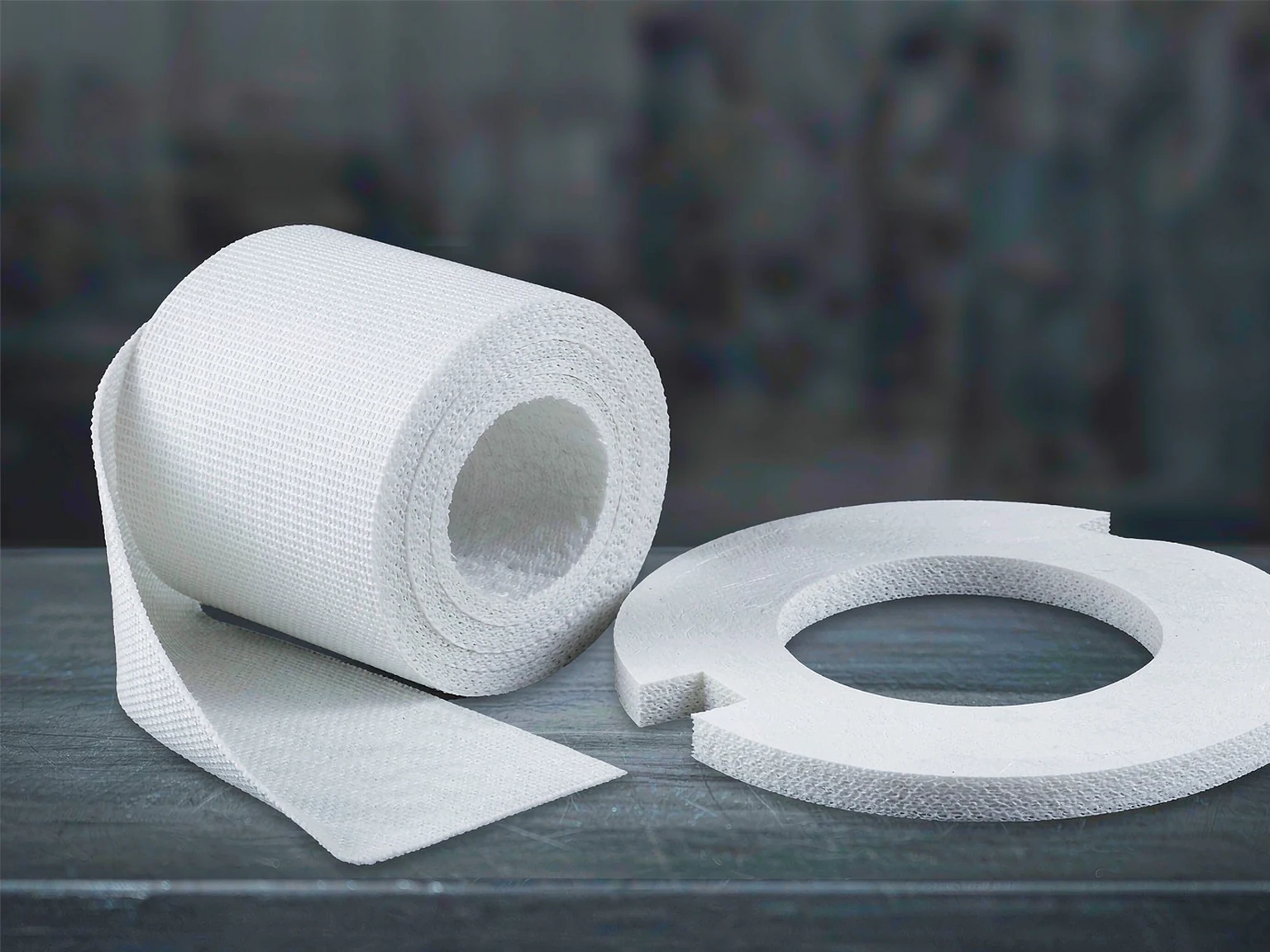
Expanded PTFE (ePTFE) is made by biaxially stretching PTFE into a fibrillated microstructure — a fundamentally different material from skived or molded sheet, though both are “PTFE”. That structure gives ePTFE its remarkable conformability and its characteristic weakness: it cannot resist extrusion the way a dense filled sheet can.
Where the fibrillated structure matters
| Propriété | PTFE expansé | Dense sheet (virgin/filled) |
|---|---|---|
| Minimum seating stress | Very low (~2–3x less) | High |
| Conformability to flawed flanges | Excellent | Poor |
| Creep resistance | https://ptfesuppliers.com/product-category/ood (fibrils resist flow) | Filled: excellent; virgin: poor |
| Extrusion resistance at gap/pressure | Limited — needs width/thickness discipline | Filled grades excellent |
| In-place thickness recovery | High — absorbs flange deflection | Low |
| Relative cost | ~1.5–3× | 1× baseline |
Choosing by joint, not by catalogue
- Enamel, glass or composite flanges: expanded — nothing else seals fragile equipment safely.
- Aging steel flanges with pitting: expanded, possibly with a dense-sheet composite for wide joints.
- High-pressure, small-gap chemical joints: filled dense sheet or a corrugated-metal composite — ePTFE extrudes where the gap opens.
- Large-diameter storage flanges: expanded for seating ease, with width selected against extrusion risk.
- Cycling hot service: filled dense sheet, or ePTFE from a maker whose fibrillation survives cycling — quality varies far more in ePTFE than in sheet.
ePTFE quality spread between makers is the widest in the gasket family — fibrillation density and binder-free construction are the difference between a gasket that recovers and one that relaxes. Chunhuan supplies both families — dense sheet and expanded products — since 1985 with lot documentation. Send flange condition, pressure, gap and bolt hardware; the answer names the family and the width/thickness discipline that keeps it sealed.
Frequently Asked Questions
When should I use expanded PTFE instead of dense sheet?
On fragile, damaged or large flanges where bolt load is limited: ePTFE seals at a fraction of the seating stress and conforms to flaws. High-pressure narrow-gap joints favor filled dense sheet.
Why is expanded PTFE more expensive?
Biaxial stretching is an additional, yield-sensitive process. The premium buys conformability and low seating stress, not more chemistry.
Does expanded PTFE creep less than virgin sheet?
Yes — the fibrillated structure resists flow better than virgin dense PTFE, though filled dense grades still lead in high-temperature creep and extrusion resistance.

 English
 Russian
 French
 Spanish
