
Short answer: for custom PTFE bushings, provide: shaft diameter and running clearance target (or shaft/housing dimensions plus load and speed), operating temperature band, load direction and magnitude, media, and quantity split. PTFE bushings are designed around clearance-at-temperature and creep under load — two numbers that must be calculated for your duty, not copied from a bronze chart.
PTFE bushings fail by two mechanisms only: clearance lost to thermal expansion and cold flow, or wear. Both are predictable, which is why a good bushing quote asks more questions than the drawing shows. Here is what to provide and why each item changes the design.
Clearance: the number that rules the part
PTFE’s thermal expansion (~10x steel) means a bushing snug at 20°C may seize at 150°C, or a designed running clearance may double at low temperature. Provide the full temperature band; the manufacturer sets room-temperature clearance so service-temperature clearance lands in the workable band. For loaded bushings, cold flow shifts clearance over time — filled grades (glass, bronze) reduce the shift 2–5x and are the default for load-carrying bushings.
Load and speed: which PTFE survives
- Low load, slow oscillation: virgin PTFE works and is cheapest.
- Continuous load or rotation: filled PTFE (bronze for load, carbon/graphite for wear) — virgin will cold-flow flat.
- High PV (pressure-velocity): beyond filled PTFE’s envelope; say so early — an honest supplier will redirect you rather than quote a part that flattens in weeks.
What to send with the RFQ
| Article | Why |
|---|---|
| Shaft Ø, housing Ø, length, temperature band | Clearance calculation at service temperature |
| Load (N and direction), speed, cycling | https://ptfesuppliers.com/product-category/rade selection and cold-flow allowance |
| Media (lubricated? chemical?) | Filler chemistry caveats |
| Quantity + forecast | Mold vs machine route decision |
| Drawing with functional dimension marked | Which tolerance gets ±0.05 mm treatment |
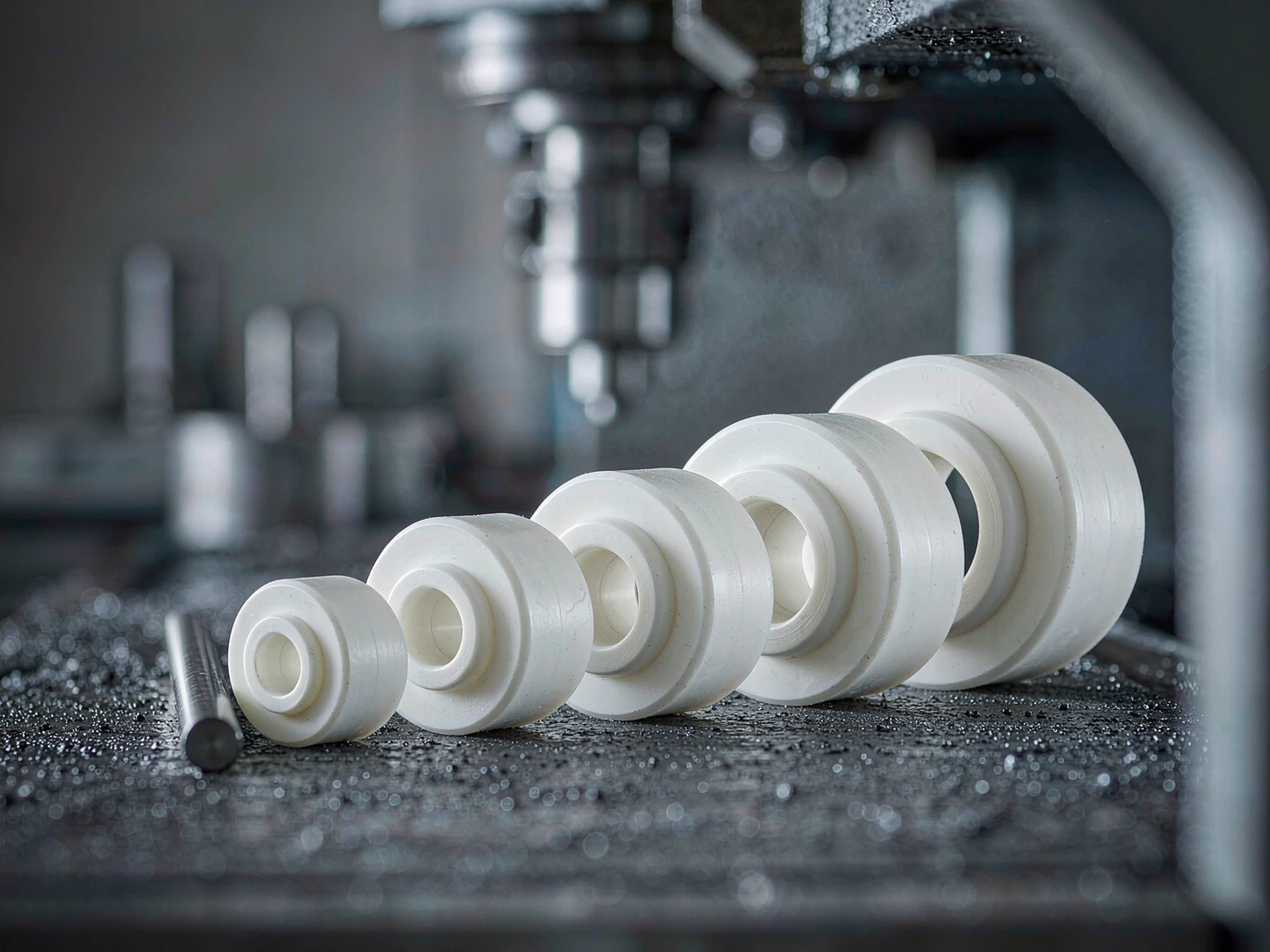
Chunhuan machines and molds bushings from its own PTFE rod and blanks since 1985, ±0.05 mm under SPC, with first-article inspection. Send the six items; the quote should come back naming grade, clearance basis and route — the three decisions that determine whether the bushing lasts.
Frequently Asked Questions
What clearance should a PTFE bushing have?
Enough that clearance remains workable at the hottest service temperature, accounting for PTFE’s ~10x-steel expansion and creep. Calculate from the temperature band — don’t copy bronze charts.
Can PTFE bushings carry continuous load?
Only filled grades (bronze, glass) — virgin PTFE cold-flows flat under sustained load. State load magnitude and direction so the grade is chosen correctly.
What information does a bushing RFQ need?
Shaft/housing dimensions, temperature band, load and speed, media, quantities with forecast, and a drawing marking the functional dimension.



 English
 Russian
 French
 Spanish
