
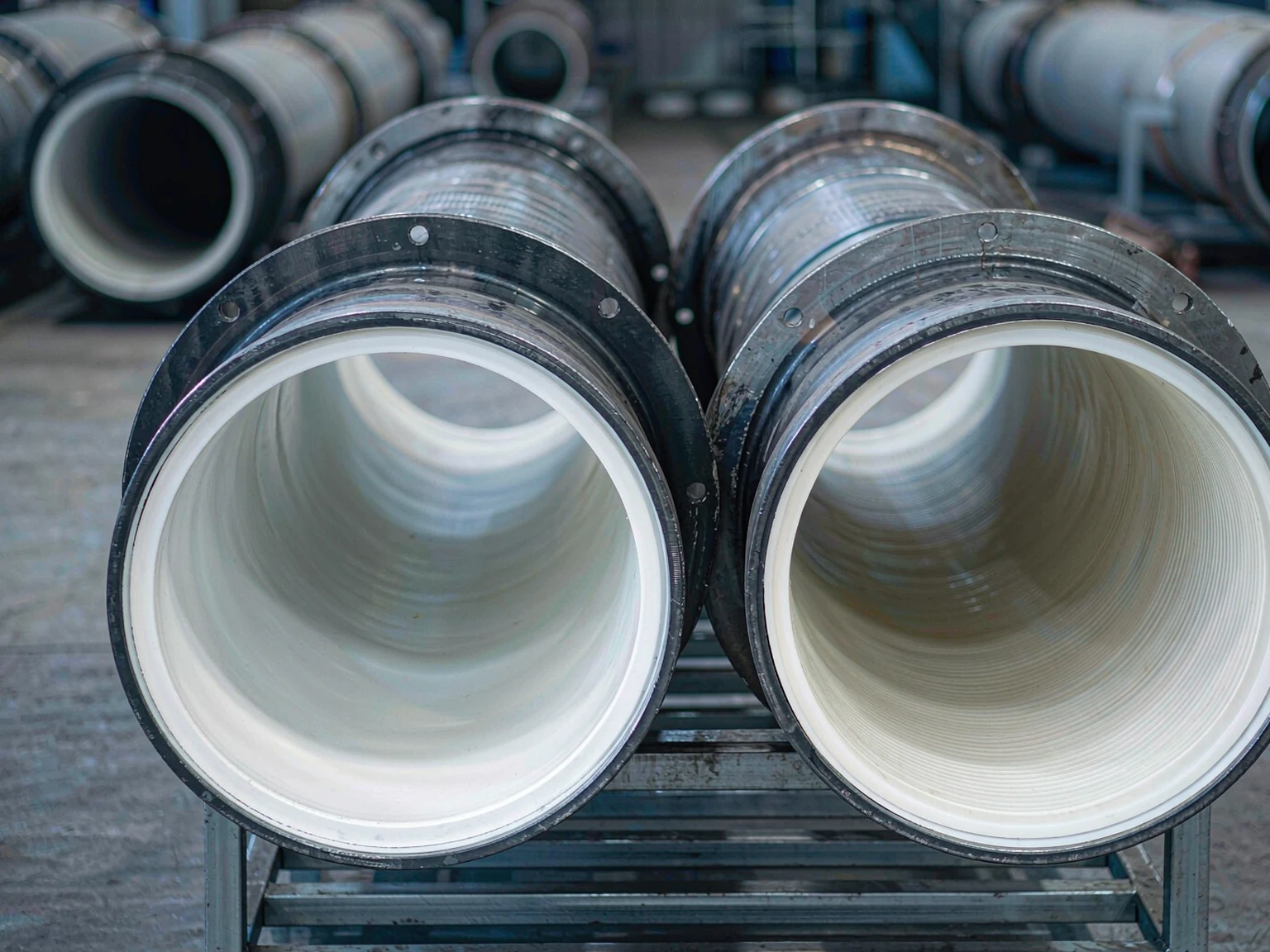
Short answer: choose PTFE lined pipe for standard corrosive service up to ~230°C where cost matters, and PFA where permeation control, smoother surface or higher cycling demands justify roughly 1.5–2x the liner cost. The chemical resistance of both is nearly universal; the decision is about permeation, processing quality and money.
The two liners resist the same chemicals, which makes this decision look arbitrary — and causes buyers to default to one or the other without a reason. The real differences sit in four measurable properties. Here is the comparison an engineering team can defend in a project review.
Head-to-head: the four properties that decide it
| Propriété | PTFE liner | PFA liner |
|---|---|---|
| Max continuous temperature | ~230°C (lower under cycling/vacuum) | ~230–260°C |
| Permeation resistance | Good; thicker walls needed for small molecules (Cl₂, HCl) | Noticeably better — lower diffusion for small molecules |
| Surface smoothness / purity | Good; skived or molded finish | Excellent; melt-processable, fewer microvoids |
| Relative liner cost | 1× (baseline) | ~1.5–2× |
| Processing route | Molded/isostatic; seams possible on complex shapes | Injection/melt molded; seamless complex geometry |
When PTFE wins
Acid and caustic transfer at moderate temperature, storage and loading lines, and any application where the duty is steady and the media is not a small-molecule permeator. PTFE liners are the industrial default for a reason: proven, economical, and repairable in the field with patching techniques.
When PFA wins
- Small-molecule service: wet chlorine, HCl, bromine at elevated temperature — permeation through PTFE is the limiting mechanism, and PFA cuts it substantially.
- Semiconductor and high-purity chemicals: fewer microvoids and better extractables performance.
- Frequent thermal cycling or steam-out: PFA’s melt-processed structure holds dimension better through repeated shock.
- Complex fittings: PFA injection molding produces seamless elbows and tees where PTFE requires molded segments.
Questions to put to any liner bidder
Ask which liner they recommend for your duty and why in writing — a supplier who defaults to whatever they stock is transferring the engineering decision to you. Then confirm per-spool spark testing, minimum liner thickness at bends, and vacuum rating at temperature regardless of material. Chunhuan manufactures both PTFE and PFA lined tanks and vessels and lined valves since 1985, so the recommendation is duty-driven rather than stock-driven. Send media, temperature profile and cycling data; the answer will name a liner and justify it.
Frequently Asked Questions
Is PFA better than PTFE for lined pipe?
For permeation-limited service (wet chlorine, HCl), high purity and heavy thermal cycling, yes — at 1.5-2x liner cost. For steady corrosive duty, PTFE is the proven, economical default.
What temperature can PTFE and PFA liners take?
Both serve around 230°C continuously; PFA reaches ~260°C. Real limits depend on cycling, vacuum and media — confirm at your worst case, not the datasheet number.
Why is PFA more expensive?
PFA is melt-processable resin costing more per kilogram, and its processing favors seamless complex geometry — the premium buys permeation control and purity, not just a brand.
Does liner choice affect permeation?
Significantly. Small molecules like chlorine and HCl diffuse through PTFE measurably at elevated temperature; PFA reduces diffusion substantially at the same thickness.



 English
 Russian
 French
 Spanish
