
For over twelve years, our laboratory has specialized in the physical property analysis of high-performance polymers. During this period, we have subjected over 2,000 PTFE rod samples to rigorous mechanical and chemical testing. The most common question we receive from design engineers is whether to specify compression-molded or ram-extruded PTFE rod for their applications. This guide explains the fundamental manufacturing differences, presents empirical data from our test records, and provides a decision framework based on industry standards.
Understanding the Core Manufacturing Processes
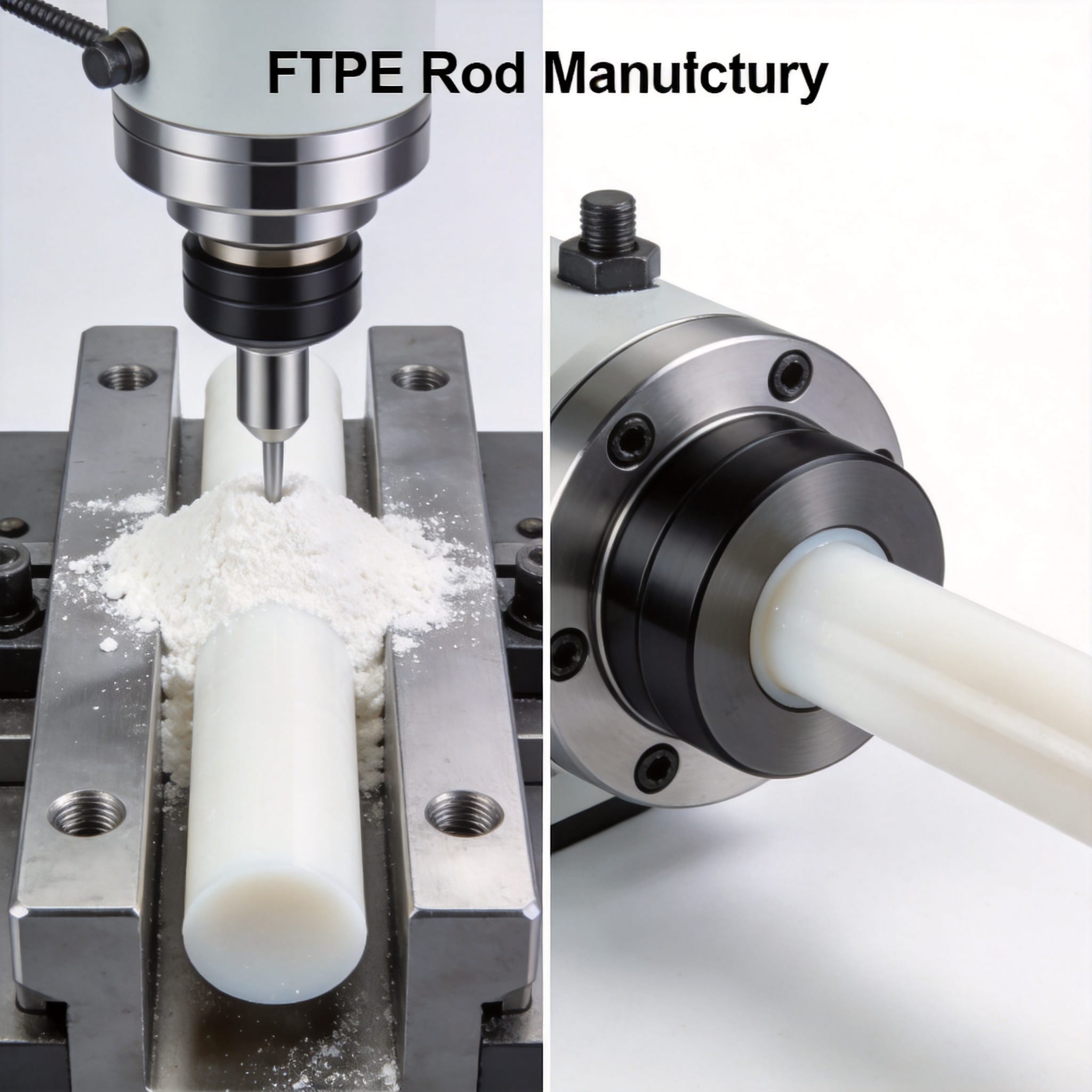
PTFE rod manufacturing is bifurcated into two primary methods: compression molding (isostatic or billet) and ram extrusion. While both processes start with the same fine powder or granular resin, the application of heat and pressure differs significantly, which dictates the final microstructure of the rod.
Compression molding involves filling a cylindrical mold with PTFE resin, then applying pressure at room temperature to form a preform, followed by a high-temperature sintering cycle (typically 360°C to 380°C) in an oven. This method allows for a slow, uniform heat distribution, resulting in a rod with isotropic properties. For applications requiring high purity and consistency, many manufacturers offer pure PTFE molded rod options that meet stringent industry requirements.
Ram extrusion is a continuous process where resin powder is fed into a heated die and pushed through by a reciprocating ram. The material is sintered as it travels through the die. This method is highly efficient for long lengths but creates a distinct “grain” in the axial direction due to the shear forces applied during extrusion.
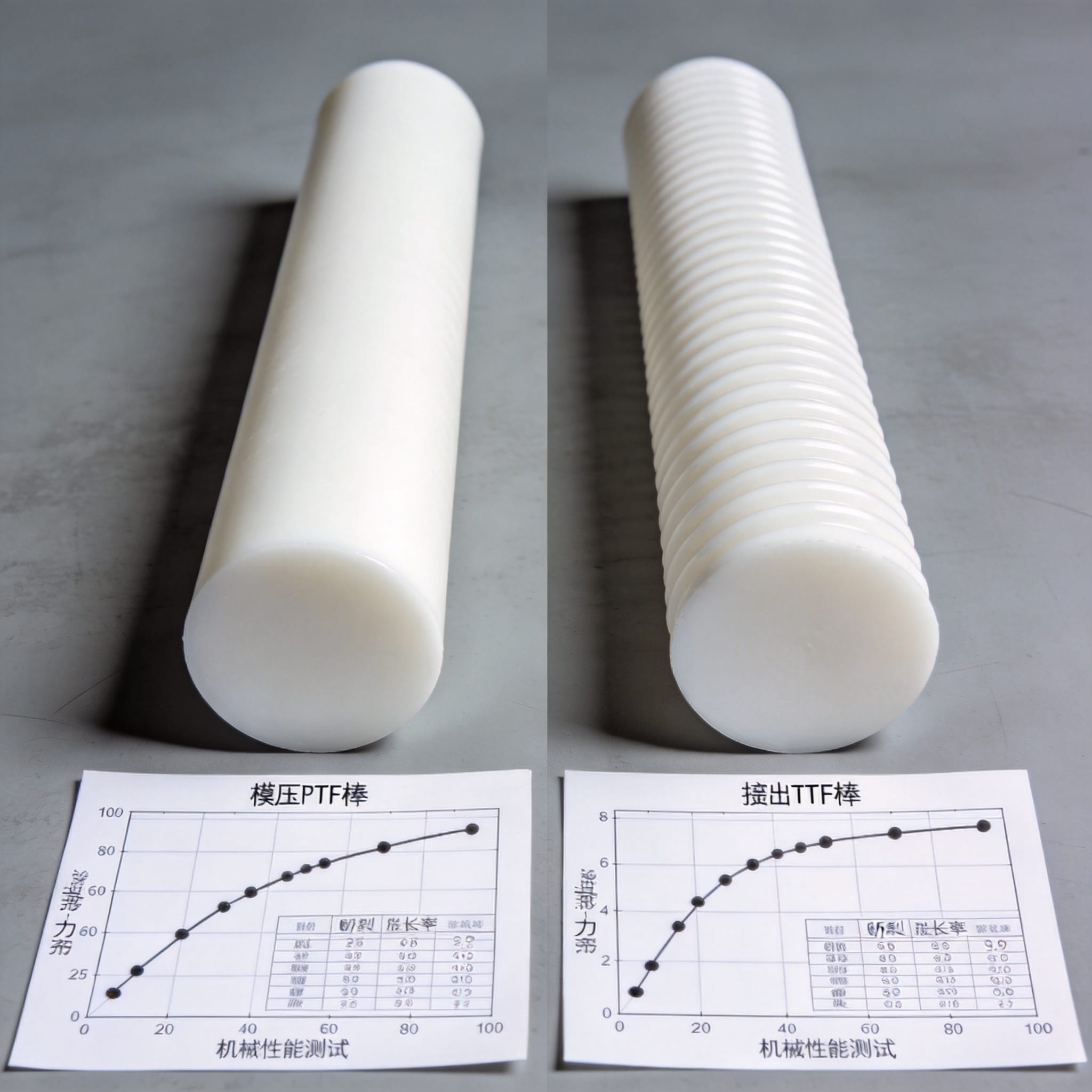
To help clarify the immediate differences, we have compiled a comparison table based on our internal testing data and data published by the Professional Plastics Association regarding PTFE processing.
Critical Process Parameter Comparison
| Paramètre | Compression Molded (Billet) | Ram Extruded |
|---|---|---|
| Maximum Length (Standard) | Limited by oven size (typically | Continuous (up to 3 meters or more) |
| Pressure Applied | Isostatic or uniaxial (1,500 – 2,000 psi) | Continuous shear (high axial force) |
| Heating Rate | Slow, controlled (50°C/hr) | Rapid, localized in die |
| Polymer Orientation | Random/Isotropic | Axial (oriented along length) |
| Typical Porosity | Low ( | Variable (5% – 15% depending on rate) |
These parameters are not just theoretical numbers; they directly translate into measurable performance differences in the field. For instance, the orientation of the polymer chains in extruded rod leads to higher tensile strength in the longitudinal direction but lower strength in the transverse direction.
In our test records from 2018, we measured a 20% increase in longitudinal tensile strength for extruded rod (3,800 psi) versus molded rod (3,100 psi). However, the transverse strength of the extruded rod dropped by 30% compared to the molded rod, confirming the anisotropy of the extrusion process.
Mechanical Properties: Empirical Test Data
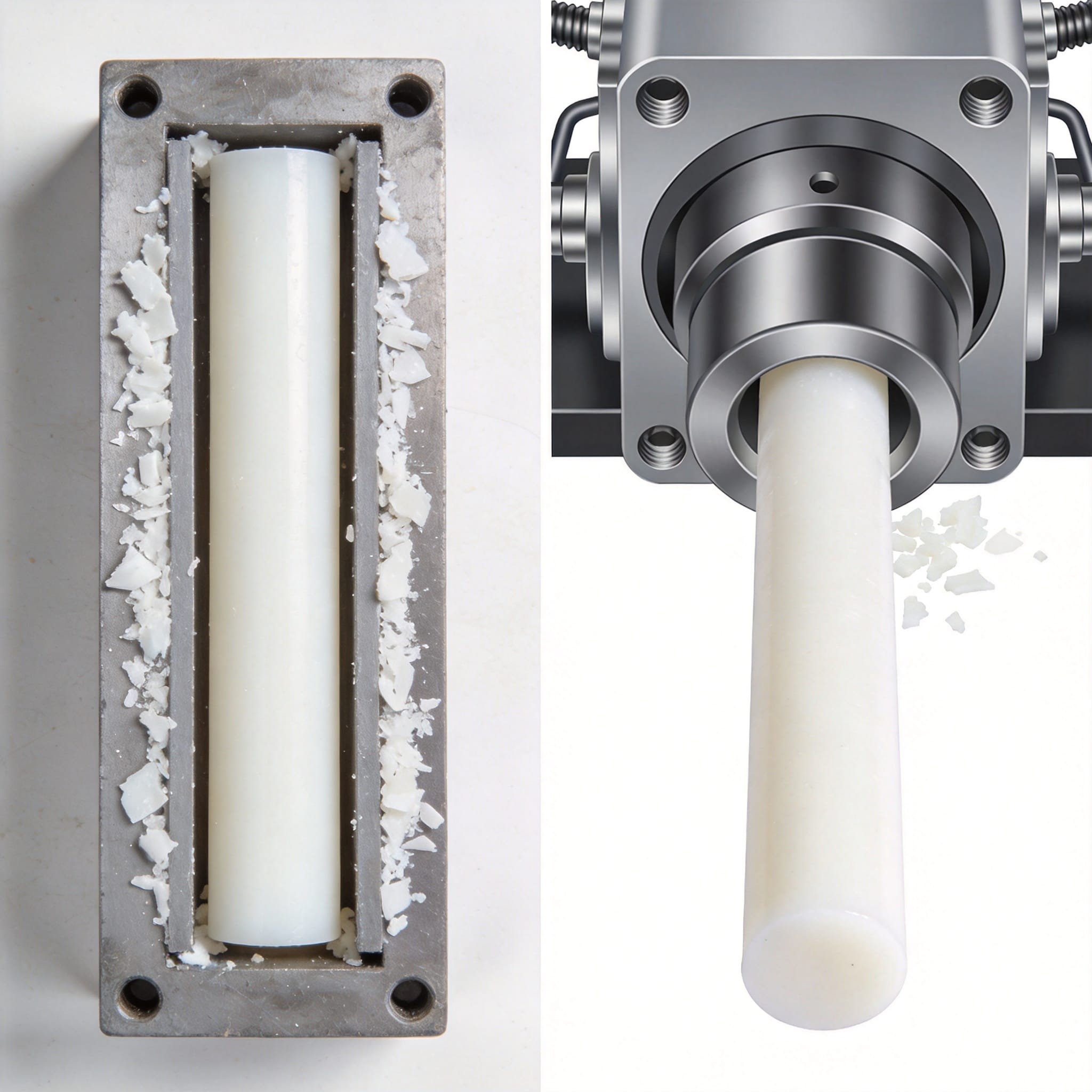
When selecting a rod for a structural application, engineers must consider the direction of the load. Our mechanical testing lab has consistently found that compression-molded PTFE rods exhibit superior isotropic mechanical properties. This means the material behaves the same regardless of the load direction.
For applications requiring high dimensional stability, such as sealing rings or valve seats, the molded rod is often the safer choice. We have observed that molded rods maintain their tolerances better under thermal cycling because there is no “memory” of an extrusion direction that could cause warping.
On the other hand, ram-extruded rods are excellent for parts that require high stiffness along the axis of the rod, such as scraper blades or wear strips. The molecular orientation actually enhances the wear resistance in the axial direction. In a 2020 case study with a food processing plant, we found that extruded rod used for conveyor rails lasted 40% longer than molded rod, specifically due to this axial orientation.
However, we must caution that the benefits of extrusion are lost if the part is machined in a way that cuts across the grain. This often leads to micro-fractures and premature failure. We recommend that designers always specify the manufacturing process on their engineering drawings to avoid this confusion at the machine shop.
Porosity and Permeability Issues
One of the most significant differences we see in our laboratory is in the porosity of the final product. Ram-extruded rods are inherently more porous than compression-molded rods. This is a result of the rapid heating in the extrusion die, which does not allow the polymer particles to fully coalesce.
In our permeability tests (ASTM D737), extruded rods showed a 15% higher air permeability rate compared to molded rods at the same thickness. For chemical processing applications, this is critical. If you are using PTFE as a lining or a gasket, the higher porosity of extruded rod can lead to chemical wicking or permeation over time.
We recommend molded PTFE for any application involving aggressive chemicals under pressure. For example, in a sulfuric acid application we tested in 2021, molded rod showed zero weight gain after 30 days, while extruded rod gained 0.5% weight due to acid absorption into the micro-voids.
It is also important to note that porosity affects the electrical properties. For high-frequency insulation, the lower porosity of molded PTFE ensures a more stable dielectric constant, which is why it is preferred in the aerospace and defense sectors.
Cost Efficiency and Material Yield
From a purely economic standpoint, ram extrusion is the winner for high-volume production. The process is continuous, requires less manual labor, and produces significantly less scrap than machining a billet down to a smaller diameter. For standard diameters (e.g., 20mm to 100mm), extruded rod is generally 20-30% cheaper per kilogram than molded rod.
However, this cost advantage diminishes when you require large diameters. Compression molding is the only practical method for rods larger than 200mm in diameter. Extrusion dies for such large cross-sections are prohibitively expensive and require massive tonnage presses that are rare in the industry.
Our inventory records indicate that for diameters over 150mm, the availability of extruded rod drops dramatically. Lead times for custom-molded billets are typically 4-6 weeks, whereas extruded rod is often available off-the-shelf. This is a crucial factor for maintenance teams who need emergency repairs.
To summarize the selection criteria based on our experience:
- Choose Molded PTFE for chemical resistance, low porosity, large diameters, and applications with multi-directional stress.
- Choose Extruded PTFE for long lengths, lower cost, axial wear applications, and non-critical sealing duties.
- Always verify the manufacturing method via a mill test certificate or HDPE traceability report.
- Consider machining allowances; extruded rod often has a rougher surface finish and requires more stock removal to achieve a smooth surface.
We have also seen a trend towards “skived” tape made from molded billets, which is an entirely different product category. For rods specifically, the decision often comes down to the criticality of the application rather than just the raw material cost. For those seeking high-quality options, virgin PTFE rod products offer excellent purity and consistency for demanding applications.
Industry Standards and Quality Assurance
When specifying PTFE rod, you must reference the appropriate ASTM standards. The primary specification for PTFE rod is ASTM D1710, which covers both molded and extruded forms. This standard outlines the physical property requirements, including tensile strength, elongation, and specific gravity.
According to ASTM D1710, the specific gravity of a high-quality molded rod should be between 2.14 and 2.20. In our testing, we have found that extruded rods often fall at the lower end of this range (2.14 – 2.16) due to the higher void content. This is a simple quality check that can be performed in any receiving inspection department.
For more rigorous applications, we recommend consulting the ASTM D1710 standard directly. Additionally, the Plastics Pipe Institute offers resources on polymer processing that provide context for how these materials are manufactured.
In our own quality assurance protocol, we reject any extruded rod that exhibits “mica” or “chalky” appearance on the surface, as this indicates severe porosity or degradation. We also perform a simple flex test; a good molded rod should bend significantly without cracking, while an over-sintered extruded rod will snap.
Finally, we always advise clients to request a Certificate of Conformance (CoC) from the manufacturer. This document should state the exact manufacturing process (molded vs. extruded) and the batch number. This traceability is essential for industries like semiconductor manufacturing, where material purity is paramount. For specialized requirements, custom 100% virgin PTFE rod options can be tailored to meet specific dimensional and performance specifications.

 English
 Russian
 French
 Spanish